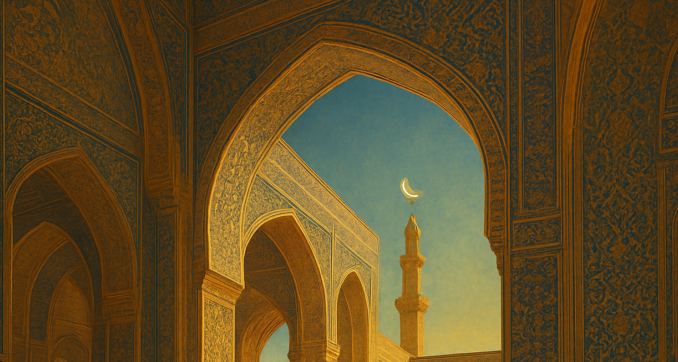
In the year 610 CE, a merchant from Mecca withdrew into a cave on Mount Hira. There, in absolute silence, a series of revelations began that would profoundly change the world. What is less widely known is that after the first revelations, a painful period of silence followed — a spiritual vacuum in which the Prophet felt abandoned. It was precisely in this context that Surah 93 was revealed: a short, powerful chapter that opens with an oath sworn by the morning light. That promise of light after darkness touches on a theme deeply embedded in the tradition of Freemasonry.
A Cave, a Silence, and a Sunrise
The historical background of Surah 93, known as Ad-Duha (The Morning Hours), is inseparable from a crisis of the soul. Early Islamic historians such as Ibn Ishaq and al-Tabari describe how the Prophet Muhammad, after his first intense experiences in the cave on Mount Hira, went through a period in which no new revelations came. This interruption — referred to by later scholars as the period of silence — lasted weeks according to some sources, months according to others. It was a time of deep doubt and existential loneliness. Had the Divine forsaken him? Was it all over?
The answer came in eleven verses that rank among the shortest and most poetic passages in the Quran. The surah opens with two images: the radiant light of the morning and the stillness of the night. Then comes the reassurance: “Your Lord has not forsaken you, nor does He despise you.” The chapter closes with a call to gratitude and compassion: care for the orphan, do not turn away the one in need, and proclaim the blessings you have received. In that simplicity lies a universal message that reaches far beyond the boundaries of any single faith tradition.
Darkness as the Gateway to Light
The structure of Ad-Duha follows a pattern that Freemasons will immediately recognize: the transition from darkness to light. In the Masonic tradition, the candidate is blindfolded during initiation, immersed in a deliberate state of not-knowing. Only when the blindfold is removed does he receive the light of the Lodge. This ritual is not mere theater — it is a lived experience designed to mirror an inner transformation. Just as the night in Surah 93 is not a punishment but a necessary prelude to the dawn, so too the darkness in the Lodge is not a threat but a school of learning.
The great German poet and Freemason Johann Wolfgang von Goethe, who studied Islam and the Quran extensively, wrote in his West-östlicher Divan with deep respect about the poetic power of the sacred text. Goethe understood that mystical experience is not the exclusive domain of any single tradition. The universal cycle of loss and rediscovery, of doubt and trust, forms the backbone of virtually every spiritual quest — whether it takes place in a mosque, a cathedral, or a Masonic Lodge.
The Orphan, the Seeker, and the Brother
One of the most striking elements of Surah 93 is its reference to the Prophet’s personal history: “Did He not find you an orphan and give you shelter? Did He not find you wandering and guide you?” These verses are at once deeply personal and archetypical. They describe the fate of every human being who moves through life searching — temporarily losing direction, and ultimately arriving at a deeper understanding.
In Freemasonry, the motif of the seeker is fundamental. The candidate who knocks at the door of the Temple is traditionally described as one who “dwells in darkness and seeks the light.” He is, in a certain sense, an orphan — someone who has not yet found a spiritual home within the Brotherhood. The path he then walks, from Entered Apprentice through Fellow Craft to Master Mason, mirrors precisely the movement described in Surah 93: from abandonment to belonging, from doubt to trust, from receiving to giving.
The deepest spiritual lesson of Ad-Duha is universal: darkness is not a destination but a passage, and whoever has received the light carries a duty to share it with others.
Compassion as a Spiritual Obligation
The closing verses of Surah 93 contain a threefold commandment that aligns remarkably well with the Masonic teachings on virtue. First: “As for the orphan, do not oppress him.” Second: “As for the one who asks, do not turn him away.” Third: “As for the blessing of your Lord, proclaim it.” Together, these three commands form an ethical program built around three core values.
The first — protection of the vulnerable — resonates with Freemasonry’s strong emphasis on charity and mutual care among Brethren and in the wider world. The second — hospitality and openness — mirrors the Masonic ideal of fraternal reception without regard to social standing, wealth, or background. The third — gratitude and testimony — reflects the understanding that spiritual growth is not meant to be hoarded but to be expressed through daily action and conduct.
The eighteenth-century founders of modern Freemasonry, including James Anderson and Jean Théophile Désaguliers, emphasized in their Constitutions that the Craft should serve as a meeting ground where men of different faiths could find common ground based on shared moral principles. It is precisely this kind of shared ground that becomes visible when we place a text like Surah 93 alongside Masonic ritual — not to erase the differences, but to recognize a kinship in ethical aspiration.
What the Morning Light Still Teaches Us Today
In an age when many people struggle with feelings of meaninglessness, loneliness, or spiritual emptiness, the message of Ad-Duha remains strikingly relevant. The promise that after every night a new morning will break is not cheap optimism — it is an invitation to trust in the process of inner growth. For Freemasons, this is recognizable as the core conviction that underpins the entire initiatory journey: that the work on the rough stone is never finished, but that every sincere effort brings the craftsman closer to his truest self.
Surah 93 reminds us that silence is not the same as abandonment, that doubt is not the opposite of faith, and that the darkest hours often precede the most transformative insights. These are not ideas confined to any one religion or fraternity — they belong to the shared heritage of human spiritual experience. When a Freemason reads these eleven verses, he does not need to convert to Islam to feel their resonance. He need only recall the moment when his own blindfold was removed, when the light of the Lodge first fell upon his face, and he understood that the darkness had not been a punishment but a preparation.
The morning light described in Surah 93 is ultimately a symbol that transcends its original context. It speaks to anyone who has ever found themselves in a dark passage, wondering whether the light would return. For Freemasons, the answer is woven into the very fabric of their ritual and philosophy: the light always returns, but only to those who have had the courage to endure the darkness. And once it does return, it comes with a responsibility — to protect the vulnerable, to welcome the seeker, and to share generously what you have received. In this, the ancient words of Ad-Duha and the timeless principles of the Craft speak with one voice.
Copyright text & image: devrijmetselaar.nl
Texts are based on the ideas and content of the author of devrijmetselaar.nl, reviewed, corrected, and supplemented with the assistance of OpenAI. Images are created based on the ideas of the author of devrijmetselaar.nl using OpenAI/DALL-E.
Frequently Asked Questions
What is the historical context of Surah 93 (Ad-Duha)?
Surah 93 was revealed during a period of spiritual crisis in the Prophet Muhammad's life. After his initial revelations in the cave on Mount Hira around 610 CE, he experienced a painful period of silence lasting weeks or months, during which he felt abandoned and doubted whether the Divine had forsaken him. The eleven verses of Ad-Duha were revealed to reassure him that he had not been abandoned, using imagery of morning light after darkness.
How does the theme of darkness transitioning to light connect Surah 93 to Freemasonry?
Both Surah 93 and Freemasonry use the symbolism of darkness transforming into light to represent spiritual and inner transformation. In Masonic initiation rituals, candidates are blindfolded and immersed in darkness before receiving 'the light of the Lodge,' mirroring the journey from the night to dawn described in Ad-Duha. Neither tradition treats darkness as punishment, but rather as a necessary prelude and school of learning that leads to enlightenment.
What is the main message of Surah 93 beyond its historical significance?
Beyond addressing the Prophet's immediate crisis of faith, Surah 93 conveys a universal message that transcends religious boundaries. After reassuring that the Divine has not forsaken the believer, the surah emphasizes gratitude and compassion—calling people to care for orphans, help those in need, and proclaim the blessings they have received. This theme of light bringing moral responsibility and kindness is applicable across different faith traditions.

Be the first to comment