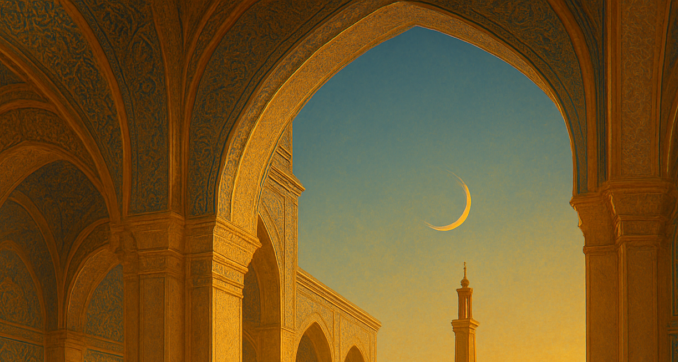
What happens when a person forbids themselves something that is perfectly permissible — simply to please someone else? And what does that act of self-denial reveal about the relationship between honesty, self-knowledge, and spiritual growth? These questions lie at the heart of the sixty-sixth surah of the Quran, known in Arabic as At-Tahrim — The Prohibition. It is a brief but penetrating text, and when read with a Masonic eye, its layers connect remarkably well with the inner journey every Freemason undertakes.
What Is The Prohibition Actually About?
Surah 66 consists of only twelve verses and was revealed in Medina. It opens with a strikingly intimate question directed at the Prophet Muhammad: why do you forbid yourself what God has made lawful to you, seeking to please your wives? From this personal opening, the text moves into broader themes — repentance, the moral responsibility within the household, and the choice between sincerity and hypocrisy.
Two women from sacred history are held up as shining examples. The wife of Pharaoh, who chose righteousness despite living at the very center of oppression, and Mary, the mother of Jesus, who maintained her purity in a world filled with doubt. At the same time, the wives of Noah and Lot are mentioned as cautionary figures — people who lived in the closest proximity to prophets yet still chose the wrong path.
This is not about a legal prohibition. It is an existential question: are you being honest with yourself and with the higher purpose you serve? That question transcends any single religious tradition and touches the very core of what it means to live a conscious human life.
What Does This Have to Do with Freemasonry?
At first glance, a Quranic admonition about domestic relationships may seem far removed from the lodge. But look deeper and a familiar theme emerges. Freemasonry constantly asks its members: are you sincere in your actions? Do you impose limitations on yourself out of fear, complacency, or the desire to fit in — while your inner voice tells you something entirely different?
The Masonic ritual confronts every brother and sister, again and again, with the mirror of self-examination. In that sense, the prohibition described in Surah 66 functions as a mirror that is also held up within the lodge: do not forbid yourself what is good out of weakness, and do not permit yourself what is wrong out of convenience.
Honesty with yourself is the first stone of every structure, whether you are building in a lodge, a house of prayer, or the chambers of your own heart.
Why Is Repentance So Central to This Surah?
One of the most striking verses in The Prohibition is the call to sincere repentance — in Arabic, tawba nasooh — a repentance that is pure and free of ulterior motives. The text promises that those who show genuine repentance may hope for forgiveness and for gardens beneath which rivers flow.
This image of purification through honest self-confrontation is universal. The Stoic philosopher Seneca, whose ideas have been explored previously on this site in relation to caring for others, wrote extensively about daily self-examination as a form of inner cleansing. Marcus Aurelius practiced the same discipline in his Meditations, calling himself to account each evening.
In Freemasonry, we find this reflected in the moment of silence and reflection — the working of the rough ashlar. Repentance, in this context, is not weakness. It is proof of courage: the courage to admit that the edifice of your character is not yet complete.
Is Repentance Not Outdated in the Modern World?
It is an understandable question in an era that celebrates self-reliance and self-confidence as the highest virtues. Yet one could argue that in a society driven by outward achievement, the inner willingness to correct course is more important than ever.
The Prohibition teaches that proximity to goodness — whether that means a prophet, a teacher, or an elevated ideal — is not enough by itself. The wives of Noah and Lot lived in the closest possible proximity to prophets, yet their hearts remained unchanged. The same principle applies in the lodge: membership alone does not make anyone a better person. It is the inner work that counts.
What Can We Learn from Mary and the Wife of Pharaoh?
The surah closes with two luminous examples. The wife of Pharaoh — known in Islamic tradition as Asiya — lived at the heart of oppression but refused to sell her soul for power and wealth. She prayed for a house near God, far from injustice. Mary, called Maryam in the Quran, is praised for her faith and her willingness to affirm the words of her Lord.
Both women represent a choice that every seeker recognizes: the choice to follow the inner light, even when the outer world pushes in a different direction. Voltaire, the Enlightenment thinker and presumed Freemason who championed the value of individual conscience, would have recognized this choice as the foundation of all genuine freedom. Goethe, himself initiated into a lodge, wrote about the eternal tension between outward life and inward calling. It is precisely within that tension that the Freemason’s work takes place.
How Does This Fit into the Broader Series on Sacred Texts?
This series explores the one hundred and fourteen surahs of the Quran from a Masonic perspective — not to claim the text or reduce it to Masonic doctrine, but to build bridges between traditions that each speak, in their own way, about light, knowledge, and moral growth. The Prohibition is the sixty-sixth stop on that journey.
What makes this surah particularly compelling is its directness. It does not speak in grand cosmic imagery but addresses the everyday: the choices you make in your closest relationships, the honesty you do or do not grant yourself. And it is precisely in the everyday that the universal resides.
The Quran invites here the same inner disposition that the Freemason cultivates in the lodge: be honest about what you forbid and what you allow — not only for others, but above all for yourself.
Surah 66 may be one of the shortest chapters in the Quran, but its message cuts deep. It asks us to examine the prohibitions we impose on ourselves — and whether they serve truth or merely comfort. For the Freemason, this is not an unfamiliar challenge. Every session in the lodge, every moment of quiet reflection before the rough ashlar, poses the same essential question: are you building with integrity, or are you merely going through the motions? The Prohibition reminds us that the most important structure we will ever raise is the one within — and that honest self-examination is the only tool sharp enough to shape it.
Copyright text & image: devrijmetselaar.nl
Texts are based on the ideas and content of the author of devrijmetselaar.nl, reviewed, corrected, and supplemented with the assistance of OpenAI. Images are created based on the ideas of the author of devrijmetselaar.nl using OpenAI/DALL-E.
Frequently Asked Questions
What is Surah 66 (At-Tahrim) about?
Surah 66, known as The Prohibition, is a brief twelve-verse chapter revealed in Medina. It opens with a question to Prophet Muhammad about why he forbids himself what God has made lawful to please his wives. The surah explores themes of repentance, moral responsibility, honesty with oneself, and the choice between sincerity and hypocrisy. It uses examples from sacred history—including the wife of Pharaoh and Mary as positive examples, and the wives of Noah and Lot as cautionary figures—to illustrate the importance of spiritual integrity regardless of external circumstances.
How does Surah 66 connect to Freemasonry?
Though seemingly focused on domestic relationships, Surah 66 addresses a universal theme central to Freemasonry: self-examination and sincerity. Both the surah and Masonic ritual challenge individuals to honestly assess whether they impose limitations on themselves out of fear or conformity, or permit themselves wrong actions out of convenience. The surah functions as a spiritual mirror that aligns with Freemasonry's constant demand that members examine their motives and maintain integrity between their inner voice and outer actions.
What is the core spiritual lesson of Surah 66 for Freemasons?
The core lesson is that true spiritual growth requires radical honesty with oneself. The surah teaches that self-denial undertaken merely to please others, or self-permission granted out of weakness, both represent a failure of authentic consciousness. For Freemasons, this translates into a fundamental principle: honesty with yourself is the foundation of every spiritual and moral structure you build. The surah transcends religious boundaries to address what it truly means to live a conscious human life aligned with one's higher purpose.


Be the first to comment