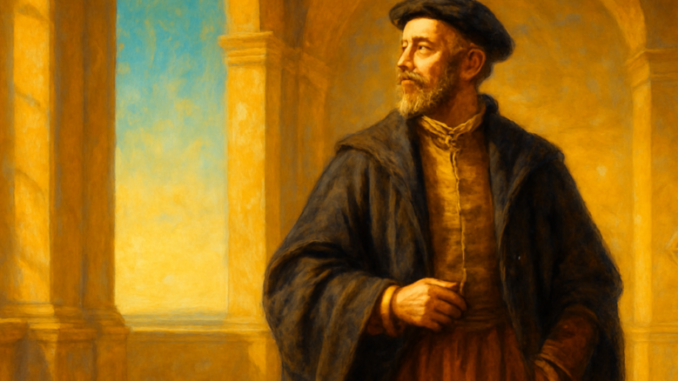
Picture the scene: you are standing on the battlefield and your opponent turns to flee. Every instinct screams at you to pursue, to press the advantage, to claim victory. But then, at the very moment of apparent triumph, the enemy wheels around in the saddle and unleashes a deadly rain of arrows. It is precisely this paradox of strength and vulnerability that captivated Michel de Montaigne in his short but remarkably rich essay On Parthian Weapons — the ninth essay in the second book of his famous Essays. What appears on the surface to be a discussion of ancient military tactics turns out to be a profound lesson about self-knowledge, adaptability, and the courage to rethink what we take for granted.
What Is This Essay About?
In On Parthian Weapons, Montaigne examines a striking military custom from antiquity: the fighting method of the Parthians, a people from ancient Persia. Their most famous tactic was the so-called retreating attack. Rather than charging the enemy head-on, Parthian horsemen would feign flight. The moment their pursuers found themselves in an exposed and vulnerable position, the riders turned in their saddles and fired their arrows backward with devastating precision. It was a style of warfare that drove Roman legions to despair — as the catastrophic campaign of Marcus Licinius Crassus in 53 BC made painfully clear.
Montaigne, however, does not use this historical example merely as a piece of military analysis. As so often in his Essays, the concrete example serves as a springboard for broader philosophical reflection. The central question he raises is this: is attack always the best form of defense, or is there a deeper kind of strength in the ability to withdraw and strike from an unexpected position?
The Art of the Apparent Retreat
What fascinates Montaigne about the Parthians is that their method runs counter to the Western ideal of the frontal assault — the equation of courage with direct confrontation. In the Greco-Roman tradition, where thinkers like Plutarch and commanders like Julius Caesar celebrated fearlessness as the supreme virtue, retreat was synonymous with cowardice. The Parthians proved otherwise: their withdrawal was not weakness but a refined form of strategy.
From this, Montaigne draws a broader lesson: we are far too quick to judge what constitutes strength and what constitutes weakness, what is courage and what is cowardice. He reminds us that Plato himself warned against confusing bravery with recklessness. True strength does not always lie in the attack. Sometimes it resides in the ability to step back, to reassess your position, and to strike differently at the right moment.
Montaigne places the Parthians alongside other peoples and commanders who employed unconventional methods. He references the Scythians, who were likewise famous for their mobility and their refusal to be pinned to a fixed battlefield. He also mentions reports that the Turks of his own era used similar tactics, leading him to conclude that this kind of martial wisdom is not tied to any single culture or epoch but reflects a universal human insight.
Montaigne’s Deeper Philosophical Point
Behind the historical anecdotes lies a deeper theme that runs through Montaigne’s entire body of work: the importance of adaptability and the danger of rigidity. The Romans did not lose because they were poor soldiers. They lost because they clung to a way of fighting that simply did not work in this particular context. They could not see past their own habits and convictions.
Montaigne sees in this a mirror for everyday life. How often do we hold on to methods, patterns of thought, or beliefs simply because they are familiar? How often do we refuse to consider a different approach — not out of strength, but out of habit? This connects seamlessly with Montaigne’s larger project of self-examination. In his Essays, which he began writing around 1572 on his estate near Bordeaux, the same conviction returns again and again: the person who truly knows himself is the one willing to question his own assumptions. Like Socrates, who claimed to know only that he knew nothing, Montaigne saw doubt not as weakness but as the highest intellectual virtue.
For anyone familiar with Masonic thought, this resonance is hard to miss. The lifelong pursuit of self-knowledge, the willingness to chip away at the rough stone of our unexamined habits, the understanding that true wisdom begins with acknowledging what we do not know — these are themes that sit at the very heart of the Craft. Montaigne may not have been a Freemason, but his philosophical temperament speaks a language that any thoughtful Brother will recognize.
What This Essay Still Teaches Us Today
Although On Parthian Weapons is one of Montaigne’s shorter essays, it touches on questions that remain strikingly relevant. In a world that rewards quick results and decisive action, the idea that retreat can be a form of strength is almost countercultural. Yet we recognize its truth when we look honestly at ourselves. The moments when we truly moved forward were often not the moments of blind determination, but the moments when we dared to pause, to reflect, and to choose a different course.
Montaigne invites you to discover the Parthian within yourself — not the warrior who flees out of fear, but the one who knows when retreat is strategic, when silence is more powerful than noise, and when letting go of a familiar approach opens the door to something better.
Key Examples at a Glance
The essay weaves together several memorable examples that illustrate its central themes:
• The Parthians and their famous technique of firing arrows backward on horseback
• The defeat of Crassus at Carrhae as a cautionary tale of strategic rigidity
• The Scythians and their mobile, non-territorial style of warfare
• Comparisons with Turkish fighting methods from Montaigne’s own era
• References to classical thinkers on the true nature of courage and valor
What makes this essay so characteristic of Montaigne’s method is the way a seemingly narrow topic — the weaponry of an ancient people — blossoms into a meditation on human flexibility, on the courage to think differently, and on the wisdom that lies in reconsidering what you have always taken for granted.
On Parthian Weapons is an essay you can read in fifteen minutes, but its message reaches far beyond the battlefield. It asks us to examine our own rigidities, to question whether our habitual way of doing things is truly the best way, and to find strength in the willingness to adapt. In that sense, it is not just a reflection on ancient warfare — it is a timeless invitation to self-knowledge, one that resonates deeply with anyone committed to the ongoing work of shaping a better self.
Copyright text & image: devrijmetselaar.nl
Texts are based on the ideas and content of the author of devrijmetselaar.nl, reviewed, corrected, and supplemented with the assistance of OpenAI. Images are created based on the ideas of the author of devrijmetselaar.nl using OpenAI/DALL-E.


Be the first to comment