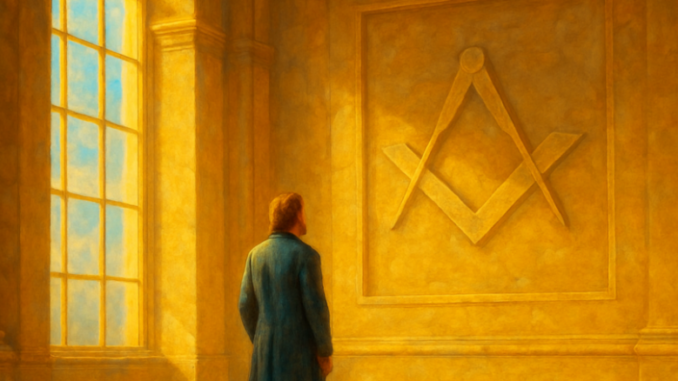
On May 1, 1776, Adam Weishaupt founded a society in the Bavarian city of Ingolstadt that would captivate the world for centuries to come: the Order of the Illuminati. The organization barely lasted a decade before the Bavarian government banned it, yet its name has echoed through conspiracy theories, popular culture, and ultimately one of the best-selling thrillers of the twenty-first century. In Dan Brown’s The Lost Symbol, the concepts of Freemasonry and the Illuminati blur together in a way that has reached millions of readers — but that, historically speaking, paints a deeply distorted picture. How did this confusion arise, what does the book actually claim, and what does history really tell us?
Two Organizations, Two Histories
Freemasonry as we know it formally began in 1717, when four London lodges united to form the first Grand Lodge. Two years later, James Anderson drafted the first constitutions, which placed brotherhood, moral improvement, and tolerance at their core. Jean Théophile Desaguliers, one of the driving forces behind this early organization, emphasized science and Enlightenment ideals. Freemasonry was never a secret society with political ambitions — it was a fraternity whose rituals drew on the traditions of medieval stonemason guilds.
The Illuminati of Adam Weishaupt, by contrast, were explicitly political in motivation. Weishaupt, a professor of canon law, sought to combat superstition and curtail the influence of the Jesuits. He modeled his order’s structure partly on Freemasonry and even had his members infiltrate existing Masonic lodges. That was the historical moment when the two organizations entered each other’s orbit — an entanglement that continues to cause confusion to this day.
What The Lost Symbol Claims
Dan Brown sets The Lost Symbol in Washington, D.C. and turns Freemasonry into the dramatic backdrop of his story. The book presents the American capital as a city steeped in Masonic influence — from its street layout to the architecture of the Capitol. The protagonist, a professor of symbology, is drawn into a mystery surrounding ancient secrets supposedly guarded by the Freemasons. Throughout the narrative, Brown suggests that these mysteries were protected by both Freemasons and related secret societies, blurring the boundaries between Freemasonry and organizations like the Illuminati.
The book doesn’t portray Freemasons as a malevolent organization, but it does create the impression that Freemasonry is part of a larger web of secret knowledge-keepers. This approach leads readers to associate Freemasonry with every type of secret society they’ve ever heard of — and in the popular imagination, that means above all the Illuminati. Brown fuels this association by presenting rituals as spectacular and mysterious, without always clearly distinguishing between what is genuine Masonic tradition and what belongs to the domain of other organizations entirely.
Why the Confusion Is So Persistent
The conflation of Freemasonry and the Illuminati predates Dan Brown by centuries. As early as the late eighteenth century, Scottish natural philosopher John Robison published an influential book claiming that the Illuminati had infiltrated Freemasonry in order to trigger the French Revolution. Around the same time, the Frenchman Augustin Barruel published similar theories. These works laid a foundation for conspiratorial thinking that would persist for generations.
Yet the historical facts are clear. The Bavarian Illuminati were banned in 1785 by Elector Karl Theodor. There are no reliable historical sources demonstrating that the order continued to exist in any organized form after that date. Freemasonry, on the other hand, has existed continuously since the early eighteenth century and today counts millions of members worldwide. These are two fundamentally different stories that popular culture — and books like The Lost Symbol in particular — has lumped together into one.
Freemasonry is a living brotherhood with an unbroken tradition spanning three centuries, while the Illuminati were a short-lived eighteenth-century organization that ceased to exist in 1785. Confusing the two is like mistaking a cathedral for the blueprint of a house that was never finished.
What History Really Tells Us
Figures such as Wolfgang Amadeus Mozart, Johann Wolfgang von Goethe, and Voltaire were all Freemasons. They sought in the lodge a space for intellectual exchange, brotherhood, and personal growth. Their membership had nothing to do with secret political plots and everything to do with the Enlightenment values that Freemasonry embodied: tolerance, the pursuit of knowledge, and moral development. Benjamin Franklin, one of the founding fathers of the American republic, was also a Freemason and played a vital role in the social fabric of his time — without any need for shadowy power structures.
Dan Brown’s The Lost Symbol has undeniably contributed to a renewed interest in Freemasonry, and that in itself is not problematic. It becomes distorted only when readers mistake fiction for historical fact. Brown himself has stated in interviews that his books are thrillers, not history textbooks. The responsibility for distinguishing between entertainment and reality ultimately lies with the reader.
From Past to Present: An Invitation to Inquiry
The lesson history offers us is that confusion between organizations and ideals often says more about the observer than about what is being observed. Adam Weishaupt borrowed the structure of Freemasonry because it was successful — but that does not make the two the same. A copy of a painting does not replace the original. For anyone genuinely interested in understanding these traditions, the path forward lies not in the pages of a thriller but in honest historical research and, perhaps, in stepping across the threshold of a lodge to discover what Freemasonry truly represents today.
The enduring confusion between Freemasonry and the Illuminati is a testament to the power of storytelling over historical nuance. While Dan Brown crafted a compelling thriller that brought renewed attention to Masonic symbolism, the real history reveals two distinct organizations with very different purposes and fates. Freemasonry continues to thrive as a global fraternity dedicated to self-improvement, brotherhood, and moral growth. The Illuminati, meanwhile, remain what they have been since 1785: a fascinating footnote in history. Knowing the difference is not just an academic exercise — it is an act of intellectual honesty that honors both traditions for what they truly were and are.
Copyright text & image: devrijmetselaar.nl
Texts are based on the ideas and content of the author of devrijmetselaar.nl, reviewed, corrected, and supplemented with the assistance of OpenAI. Images are created based on the ideas of the author of devrijmetselaar.nl using OpenAI/DALL-E.
Frequently Asked Questions
What is the main difference between Freemasonry and the Illuminati?
Freemasonry, formally established in 1717, is a fraternity based on brotherhood, moral improvement, and tolerance, drawing from medieval stonemason guild traditions. The Illuminati, founded by Adam Weishaupt in 1776, were explicitly political in motivation, seeking to combat superstition and curtail Jesuit influence. While Weishaupt modeled his order partly on Freemasonry and infiltrated Masonic lodges, the two organizations had fundamentally different purposes and origins.
Why are Freemasonry and the Illuminati often confused together?
The confusion largely stems from historical entanglement when Illuminati members infiltrated existing Masonic lodges in the late 18th century. This confusion was further popularized by Dan Brown's novel The Lost Symbol, which blurs the boundaries between Freemasonry and secret societies like the Illuminati, reaching millions of readers with a historically distorted picture that conflates the two organizations.
How does Dan Brown's The Lost Symbol portray Freemasonry?
In The Lost Symbol, set in Washington, D.C., Dan Brown presents Freemasonry as the dramatic backdrop of his mystery thriller, suggesting that Masonic influence permeates the capital's street layout and architecture. The book creates the impression that Freemasonry guards ancient secrets and is interconnected with related secret societies. While the book doesn't portray Freemasons as malevolent, it does suggest Freemasonry is part of a larger network of mysterious organizations, which historians argue is a distorted representation.


Be the first to comment