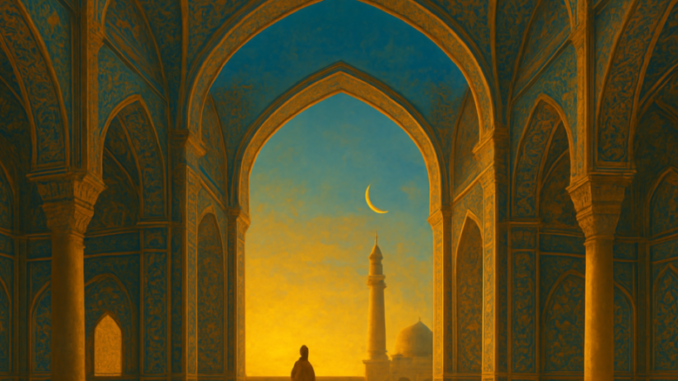
Perhaps you recognize the feeling: life closes in around you, pressure builds, and somewhere deep inside you long for space. Not a bigger room or more free time, but an inner expansion — a sense that your chest is opening up and you can finally breathe again. That exact image lies at the heart of one of the shortest yet most powerful chapters of the Quran: Surah 94, known in Arabic as Ash-Sharh, or The Expansion. In just eight verses, this surah describes a transformation that every seeker, regardless of tradition, will recognize. And it is precisely that transformation that plays a central role in Freemasonry as well.
What Does The Expansion Tell Us?
Surah 94 addresses the Prophet Muhammad directly, opening with the rhetorical question: “Have We not expanded your breast?” It serves as a reminder of a moment of liberation. The burden that weighed upon his back is lifted. Twice, the surah promises that with every hardship comes ease. It is a text of comfort, of hope, and above all, of trust in the process of inner growth.
For Muslims, this chapter is a source of strength during times of adversity. But its imagery reaches far beyond any single tradition. The idea that the heart must open before wisdom can flow in is found in virtually every spiritual path in the world.
The Breast as an Inner Workshop
In Freemasonry, we speak of the “rough ashlar” that must be shaped into a “perfect cube.” This is not a literal building project — it is a metaphor for working on oneself. The expansion of the breast described in Surah 94 can be understood as the very same process: removing what no longer serves, opening what has been closed, creating inner space.
Just as an Entered Apprentice steps into the lodge with the intention of allowing himself to be shaped, the reader of The Expansion is invited to open his heart to what lies ahead. This is not passive waiting. The surah explicitly states: “So when you have finished [your duties], then stand up [for worship].” This call to active effort after receiving grace is remarkably similar to the Masonic principle that insight only gains value when you act upon it.
Hardship as a Prerequisite for Growth
One of the most striking elements of Surah 94 is its repetition: “Verily, with hardship comes ease. Verily, with hardship comes ease.” This repetition is no accident. It is an emphasis that resonates deeply with anyone who understands that growth is rarely comfortable.
The Greek philosopher Aristotle wrote that virtue arises from habit and practice, not from comfort. The Roman emperor and Stoic philosopher Marcus Aurelius went further still: he regarded adversity as the raw material from which a person forges character. In Freemasonry, this understanding is equally fundamental. The trials a candidate undergoes during initiation are not meant to discourage but to reveal. They bring to light what already lives within you but has remained hidden beneath layers of uncertainty, fear, or ignorance.
The burden that is lifted in The Expansion does not mean the disappearance of all problems. It is the ability to carry those problems differently — with an expanded heart.
Inner expansion is not the absence of burden, but the capacity to carry that burden with an open heart and a clear mind.
Light After Darkness: A Universal Theme
The theme of light following darkness is one of the strongest connections between the message of Surah 94 and Freemasonry. The candidate who enters the lodge is blindfolded. He experiences darkness. Only when the right moment arrives is the blindfold removed, and light floods in.
This ritual moment is not mere theater. It embodies the universal human longing for enlightenment, for understanding, for the assurance that darkness does not have the final word. In The Expansion, that longing is answered with a promise: after trial comes illumination.
That promise is not exclusive to any single faith. It belongs to everyone willing to walk through the darkness rather than flee from it. Voltaire, himself a Freemason, wrote about the importance of the light of reason as a counterweight to superstition and narrow-mindedness. Though his context was different, his words and the message of Surah 94 share the same conviction: expansion begins with the courage to look.
What This Could Mean for You
You don’t need to be a Muslim to be moved by The Expansion. Nor do you need to be a Freemason to see the value of working on your inner self. What this surah offers is a mirror. It asks you: where in your life do you feel constriction? What burden do you carry that might become lighter — not because someone takes it from you, but because you learn to relate to it differently?
Freemasonry offers no ready-made answers to such questions. What it does offer is a method: the quiet work on yourself, supported by brothers who walk the same path. Just as in Surah 94, where the Prophet is reminded that he is not alone in his struggle, the lodge reminds every Mason that personal growth need not be a solitary endeavor.
The French philosopher Michel de Montaigne wrote that examining one’s own inner life is the highest form of wisdom. That sounds like an echo of what Surah 94 offers: the heart that opens, the burden that lightens, and the invitation to move forward after that opening. Montaigne might have put it this way: the expansion is already there — you just have to dare to feel it.
Strive When You Are Ready
The final verses of Surah 94 call for effort after the experience of relief. This may be the most powerful lesson of this brief chapter. Expansion is not a destination — it is a beginning. The moment your heart opens, the real work starts. The gift of inner space comes with a responsibility: to use it, to fill it with purpose, and to keep moving forward.
This mirrors one of Freemasonry’s deepest teachings. Initiation is not the end of the journey — it is the first step. The light you receive in the lodge is not meant to be admired from a distance. It is meant to be carried into the world, into your daily life, into every interaction and every challenge you face. The expansion described in Surah 94 and the illumination experienced in the lodge both point toward the same truth: transformation is not something that happens to you once — it is something you must choose, again and again, every single day.
Surah 94 and the Masonic journey share a profound and timeless message. The heart must be opened before wisdom can enter. Hardship is not punishment but preparation. And the light that follows darkness is not a reward for passivity — it is a call to action. Whether you find your path through sacred scripture, through the rituals of the lodge, or through the quiet examination of your own soul, the invitation remains the same: dare to expand, dare to grow, and when you are ready, strive with everything you have.
Copyright text & image: devrijmetselaar.nl
Texts are based on the ideas and content of the author of devrijmetselaar.nl, reviewed, corrected, and supplemented with the assistance of OpenAI. Images are created based on the ideas of the author of devrijmetselaar.nl using OpenAI/DALL-E.
Frequently Asked Questions
What is Surah 94 (The Expansion) and why is it significant in Freemasonry?
Surah 94, known as Ash-Sharh or The Expansion, is one of the shortest yet most powerful chapters of the Quran. It describes a spiritual transformation where the heart opens to wisdom and inner growth. In Freemasonry, this surah's imagery of expanding the breast parallels the core Masonic practice of shaping oneself—symbolized by refining the 'rough ashlar' into a 'perfect cube.' Both traditions emphasize inner liberation and the opening of the heart as prerequisites for spiritual development.
How does the concept of 'expanding the breast' relate to Masonic work?
In Freemasonry, the breast represents an inner workshop where the individual works on themselves through moral and spiritual development. The expansion described in Surah 94—removing what no longer serves and creating inner space—mirrors the Masonic journey of an Entered Apprentice who enters the lodge intending to be shaped and refined. Both traditions view this expansion not as passive waiting but as active, deliberate work undertaken after receiving spiritual grace.
What does Surah 94 teach about hardship and growth?
Surah 94 emphasizes through repetition that 'with hardship comes ease,' stressing that growth is rarely comfortable. This teaching resonates with the Masonic understanding that true development requires effort and perseverance through challenges. The surah's message reinforces that difficulty is not an obstacle to spiritual progress but rather a necessary prerequisite for genuine inner expansion and the attainment of wisdom.


Be the first to comment