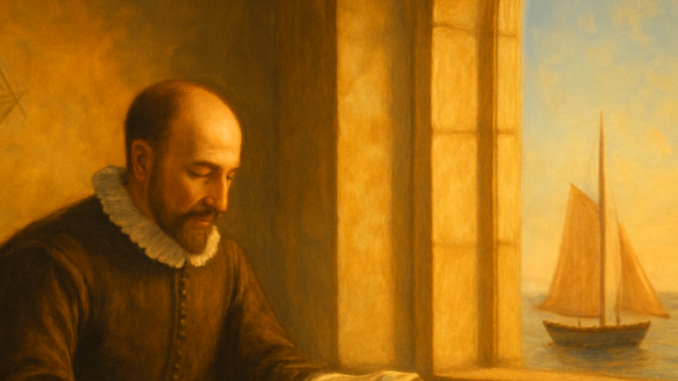
When Michel de Montaigne wrote about his relationship with books in the sixteenth century, he did something remarkable: he refused to hide behind authority. He judged openly, admitted his preferences, and acknowledged his limitations. Centuries later, a brotherhood emerged in Europe built on strikingly similar principles — honesty with oneself, the pursuit of self-improvement, and the conviction that truth is not a destination but a journey. What happens when we place these two worlds side by side? Not to equate them, but to discover where their echoes meet.
Montaigne’s World: The Book as Mirror
In his essay “Of Books,” Michel de Montaigne presents reading not as a scholarly exercise but as a personal confrontation. He does not read to accumulate knowledge or impress others with his erudition. He reads to know himself better. For Montaigne, books are not unquestionable monuments of wisdom to be accepted without challenge — they are conversation partners who provoke, entertain, and sometimes disappoint him. He writes with striking honesty about authors who bore him and works that leave him cold, even when the entire learned world holds them in high esteem.
What Montaigne does here is radical for his time. He places personal judgment at the center — not as arrogance, but as duty. To live honestly, he seems to say, one must dare to read honestly. His library in the tower of his château is not a temple of authority but a workshop of thought. The book serves the reader, not the other way around. This attitude requires courage: the courage to admit you do not understand something, that you have changed your mind, that you harbor uncertainties. It is precisely this vulnerability that makes his essays so timeless.
The Freemason’s World: The Lodge as Workshop
Freemasonry operates within a comparable dynamic, though it takes a different form. Where Montaigne quietly converses with himself through books, the Freemason enters into dialogue within the lodge. The lodge, much like Montaigne’s library, is a protected space where thinking takes center stage. No dogmas are imposed here. No single worldview is presented as the only correct one. Instead, brethren are invited to reflect, to listen, and to hold their own convictions up to the light.
The pursuit of truth in Freemasonry is deliberately unfinished. This is not a weakness — it is a principle. A Freemason is not expected to arrive at ultimate truth but to move continually toward more light. That word — light — refers to knowledge, insight, and moral awareness. Just as with Montaigne, the path matters more than the destination. The rituals and customs within the lodge are not final answers but invitations to deeper reflection. Brotherhood does not arise from sharing the same conclusions, but from sharing the same willingness to search honestly.
What the Essayist and the Brotherhood Share
At first glance, the worlds of Montaigne and Freemasonry seem far apart. One is a sixteenth-century nobleman writing in solitude; the other is a brotherhood that works in community. Yet they share a deeply rooted conviction that fundamentally connects them: self-reflection as a moral act. Montaigne describes how reading Plutarch and Seneca does not so much teach him new facts as confront him with his own character. The Freemason experiences something similar when he is invited in the lodge to work his rough ashlar — an image for the continuous shaping and refining of one’s inner self.
Both Montaigne and Freemasonry teach us that honesty with oneself is the first prerequisite for any genuine pursuit of truth.
There is another parallel worth noting: the attitude toward authority. Montaigne refuses to admire a book simply because it is old or famous. He demands of himself that he judge every work on its own merits. A comparable tradition exists within Freemasonry. No brother speaks from a position of infallibility. The Worshipful Master leads the proceedings but does not dictate truth. James Anderson, who compiled the first constitutions of modern Freemasonry in 1723, emphasized that the brotherhood should be a meeting place for people of diverse backgrounds and beliefs. That ideal demands precisely the kind of intellectual humility that Montaigne so powerfully articulated.
Lessons from the Comparison
The value of placing Montaigne alongside Freemasonry does not lie in proving they are the same. They are not. Montaigne was not a Freemason, and Freemasonry does not base itself on his work. But it is precisely in the differences that we see how universal certain human longings are. The longing to live honestly. The longing not to follow blindly, but to think for oneself. The longing to become a better person in the company of others — whether those others are authors or brethren.
Three Shared Values in Perspective
Self-reflection as foundation: Montaigne uses the book as a mirror for his shortcomings. The Freemason uses ritual and the silence of the lodge for the same purpose. Both traditions recognize that growth begins not with looking outward, but with looking inward — honestly and without flinching.
Truth as process: Neither Montaigne nor Freemasonry claims to possess definitive truth. What matters is the movement, not the arrival. This shared understanding prevents both from falling into the trap of dogmatism and keeps the door open for continued growth and discovery.
Intellectual honesty: Both Montaigne and the Freemason refuse to follow authority blindly, choosing instead to let conscience serve as their compass. Marcus Aurelius wrote in his Meditations that a person should not seek what others think, but what he himself knows to be right. That Stoic thought resonates in both Montaigne’s essays and in Masonic ethics. It is no coincidence that Stoic philosophers like Seneca and Epictetus are valued by both traditions as guides toward a more examined life.
Montaigne and Freemasonry walk different roads, but those roads run in the same direction — toward greater self-knowledge, moral awareness, and the humility to admit that the journey never truly ends. For anyone who has ever sat quietly in a lodge, contemplating the meaning of the work, or who has turned the page of an old essay and felt a sudden shock of recognition, the connection between these two traditions needs little explanation. The pursuit of truth, honestly undertaken, always leads us back to the same place: ourselves.
Copyright text & image: devrijmetselaar.nl
Texts are based on the ideas and content of the author of devrijmetselaar.nl, reviewed, corrected, and supplemented with the assistance of OpenAI. Images are created based on the ideas of the author of devrijmetselaar.nl using OpenAI/DALL-E.
Frequently Asked Questions
What is Montaigne's revolutionary approach to reading and books?
Montaigne refuses to accept books as unquestionable authorities. Instead, he reads for personal self-discovery and judges works honestly based on his own experience. He admits when he is bored by celebrated works or doesn't understand something, placing personal judgment at the center rather than blindly accepting what the learned world considers important. This requires courage and vulnerability, treating books as conversation partners rather than monuments of wisdom to be passively accepted.
How is the Freemason's lodge similar to Montaigne's library?
Both spaces function as protected workshops for thought rather than temples of authority. In Montaigne's library tower and in the Masonic lodge, individuals are encouraged to think independently, reflect deeply, and hold their own convictions up to scrutiny. Neither space imposes dogmas or declares a single correct worldview. Instead, both invite honest intellectual engagement and personal exploration.
Why is the pursuit of truth in Freemasonry described as deliberately unfinished?
In Freemasonry, the pursuit of truth is not meant to reach a final destination or ultimate answer. Rather, Freemasons are invited to move continually toward 'more light' — representing ongoing growth and illumination. This unfinished quality is not a weakness but a fundamental principle, emphasizing that truth-seeking is a continuous journey of self-improvement and understanding rather than a fixed endpoint to be reached.



Be the first to comment