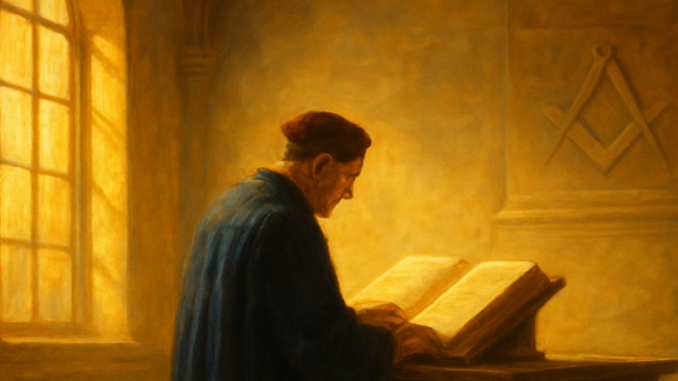
Imagine that everything you think you know about secret societies didn’t come from historical research, but from a thriller you devoured on a rainy Sunday afternoon. That is precisely the paradox Dan Brown’s novel Origin forces us to confront. The book paints a world in which shadowy brotherhoods shape the course of civilization — and it invites the reader to accept that picture as plausible. But what does the novel actually claim, and where does its fiction intersect with the reality of fraternities like Freemasonry?
Secret Societies as the Hidden Engine of Civilization
In Origin, Dan Brown draws on a familiar yet powerful idea. Secret societies, within the logic of his story, are not mere historical curiosities. They are active forces influencing scientific breakthroughs, religious power structures, and political revolutions. The protagonist Robert Langdon once again navigates a world where hidden networks hold the key to knowledge that could transform humanity. The novel suggests these societies have operated for centuries in the shadows of churches, universities, and palaces, their members deliberately choosing secrecy to protect their insights from hostile powers.
Brown does not present this as pure fantasy. His novels consistently open with the assertion that certain organizations and locations described within are real. Origin is no exception. By weaving fact and fiction with surgical precision, he creates an atmosphere in which the reader is inclined to believe the boundary between novelistic imagination and historical reality is thinner than commonly assumed. This is a literary strategy, but it is also a philosophical stance — the suggestion that official history only shows us the visible surface of a much deeper truth.
The Brotherhood as Guardian of Forbidden Knowledge
What sets Origin apart within Dan Brown’s body of work is a notable shift from religion to science as the source of the great secret. While earlier novels revolved around religious mysteries, this book places the tension between faith and scientific discovery at center stage. The secret society in the story serves as the custodian of a discovery that would reveal both the origin and the destiny of humankind. The promise is nothing less than an answer to humanity’s two oldest questions: Where do we come from, and where are we going?
In this premise, we recognize a pattern far older than Dan Brown himself. The idea that a select group of initiates possesses knowledge too dangerous or too revolutionary for the general public dates back to the Pythagoreans of ancient Greece. Pythagoras himself insisted that his students undergo years of silence before they were granted access to the deepest mathematical and cosmological insights. Plato described a comparable dynamic in his Allegory of the Cave: those who have seen the light are misunderstood by the masses. In Origin, Brown draws from that same ancient well.
A Counterpoint: The True Nature of Freemasonry
Here, however, an important tension emerges that any honest discussion cannot ignore. Freemasonry — the most well-known fraternity that features prominently in Brown’s novels — functions in reality in a fundamentally different way than his fiction suggests. Freemasonry is not an organization guarding world-shattering secrets or steering the course of history from hidden chambers. Its core revolves around personal development, ethical reflection, and brotherly connection. The rituals and customs are not designed to conceal knowledge from outsiders, but to guide members step by step toward deeper self-examination.
The real secret of Freemasonry is not a hidden fact but a personal experience: the insight that self-knowledge cannot be taught — it can only be lived.
Historical figures such as Voltaire, Wolfgang Amadeus Mozart, and Johann Wolfgang von Goethe were all Freemasons. None of them were members of a conspiracy. They found in the lodge a space for free thought, for asking questions that could not be asked elsewhere. James Anderson, who drafted the first constitutions of modern Freemasonry in 1723, specifically emphasized tolerance and the transcendence of religious and political division. That is something profoundly different from the picture Dan Brown conjures.
Why the Fiction Is So Seductive
Yet it would be too easy to dismiss Dan Brown as simply a writer who distorts reality for the sake of suspense. Origin taps into a deeply human longing — the desire for meaning behind the visible world. The philosopher Baruch de Spinoza wrote in the seventeenth century that human beings are inclined to perceive purposeful design everywhere, even where none exists. We want there to be a hidden order, a plan, a secret that explains everything. The enormous popularity of Dan Brown’s genre is, in a sense, living proof of Spinoza’s observation.
And it is precisely here that the fiction touches something genuinely meaningful within Freemasonry. Not because the lodge guards secrets that would change the world, but because it acknowledges that the search itself has value. The journey from darkness to light that every Freemason undertakes during initiation is not an answer to the great questions. It is an invitation to take those questions seriously — to refuse to settle for superficial certainties.
Fiction as a Mirror, Not a Source
Dan Brown’s Origin is not a reliable guide for understanding secret societies. The novel is a mirror of our own fascination with the hidden — a literary construction that both exploits and exposes our need for mystery. The claim that fraternities like Freemasonry hold the key to concealed truths makes for a powerful storyline, but it is not historical reality.
The real strength of Freemasonry has never resided in possessing secret information. It lives in the practice of reflection, in the willingness to question one’s own assumptions, and in the commitment to meet fellow seekers as equals within the lodge. That narrative may be less cinematic than Dan Brown’s version — but it is more enduring, and arguably more meaningful.
If Origin inspires readers to look beyond the thriller and explore what Freemasonry genuinely stands for, then perhaps the novel serves a purpose Brown himself may not have fully intended: not as a revelation of secrets, but as a doorway to genuine curiosity.
Dan Brown’s novels will continue to captivate millions, and secret societies will remain irresistible material for storytellers. But for those willing to look past the fiction, the real tradition of Freemasonry offers something the novels never can — not a dramatic unveiling of hidden truths, but a quiet, lifelong invitation to pursue self-knowledge, moral growth, and brotherhood. The greatest secret, as every Freemason discovers, is that the journey inward is the most extraordinary journey of all.
Copyright text & image: devrijmetselaar.nl
Texts are based on the ideas and content of the author of devrijmetselaar.nl, reviewed, corrected, and supplemented with the assistance of OpenAI. Images are created based on the ideas of the author of devrijmetselaar.nl using OpenAI/DALL-E.
Frequently Asked Questions
Does Dan Brown claim that the secret societies described in Origin are real?
Dan Brown's novels, including Origin, typically open with assertions that certain organizations and locations described are real. However, Origin is a work of fiction that blends fact with imaginative storytelling. While some real organizations like Freemasonry exist, Brown uses them as a foundation for fictional narratives that mix historical elements with invented plots and characters. Readers should distinguish between the real historical aspects and the fictional narrative constructed around them.
What role do secret societies play in Dan Brown's novel Origin?
In Origin, secret societies are portrayed as active forces that have shaped civilization for centuries by influencing scientific breakthroughs, religious power structures, and political revolutions. Rather than being mere historical curiosities, they are depicted as guardians of forbidden knowledge operating in the shadows of churches, universities, and palaces. The novel suggests these hidden networks deliberately choose secrecy to protect insights from hostile powers.
How does Origin differ from Dan Brown's previous novels in terms of its central mystery?
While Dan Brown's earlier novels focused primarily on religious mysteries, Origin shifts the central secret from religion to science. The novel places tension between faith and scientific discovery at the forefront, with the secret society serving as guardian of a discovery that would answer humanity's two fundamental questions: Where do we come from, and where are we going? This represents a notable evolution in Brown's exploration of hidden knowledge.


Be the first to comment