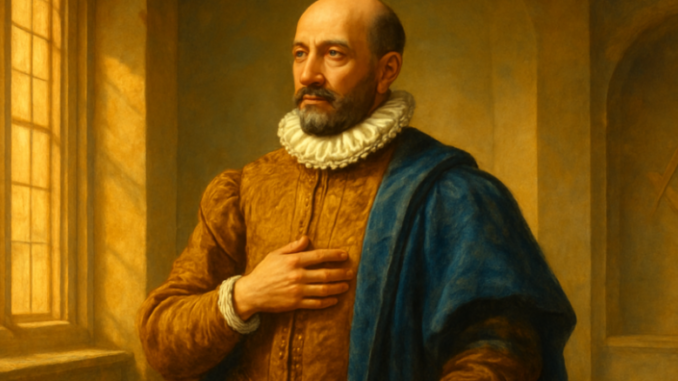
In 1580, Michel de Montaigne published a remarkable essay that exposed the apparent inequality between people as little more than an illusion of outward appearances. Nearly a century and a half later, the first Masonic lodges would emerge in London, rooted in the very same conviction: that beneath the surface of rank, wealth, and lineage lies a fundamental equality shared by all. What connects this sixteenth-century thinker to a tradition that would not reach its full expression until much later? The answer lies not in direct influence, but in a shared quest to discover what truly makes us human.
A Castle Lord Who Sought His Equals
Michel de Montaigne was no revolutionary in the conventional sense. As a nobleman and lord of a château in southwestern France, he belonged to the privileged class of his era. Yet in his essay “On the Equality Among Us,” he turned his back on the conventions of his social standing. He observed how kings, popes, and emperors draped themselves in splendor and ceremony, but how those very same people — stripped bare by illness, nakedness, or fear — were utterly indistinguishable from the poorest peasant. For the sixteenth century, this was a radical observation: a person’s worth is not determined by outward circumstances, but by inner qualities.
Montaigne did not write from abstract theory but from personal experience. He had lived through the devastating Wars of Religion in France and witnessed how nobles and peasants died equally on the battlefield, how the plague drew no distinction between rich and poor. These experiences deepened his conviction that the human condition is universal, regardless of the accidental circumstances of birth.
The Rough Ashlar as a Mirror of Human Equality
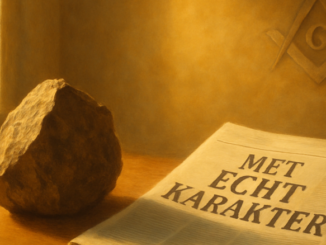
When Freemasons speak of the rough ashlar — the unworked stone that must be shaped into a perfect cube — they touch upon the same principle Montaigne articulated centuries earlier. Every Brother enters the lodge as an imperfect human being, regardless of his position in society. The lawyer stands beside the carpenter; the physician works alongside the baker. Their shared endeavor is one of self-refinement: chiseling away the rough edges of character and conduct. This ritual image mirrors Montaigne’s insight perfectly: the true measure of human worth lies not in what a person possesses or what title he holds, but in the effort he makes to become a better version of himself.
Equality does not begin with erasing differences. It begins with recognizing a shared humanity that runs deeper than any rank or station.
From Renaissance Study to Enlightened Lodge
The intellectual thread running from Montaigne to Freemasonry passes through the great thinkers of the seventeenth century. Philosophers like René Descartes and Baruch Spinoza built upon the humanistic foundation that Montaigne had laid. Both emphasized the primacy of reason over tradition, of personal inquiry over blind obedience to authority. By the time the first Grand Lodge was established in London in 1717, these ideas had permeated the core of Enlightenment thought.
The founders of that Grand Lodge — among them John Theophilus Desaguliers and James Anderson — drafted the Constitutions, which explicitly stated that Brethren of all religions and backgrounds were welcome, provided they embraced “that morality in which all men agree.” This echoes precisely what Montaigne advocated: beyond superficial differences lies a common moral ground. Freemasonry institutionalized this insight through its rituals and symbols, where the level became the emblem of equality and the square the symbol of justice and fair dealing.
Self-Reflection as the Foundation of Brotherhood
Montaigne’s method was above all introspective. His Essays are an ongoing conversation with himself — an honest examination of his own prejudices, fears, and shortcomings. We find this same attitude reflected in the Masonic practice of silent contemplation. Before a Brother can work toward the betterment of the world, he must first come to know his own inner landscape. The search for Light, so central to Masonic symbolism, begins with illuminating one’s own darkness.
This parallel is no coincidence. Both traditions are rooted in the conviction that moral growth demands personal responsibility. Neither Montaigne nor Freemasonry offers ready-made answers; both extend an invitation to a lifelong journey of self-examination and improvement.
What History Teaches Us Today
The distance between Montaigne’s sixteenth-century study and a modern Masonic lodge may seem vast, but the bridge between them is shorter than one might think. In an age when social division so often dominates the conversation, both traditions offer a powerful counterbalance. They remind us that beneath all our diversity exists a shared humanity — and that brotherhood is not built on making everyone the same, but on mutual recognition and respect.
Consider these enduring lessons from both traditions:
- Montaigne taught that outward differences do not negate inner equality.
- Freemasonry ritualized this insight through symbols like the level and the rough ashlar.
- Both traditions emphasize self-reflection as a prerequisite for genuine connection with others.
- The pursuit of virtue and self-improvement is a lifelong process, never a destination.
The lesson Montaigne left us — and that Freemasonry has preserved in its rituals — is as simple as it is timeless: true equality is not discovered by looking outward, but by turning inward. Only when we acknowledge our own imperfections can we regard the imperfections of others with compassion and understanding. In that recognition lies the beginning of genuine brotherhood. Montaigne wrote his reflections in a century of religious conflict and social upheaval. His insights on equality were not a political program but a philosophical invitation: look beyond the surface and seek the human in the other. Freemasonry accepted that invitation and gave it form through ritual and symbol. Today, more than four centuries later, that invitation remains as relevant — and as necessary — as ever.
Copyright text & image: devrijmetselaar.nl
Texts are based on the ideas and content of the author of devrijmetselaar.nl, reviewed, corrected, and supplemented with the assistance of OpenAI. Images are created based on the ideas of the author of devrijmetselaar.nl using OpenAI/DALL-E.

Be the first to comment