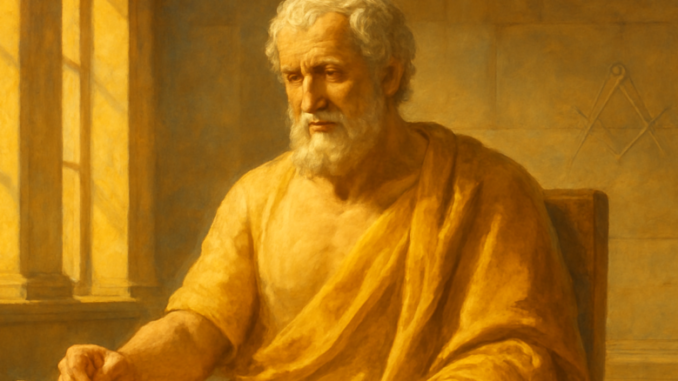
What does it truly mean to live with the awareness that time is finite? Lucius Annaeus Seneca posed this question to his friend Lucilius two thousand years ago, and its echo still reverberates in the temples where Freemasons gather. Letter 77 from his Letters to Lucilius is not a grim meditation on death — it is a call to authentic living. This essay explores how Seneca’s reflections on impermanence and human connection resonate with the very heart of Freemasonry: the brotherhood that arises when people acknowledge their own mortality.
The Paradox of Brevity
A curious paradox emerges in Seneca’s writing. He does not claim that life is too short — he argues that we make it too short. We squander our days on vanities, on anxieties about the future, on chasing things that ultimately do not matter. Life, he writes, is long enough if we use it fully. This thought sounds almost like an accusation, but it is really an invitation — an invitation to wake up.
For the Freemason, this is a familiar call. The ritual work in the lodge begins with a fundamental awareness: human beings are mortal, and that mortality gives meaning to their actions. The symbolism of the rough and polished ashlar points to this process of awakening. It is not the length of life that determines its value, but the degree to which we have shaped ourselves, refined our character, and forged meaningful connections.
Connection as an Answer to Impermanence
Seneca did not write his letters for himself. He wrote them for Lucilius — for a friend, for a fellow human being wrestling with the same existential questions. This is perhaps the most overlooked aspect of his philosophy: wisdom is not a solitary pursuit. It flourishes in dialogue, in reciprocity, in what the Stoics called oikeiosis — the natural inclination toward connection with others.
The recognition of our finitude is not a reason for despair. It is the foundation for genuine brotherhood.
Freemasonry embodies precisely this idea. The fraternal bond does not exist despite the transience of life — it exists because of a shared acknowledgment of that transience. When brethren meet in the lodge, they do so as mortal beings who know their time is limited. That knowledge deepens the bond. It makes every handshake more meaningful, every shared insight more precious.
Virtue as a Compass Through Time
But what, then, should we do with the time we are given? Seneca’s answer is clear: live virtuously. Not out of fear of punishment or hope for reward, but because virtue is the only path to a fulfilled existence. The wise person does not chase external goods — not fame, not wealth. Instead, he seeks inner peace through just action, through temperance, through the courage to face truth head-on.
Freemasonry offers a strikingly similar compass. The search for light, for knowledge, for moral perfection lies at the core of the Masonic endeavor. This is no abstract ideal. It manifests in concrete actions: honesty in daily life, assistance to those in need, the continual work on one’s own shortcomings. The square and compasses are not decorations — they are tools for self-reflection.
A Counterpoint: Is This Not Elitist?
A critical note is warranted here. One could argue that both Seneca and Freemasonry speak from a position of privilege. It is easier to philosophize about the brevity of life when you are not struggling with poverty or oppression. Is this emphasis on inner peace not a luxury that only a few can afford?
It is a fair question, but Seneca himself would reject the premise. He was no stranger to adversity. He experienced exile, political intrigue, and ultimately a forced suicide under Emperor Nero. His philosophy is not an escape from the world — it is a way of standing firmly within it, regardless of circumstances. And Freemasonry, though historically associated with certain social classes, is in principle open to anyone who embraces the values of brotherhood and self-improvement.
The Synthesis: Time as Gift, Connection as Duty
Let us draw the threads together. Seneca teaches us that the brevity of life is not a curse but a fact that demands a response. That response lies in conscious living, in virtuous action, in cherishing genuine human connections. Freemasonry provides a framework in which these ideas take practical shape: the lodge as a training ground for brotherhood, the ritual as a reminder of impermanence, the symbolism as a language for what words alone can barely express.
Consider what this synthesis looks like in practice: self-reflection as a daily discipline rather than an occasional exercise; brotherhood rooted in shared vulnerability; virtue as a compass rather than a straitjacket; and the search for truth as a lifelong journey rather than a destination.
The question that lingers is this: if we know our time is limited, why do we still hesitate? Seneca would say that every day can be a new beginning. The Freemason would add that this beginning always takes place in community. Perhaps that is the deepest lesson of Letter 77 — that we do not carry our finitude alone, and that it is precisely this shared burden that binds us together.
Seneca’s Letter 77 is not a manual for how to die — it is a guide for how to live. Freemasonry shares this focus on the here and now, on the responsibility that every moment carries. In both traditions, we find the conviction that awareness of mortality does not paralyze — it liberates. It invites us to act, to connect, to continually work on who we are. The remaining question is deeply personal: what will we do today with the time we have been given, and with whom will we share the journey?
Copyright text & image: devrijmetselaar.nl
Texts are based on the ideas and content of the author of devrijmetselaar.nl, reviewed, corrected, and supplemented with the assistance of OpenAI. Images are created based on the ideas of the author of devrijmetselaar.nl using OpenAI/DALL-E.
Frequently Asked Questions
What is the main connection between Seneca's Letter 77 and Freemasonry?
Both Seneca's Letter 77 and Freemasonry share a fundamental awareness that human mortality gives meaning to life and actions. Seneca argues that we make life too short by squandering it on vanities, while Freemasonry's ritual work begins with the recognition that human beings are mortal, and that mortality determines the value of our character and connections. This shared acknowledgment of finitude forms the foundation of authentic living and genuine brotherhood.
How does Seneca's concept of oikeiosis relate to Masonic brotherhood?
Seneca believed that wisdom flourishes through dialogue and reciprocity with others—a concept he called oikeiosis, the natural inclination toward connection. Freemasonry embodies this idea through its fraternal bond, which exists precisely because brethren acknowledge their shared mortality and finitude. This recognition deepens the bond between Masons, making every interaction and shared insight more meaningful and precious.
What does Seneca mean when he says 'we make life too short'?
Seneca argues that the brevity of life is not inherent to time itself, but rather a result of how we choose to live. He claims we squander our days on anxieties about the future and pursuit of things that ultimately do not matter. Instead, life is long enough if we use it fully and purposefully. This message serves as an invitation to wake up and live authentically, a principle that resonates with Freemasonry's call for self-refinement and meaningful living.



Be the first to comment