Vrijmetselarij - Marcus Aurelius Boek VIII: de ware aard van de mens ontdekt
Marcus Aurelius – Freemasonry & Connection

Marcus Aurelius Book VIII: Discovering Our True Human Nature

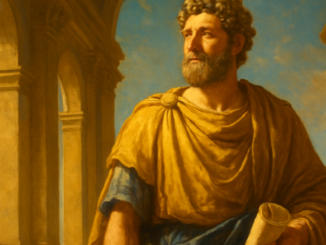
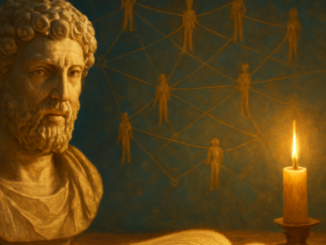
What truly makes us human? Marcus Aurelius posed this question to himself nearly two thousand years ago while serving as Roman Emperor, surrounded by wars and political intrigue, quietly writing his most intimate reflections. In Book VIII of the Meditations, he examines the true nature of humanity — not as isolated individuals, but as beings fundamentally connected to one another and to a greater whole. For Freemasons, this perspective opens a rich dialogue between Stoic wisdom and the fraternal ideals cherished within the lodge. The Philosopher-Emperor on Human Connection Marcus Aurelius never wrote his Meditations for publication. They were inner exercises — private conversations with himself. Throughout Book VIII, he returns again and again to a central theme: no person is an island. He describes how all of us form part of one great organism, with humanity functioning as a single body in which every individual is a limb. When we harm others, we harm ourselves. When we serve the common good, we fulfill our true nature. This vision stands in sharp contrast to the popular image of the Stoic as an unmoved, emotionless figure. For Marcus Aurelius, genuine inner peace does not come from detachment but from the deep […]

Ancient Stoic philosophy book with Masonic square and compass symbolizing wisdom
Lucius Annaeus Seneca – Freemasonry & Connection

Seneca on Simplicity: Letter XX and the Masonic Path

What does it truly mean to live in accordance with your beliefs? Lucius Annaeus Seneca posed this question to his student Lucilius nearly two thousand years ago — and it is precisely the same question that Freemasons continue to ask themselves on their journey toward inner truth. In his twentieth letter from the Epistulae Morales, the Stoic philosopher explores how simplicity and consistency form the foundation of an authentic philosophical life. These ancient insights resonate deeply with the timeless principles of Freemasonry, and they deserve a closer look. Why Does Seneca Consider Simplicity a Foundation? Seneca opens his twentieth letter with an urgent appeal: let your words and your actions align. He criticizes those who profess philosophy with their lips yet deny it through their daily conduct. For Seneca, simplicity is not poverty or deprivation — it is a deliberate choice to release what is unnecessary. The real question he poses is this: do you live according to what you preach? This principle of harmony between the inner life and outward behavior is far from an abstract philosophical exercise. Seneca asks Lucilius to test himself honestly: can you be content with little? Could you endure the loss of wealth and […]

Marble bust of Marcus Aurelius with Masonic square and compass symbolism
Marcus Aurelius – Freemasonry & Connection

Marcus Aurelius on Virtue as the Only True Value

What if everything you own — your status, your reputation, even your body — were to vanish tomorrow? Would anything of real value remain? Marcus Aurelius, the Roman emperor-philosopher who ruled nearly nineteen centuries ago, posed this question to himself again and again. In the sixth book of his Meditations, he arrives at an answer that is both radical and consoling: only virtue holds genuine worth. This insight resonates profoundly with Freemasonry, where the pursuit of moral perfection and the cultivation of inner qualities stand at the very center of practice. Both traditions converge on a fundamental conviction: who you are matters far more than what you have. The Paradox of the Powerful Philosopher Here we enter curious territory. Marcus Aurelius wielded virtually unlimited power. As emperor, he could amass wealth, destroy enemies, and have his name chiseled in marble for all eternity. Yet night after night, he wrote in his private journal that none of these things moved him. More than that — he regarded them as distractions from what truly matters. Throughout Book VI, he repeats like a mantra that external circumstances are neither good nor bad. They are indifferent, neutral, merely the raw material with which the […]

Ancient Roman bust of Marcus Aurelius symbolizing Stoic virtue and Freemasonry
Marcus Aurelius – Content & Summary

Marcus Aurelius Book VI: Virtue as Compass in a Faltering Empire

Somewhere around 173 AD, amid military campaigns along the Danube, a Roman emperor sat down by candlelight to write his thoughts. Not for publication, not for fame, but as an exercise in inner discipline. Marcus Aurelius knew that external circumstances could be stripped from him at any moment — his throne, his health, even his life. But one thing no one could take away: his character. In the sixth book of his Meditations, he distills this insight into a philosophical core that still resonates today, not least within Freemasonry. The Historical Context of Book VI To truly understand Book VI, we must transport ourselves to the Roman Empire in the second century. Marcus Aurelius ruled from 161 to 180 AD, a period marked by plague, frontier wars, and internal instability. Unlike the philosophers of his day, who could contemplate in relative tranquility, this Stoic emperor wrote his reflections quite literally on the battlefield. The Meditations are not a systematic treatise but a collection of personal notes, originally titled Ta eis heauton — “To Himself.” Book VI was most likely composed during the Marcomannic Wars, when the emperor confronted mortality on a massive scale. It is precisely within this chaos that […]

Ancient Roman scroll symbolizing Seneca's philosophy and Masonic inner freedom
Lucius Annaeus Seneca – Letters to Lucilius

Seneca on True Freedom: Philosophical Roots of Letter XVIII

What does it truly mean to be free? Not free from laws or obligations, but free on the inside — free from fear, from greed, from the tyranny of your own desires. Nearly two thousand years ago, Lucius Annaeus Seneca explored exactly this question in a letter to his friend Lucilius. His words still resonate today. In Letter XVIII, Seneca examines what true freedom really entails, drawing on a rich philosophical heritage that proves surprisingly familiar to modern Freemasons. Stoicism as the Foundation Seneca was one of the towering figures of Roman Stoicism, a philosophical tradition that originated around 300 BCE in Athens. Its founder, Zeno of Citium, taught in the Stoa Poikile — the painted colonnade from which the movement took its name. At the heart of Stoic thought lies a deceptively simple distinction: the difference between what is within our power and what is not. External circumstances — wealth, health, the opinions of others — fall outside our control. Our inner disposition, our judgments, and our responses, however, belong entirely to us. This core principle forms the backbone of Letter XVIII. Seneca argues that true freedom does not depend on social status or material possessions. A slave can […]

Open book showing Voltaire's Candide with garden and Masonic symbolism
Symbolism & Rituals

Voltaire and Candide: The Philosophical Roots of the Garden

You have probably heard the famous closing line of Voltaire’s Candide: “We must cultivate our garden.” It is a sentence that has made people think for nearly three centuries. But where did this deceptively simple idea come from? Which philosophers and intellectual currents shaped Voltaire’s razor-sharp pen when he wrote this satirical masterpiece? Beneath the surface of what appears to be a lighthearted adventure story lies a rich web of philosophical thought — one that resonates deeply with anyone who has ever worked at shaping the rough stone of their own character. Leibniz and the Optimism Voltaire Fought Against At the philosophical heart of Candide lies a direct attack on the optimism of Gottfried Wilhelm Leibniz. This German philosopher championed the idea that we live in “the best of all possible worlds.” God, as a perfect being, could not have created anything less. Voltaire considered this position not merely naive but outright dangerous. The character of Pangloss in Candide is a biting caricature of Leibniz — a man who, no matter how many catastrophes befall him, insists that everything is for the best. Voltaire wrote Candide shortly after the devastating Lisbon earthquake of 1755, which killed tens of thousands of […]

Open book with classical philosophical texts relating to Montaigne and fear
Michel de Montaigne – Philosophical Background

Montaigne on Fear: The Philosophical Roots of Essay 17

Michel de Montaigne did not write his essay ‘On Fear’ in an intellectual vacuum. Behind his seemingly personal observations about anxiety lies a rich philosophical tradition stretching back to Greek and Roman antiquity. By tracing these roots — Stoicism, Skepticism, and the moral psychology of Plutarch — we can better understand how sixteenth-century thinking about fear connects to the contemplative practice that also lies at the heart of Freemasonry. Stoicism as the Foundation Stoic philosophy is arguably the most important undercurrent in Montaigne’s thinking about fear. Seneca, whose letters Montaigne studied closely, regarded fear as a passion born from false judgments about reality. For the Stoics, fear arises when we treat external events as threats to our well-being, when true well-being resides in virtue alone. Epictetus put it sharply: it is not things themselves that disturb us, but our judgments about those things. Montaigne absorbs this Stoic insight but transforms it at the same time. Where Seneca aims for complete mastery over the passions, Montaigne is more modest. He acknowledges that fear is a human reality that cannot simply be reasoned away. This nuance makes his essay far more approachable than the sometimes severe Stoic treatises. He does not ask […]

Masonic rough ashlar symbolizing talent, responsibility, and ethical duty
Philosophy & Ethics

What Being the Favorite Teaches Us About Ethics in Masonry

When someone is labeled the favorite, something curious happens: the expectation of victory transforms winning from a possibility into an obligation. Professional cyclist Lorena Wiebes, who recently claimed another dominant stage victory at the Tour, carries that burden with apparent ease. But what does it truly mean to be required to perform simply because others expect it of you? And doesn’t this touch on a deeper ethical question that lies at the very heart of Freemasonry — the relationship between talent, responsibility, and moral duty? The Paradox of Merit and Expectation There is a philosophical tension here that seems harmless on the surface but raises fundamental questions upon closer examination. A cyclist who has become the best through years of dedication and innate talent is criticized when she doesn’t win. The logic seems perverse: precisely because she excels, what was once remarkable becomes obligatory. Aristotle might have spoken here about the relationship between aretè — the virtue of excellence — and the social context in which that virtue acquires meaning. Freemasonry knows a remarkably similar dynamic. Once a man is initiated as a Brother, he accepts an invisible but very real contract — not just with his lodge, but with […]

Rough ashlar stone symbolizing Montaigne's philosophy of the inconsistent self
Michel de Montaigne – The Essays

Montaigne and the Philosophy of the Inconsistent Self

A stone being worked bears the marks of many hammer blows. Some make it smoother; others leave cracks behind. This is precisely how the sixteenth-century thinker Michel de Montaigne viewed the human soul — as a piece of work that never quite reaches completion, continually shaped by contradictory forces. His essay on the inconsistency of our actions drew from a rich philosophical tradition reaching back to antiquity. Which thinkers whispered to him what it truly means to be human in all our inconsequence? The Rough Ashlar as Starting Point In Freemasonry, the rough ashlar is a well-known symbol: the unworked stone representing the apprentice at the beginning of his path. This stone is not flawed — it is simply unfinished. It awaits the work of reflection and experience. Montaigne would have recognized this image immediately. His essay on inconsistency opens with the observation that we human beings possess no fixed core, but instead consist of layers, fractures, and surprising turns. The philosopher treated himself as his own subject of study and discovered within a fundamental mutability that did not trouble him, but fascinated him. This view of the human being as a work in progress had deep roots in Renaissance […]

Open book with Montaigne's Essays beside Masonic square and compasses in soft light
Michel de Montaigne – The Essays

Montaigne on Grief: Philosophical Roots and Masonic Symbolism

There comes a moment when words fail. A moment when the soul is so overwhelmed by sorrow that it freezes, falls silent, or erupts in a flood no one anticipated. Michel de Montaigne wrote about precisely this in his second essay — a brief but deeply penetrating exploration of the limits of human emotion. Beneath its seemingly simple subject lies a rich philosophical inheritance stretching from the Greek Stoics to Renaissance humanism. And for those accustomed to thinking in symbols, it opens a world of meaning that reaches far beyond the surface of everyday experience. The Silent Voice of the Stoics Montaigne‘s reflections on grief are unthinkable without Stoic philosophy. This school of thought, born in third-century Athens, taught that emotions are the result of the judgments we make about reality. Sorrow does not arise from what happens to us, but from how we interpret it. Seneca, the Roman philosopher whom Montaigne so frequently quotes, wrote extensively about the art of dealing with loss and adversity. He insisted that the wise person does not suppress emotions but learns to understand them. In his essay on sadness, however, Montaigne takes a more nuanced position. He observes that extreme emotions sometimes paralyze […]