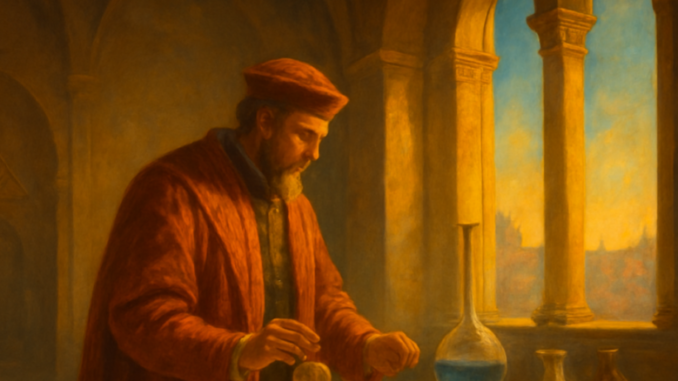
What if the quest for gold was never really about gold? At the court of Emperor Rudolf II in Prague, toward the end of the sixteenth century, astronomers, alchemists, and artists gathered in pursuit of something that could never be captured in a crucible. That pursuit still resonates today in the rituals and philosophy of Freemasonry. But where does history end and myth begin — and what does Dan Brown’s The Secret of Secrets have to do with any of it?
Alchemy Was Never Chemistry — It Was Philosophy
Let’s start with a claim that may surprise you: the alchemists at the court of Rudolf II were not early chemists who simply happened to be on the wrong track. They were philosophers who regarded the transformation of the human soul as their true work. The crucible, the furnace, mercury, and sulfur — these were elements of a symbolic language, a way of speaking about inner processes that resisted ordinary expression. The Swiss physician Paracelsus, who lived a generation earlier and whose ideas were eagerly studied in Prague, put it this way: healing begins with understanding the connection between the human being and the cosmos. This was not superstition. It was a radically holistic vision, far ahead of its time.
Emperor Rudolf II, Holy Roman Emperor from 1576 to 1612, turned Prague into a magnet for such thinkers. Tycho Brahe and Johannes Kepler carried out their astronomical calculations there. The English scholar John Dee visited the court, bringing with him a world of Hermetic texts. Edward Kelley, Dee’s controversial companion, claimed he could transmute base metals into gold and was rewarded with a noble title by the emperor. Rudolf’s court was a laboratory in the broadest sense of the word — a place where knowledge, art, and mysticism fused together.
What Dan Brown Gets Wrong — and Why It Matters
In The Secret of Secrets, Dan Brown uses alchemy as dramatic scenery. Brown is a master at weaving historical facts into fictional conspiracies, and the results make for gripping stories. But they also create a persistent misconception: that alchemy, Hermetic philosophy, and secret societies like Freemasonry are all part of the same underground tradition, dedicated to hiding dangerous knowledge from the outside world. Brown’s novel suggests connections that are historically tenuous at best. The Freemasonry we know today emerged more than a century after Rudolf II’s death, with the founding of the first Grand Lodge in London in 1717.
Freemasonry possesses no secret formula for making gold. Its real alchemy is the transformation of the individual — from rough material into a more conscious, more virtuous existence.
The Counterpoint: A Shared Intellectual Heritage
That said, it would be too easy to dismiss every link between Prague’s alchemical culture and later Freemasonry. The Hermetic tradition, rooted in texts attributed to Hermes Trismegistus, formed an intellectual undercurrent that influenced both Rudolf’s alchemists and the early Freemasons. James Anderson’s Constitutions of 1723 — the founding document of modern Freemasonry — placed the fraternity within a mythical history stretching back to the building of King Solomon’s Temple. That claim to ancient wisdom runs strikingly parallel to the alchemical tradition, which likewise presented itself as a vessel for primordial knowledge.
Consider Isaac Newton. Remembered today primarily as a physicist, Newton actually devoted more time to alchemical research than to his mechanics. His manuscripts, fully examined only in the twentieth century, reveal a thinker who did not draw the sharp boundary between science and Hermetic philosophy that we do now. Newton was not a Freemason, as far as we know, but his intellectual world was the same soil from which Freemasonry grew. The philosopher and mathematician John Theophilus Desaguliers, who did play a pivotal role in the early Grand Lodge of London, moved through the very same circles of experimental science and philosophical speculation.
The Inner Transmutation: A Common Thread
Where Prague’s alchemists spoke of the Great Work — the transmutation of base metal into gold — Freemasons use the image of the rough stone shaped into a perfect ashlar. Both traditions employ a metaphor for the same process: the refinement of the self. This is no coincidence, but neither is it proof of a secret lineage of transmission. It is, rather, an expression of a universal human longing for growth and self-knowledge — a longing that finds its own language in every age.
The French writer and philosopher Michel de Montaigne, who features in other articles on this site, wrote about the necessity of self-examination as early as the sixteenth century. His essays appeared during the very same decades that Rudolf II was shaping his Prague court into a haven for unconventional thought. Montaigne was no alchemist, but his method — constantly questioning, moving from one perspective to another without claiming a final answer — shares a deep kinship with both the alchemical and the Masonic approach to knowledge.
What Dan Brown’s Novel Overlooks
The Secret of Secrets presents secret societies as custodians of hidden power. Reality is more subtle. Freemasonry does not guard cosmic secrets; it offers a method. That method — built on ritual, brotherhood, and moral reflection — places the individual human being at its center. The secret is not something kept hidden from outsiders. It is something that can only be understood through personal experience, like the taste of a fruit you can only know once you bite into it.
The alchemy of Rudolf II sought transformation of matter as a mirror for the transformation of the spirit. Freemasonry inherited that aspiration — not through a hidden chain of initiation, but through a shared cultural memory. The rough stone on the lodge floor and the philosopher’s stone in the alchemist’s furnace point in the same direction: inward.
The story of Prague’s alchemists and their connection to Freemasonry is neither the sensational conspiracy that Dan Brown imagines nor a mere historical curiosity. It is a reminder that the most enduring traditions are those that speak to something deeply human — the desire to transform ourselves, to move from ignorance toward understanding, from roughness toward refinement. That is the real gold, and it was never hidden. It was always waiting to be forged.
Copyright text & image: devrijmetselaar.nl
Texts are based on the ideas and content of the author of devrijmetselaar.nl, reviewed, corrected, and supplemented with the assistance of OpenAI. Images are created based on the ideas of the author of devrijmetselaar.nl using OpenAI/DALL-E.
Frequently Asked Questions
Was alchemy really just an early form of chemistry?
No. The alchemists at Emperor Rudolf II's court were philosophers, not early chemists. They used symbolic language like crucibles, furnaces, mercury, and sulfur to represent inner spiritual transformation and the connection between the human being and the cosmos. Their true work was the transformation of the human soul, not the literal creation of gold.
What made Emperor Rudolf II's court in Prague so significant for alchemy and philosophy?
Rudolf II (Holy Roman Emperor 1576-1612) transformed Prague into a magnet for great thinkers including astronomers like Tycho Brahe and Johannes Kepler, scholar John Dee with his Hermetic texts, and alchemist Edward Kelley. The court functioned as a laboratory where knowledge, art, and mysticism fused together in pursuit of spiritual and intellectual advancement.
Is Dan Brown accurate about the connection between alchemy and Freemasonry?
No. While Dan Brown's novels use alchemy as dramatic scenery and suggest these are part of the same underground tradition, the historical connections are tenuous. Modern Freemasonry emerged more than a century after Rudolf II's death with the founding of the first Grand Lodge in London in 1717, making the direct link between Rudolf's alchemists and organized Freemasonry historically inaccurate.

Be the first to comment