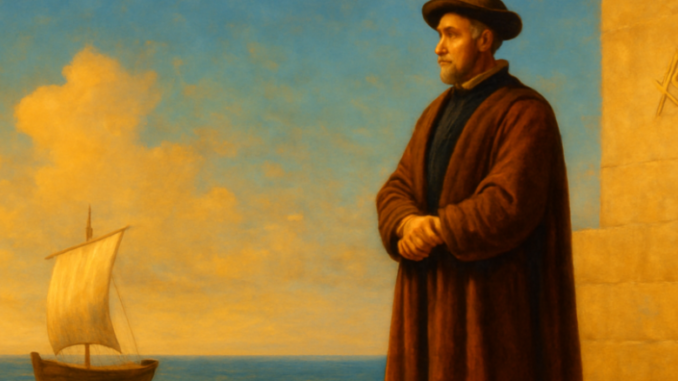
Picture a man seated at a heavy oak writing desk in a tower room overlooking the courtyard of his estate in the Dordogne. The year is somewhere around 1580. Michel de Montaigne leafs through a worn copy of Plutarch, underlining passages with ink and muttering about generals who delayed their decisions until it was too late. From those seemingly casual moments of note-taking emerged an essay that still resonates with anyone who struggles with the urge to put things off. But which thinkers and traditions were whispering in Montaigne’s ear when he composed this short but powerful piece?
Plutarch as Spark and Starting Point
At the heart of the fourth essay from the second book of Montaigne’s Essays lies a warning: those who continually postpone action eventually lose their grip on their own fate. Montaigne drew heavily on the work of Plutarch, the Greek biographer and moral philosopher of the first century. Plutarch’s Lives of the Noble Greeks and Romans offered Montaigne a treasure trove of historical examples in which indecision and delay led to catastrophic consequences. Where Plutarch confronted his readers with commanders who lost battles through hesitation, Montaigne recognized a universal human pattern — the tendency to push the discomfort of action onto an imaginary tomorrow.
What set Montaigne apart was that he did not merely cite Plutarch as an authority. Instead, he used the ancient writer’s anecdotes as a springboard for self-reflection. This was characteristic of the Renaissance humanist method: antiquity served not as unquestionable law but as a mirror for one’s own inner life. Montaigne read Plutarch the way an apprentice studies a master — not to imitate him, but to better understand himself.
The Stoic Call to Action
Beneath the surface of this essay runs a deep Stoic undercurrent. Seneca, the Roman philosopher and statesman, repeatedly emphasized that human beings possess only the present moment. In his Letters to Lucilius, Seneca wrote that procrastination is the most dangerous form of self-deception because it creates the illusion that the future will always be available to us. Montaigne knew these letters intimately and wove Seneca’s core insight into his own argument: whoever invents tomorrow as an excuse robs themselves of the only moment in which real action is possible.
Marcus Aurelius, the Roman emperor-philosopher, also echoes through Montaigne’s reasoning. In his Meditations, Marcus Aurelius insisted that every moment is an opportunity to act virtuously and that death can irrevocably punish every delay. This Stoic urgency — the awareness that life is finite and unpredictable — forms the philosophical backbone of the essay. Montaigne shared with the Stoics the conviction that conscious action in the present is the only honest posture toward the uncertainty of existence.
Skepticism and the Art of Doubt
Yet Montaigne was no orthodox Stoic. His thinking was shaped at least as profoundly by Pyrrhonian skepticism — the philosophical tradition that calls all certain knowledge into question. Sextus Empiricus, the Greek physician and philosopher, provided the intellectual tools with which Montaigne forged his famous motto Que sais-je? (What do I know?). In the essay on procrastination, this skepticism manifests subtly: Montaigne does not judge from the vantage point of absolute moral law but observes human behavior with a blend of gentleness and irony. He knows that he himself is prone to delay, and it is precisely this honesty that gives his argument its power.
His skepticism led Montaigne to avoid any dogmatic claim that procrastination is always wrong. Instead, he used concrete examples to show how delay proved fatal in specific circumstances. This empirical approach — placing lived experience above abstract dogma — made Montaigne a forerunner of modern humanistic thought.
Renaissance Humanism: The Self as an Ongoing Project
The broader intellectual climate in which Montaigne wrote was that of Renaissance humanism. Thinkers like Erasmus and Petrarch had paved the way for a rediscovery of classical antiquity and for a new kind of self-awareness — the idea of the human being as a creature capable of shaping itself through study, reflection, and deliberate choices. This conviction that people are not fixed but can continually improve themselves is precisely what Montaigne conveys in this essay. From that perspective, procrastination is not merely a practical problem; it is a philosophical failure. To postpone is to refuse to work on oneself.
For Montaigne, procrastination is no innocent habit but a philosophical neglect: the refusal to seize the only moment over which you truly have dominion.
The Masonic Echo: Shaping the Rough Stone Now
This humanistic principle finds a remarkable echo in the tradition of Freemasonry. Within the lodge, too, the central idea is that a person is a “rough ashlar” — an unfinished stone that can be brought to a more perfect form through conscious self-improvement. Like Montaigne, Freemasons view personal development not as something that can be deferred until a more convenient moment arrives. The work on the inner temple begins now, or it does not begin at all. The rituals within Freemasonry serve as constant reminders that time is precious and that procrastination is the enemy of genuine growth.
Both Montaigne and the Masonic tradition understand that self-knowledge and self-improvement are not abstract ideals to be contemplated at leisure. They are daily practices, requiring the same dedication and presence that a craftsman brings to shaping stone. Every postponed effort is a missed opportunity to refine the self — to smooth another rough edge, to bring oneself closer to that more perfected form that both the philosopher and the Mason envision.
Aristotle and the Virtue of Resolve
Although Montaigne cited Aristotle less frequently than Plutarch or Seneca, Aristotelian ethics were unmistakably present in the background of his thought. Aristotle taught that virtue is not a state of being but a practice: one becomes just by performing just acts, courageous by making courageous decisions. In this framework, procrastination is the opposite of virtuous action because it blocks the very repetition needed to build character. Montaigne understood intuitively that every postponed action is a missed exercise in becoming the person one aspires to be.
This Aristotelian insight aligns seamlessly with the Masonic emphasis on regularity and ritual. The lodge does not meet once in a lifetime; it convenes repeatedly, because growth demands sustained practice. The Brother who attends, who reflects, who returns to the work again and again, enacts the same principle that Aristotle articulated centuries before Montaigne put pen to paper: character is forged through consistent, deliberate action — never through delay.
Montaigne’s brief essay on procrastination is far more than a warning against putting things off. It is a philosophical tapestry woven from Plutarch’s historical examples, Seneca’s Stoic urgency, the gentle doubt of Pyrrhonian skepticism, and the Aristotelian conviction that virtue demands practice. Underpinning all of this is the Renaissance humanist belief that human beings are works in progress — a belief that finds its living expression in the Masonic tradition of shaping the rough ashlar. The lesson that emerges from these converging traditions is as urgent today as it was in Montaigne’s tower room: the only moment available for self-improvement is this one. Tomorrow is a promise no one can keep.
Copyright text & image: devrijmetselaar.nl
Texts are based on the ideas and content of the author of devrijmetselaar.nl, reviewed, corrected, and supplemented with the assistance of OpenAI. Images are created based on the ideas of the author of devrijmetselaar.nl using OpenAI/DALL-E.
Frequently Asked Questions
What is the main topic of Montaigne's Essay 2.4?
Essay 2.4 addresses procrastination and the human tendency to delay action. Montaigne argues that those who continually postpone their decisions eventually lose control of their fate, drawing on historical examples and philosophical traditions to illustrate how postponement is a form of self-deception that robs us of the present moment.
Which ancient thinkers most influenced Montaigne's essay on procrastination?
Montaigne drew heavily from Plutarch's Lives of the Noble Greeks and Romans for historical examples of commanders who failed through hesitation and indecision. He also drew inspiration from Stoic philosophers, particularly Seneca's Letters to Lucilius and Marcus Aurelius's Meditations, which emphasize that only the present moment is truly available to us.
How did Montaigne use Plutarch's work differently than other Renaissance thinkers?
Rather than citing Plutarch as an unquestionable authority, Montaigne used ancient anecdotes as a springboard for self-reflection. This Renaissance humanist approach treated antiquity not as absolute law but as a mirror for understanding one's own inner life, allowing Montaigne to recognize universal human patterns in Plutarch's historical examples.


Be the first to comment