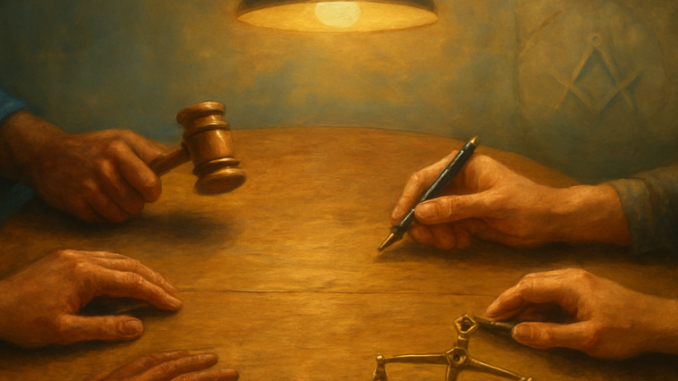
When a foreign government declares your way of working together illegal, it forces an uncomfortable question: is what we consider self-evident truly as universal as we believe? The recent news that the U.S. Department of Justice has deemed certain aspects of the Dutch “polder model” incompatible with American law touches on far more than legal technicalities. It strikes at the very heart of what it means to collaborate, compromise, and share trust — in other words, it strikes at brotherhood, the foundation upon which Freemasonry is built.
A Paradox: Cooperation as a Crime
Here lies the paradox that makes this story so fascinating. In the Netherlands, the polder model is celebrated as a hallmark of civilized society: employers, employees, and government representatives sit down together, weigh competing interests, and arrive at broadly supported solutions. In the United States, that very same kind of cooperation between parties who would normally be competitors can be classified as cartel formation or illegal price-fixing. What one side of the Atlantic calls a virtue, the other calls a crime.
This is not a legal footnote. It is a philosophical riddle about whether brotherhood has boundaries — and if so, who gets to draw them.
Freemasonry has grappled with this tension for centuries. When James Anderson published his Constitutions in 1723, he wrote that a Freemason must obey the laws of the country in which he resides, even when those laws restrict the brotherhood itself. It was a pragmatic choice, but also a candid acknowledgment that universal values cannot always be lived out in the same way everywhere. That tension has never been resolved. Instead, it has been made productive.
Two Visions of Trust
Behind the legal difference lies a deeper philosophical divide about the nature of trust. The Dutch model assumes that parties sitting at the same table are capable of transcending self-interest for the common good. American antitrust law, by contrast, assumes that any cooperation between competitors is potentially harmful unless proven otherwise. The first model trusts in human goodwill; the second distrusts that goodwill as a naïve illusion.
The Scottish philosopher Adam Smith — himself connected to circles that intersected with early Freemasonry — warned in the eighteenth century that whenever merchants gather, the conversation quickly turns into a conspiracy against the public. Yet this same Smith was a passionate defender of moral sentiments, the human capacity for empathy and the ability to act from an understanding of another’s perspective. That duality is not an inconsistency. It is the same duality that every Freemason recognizes within himself: the desire to do good, coupled with the honesty to admit that self-interest never entirely disappears.
Brotherhood as Method, Not Destination
Here lies perhaps the most valuable insight Freemasonry can offer to this debate. Within the lodge, brotherhood is not a state you achieve and then possess. It is a method — a continuous practice. Every ritual gathering reminds the brethren that equality does not come naturally; it must be actively shaped, again and again. The rituals of the three degrees — from Entered Apprentice through Fellow Craft to Master Mason — are not a hierarchical ladder but a training path in tolerating disagreement, listening to the other, and tempering one’s own ego.
Brotherhood is not the elimination of opposition. It is the art of building together despite it.
This definition stands in stark contrast both to the naïve trust sometimes attributed to the polder model and to the systematic distrust that characterizes American competition law. Brotherhood in the Masonic sense is realistic idealism: you know that the other person has his own interests, and precisely for that reason you choose to cooperate based on shared principles. Not because you trust blindly, but because you have learned that the rough stone finds its shape only through collective effort at the chisel.
Lessons from Montesquieu and Spinoza
It is no coincidence that two thinkers of immense value to Freemasonry devoted considerable attention to this very question. Charles de Montesquieu argued in his masterwork The Spirit of the Laws that legal systems cannot be separated from the climate, culture, and history of a people. What is just in one society may prove destructive in another. This is not relativism — it is a call for humility: legislation is the work of human hands and always bears the fingerprints of its makers.
Baruch de Spinoza, the Amsterdam lens-grinder whose ideas on freedom of thought helped shape the Enlightenment, added a different dimension. For Spinoza, the state was only justified insofar as it protected the free development of the individual. When laws criminalize cooperation between people without any actual harm being done, the law loses its moral authority. It is a thought that challenges both the Dutch and the American system: the form of cooperation is not what matters most, but rather whether that cooperation serves the well-being of all.
The Lodge as Laboratory
In a very real sense, every Masonic lodge is a laboratory for exactly this experiment. Within the temple walls, people come together who, outside the lodge, might be competitors, adversaries, or strangers to one another. The physician sits beside the carpenter, the entrepreneur beside the civil servant. What binds them is not a shared economic interest but a shared willingness to work on themselves and to support one another in that work.
It is a model that is neither purely Dutch nor purely American, but one that draws elements from both traditions. Like the polder model, it demands genuine dialogue and the willingness to compromise. Like the American system, it acknowledges the reality of competing interests and refuses to pretend they don’t exist. The lodge does not ask its members to abandon their individuality — it asks them to bring it, fully and honestly, into a space where it can be refined through encounter with others.
This is what makes the Masonic approach so distinctive and so relevant. It does not choose between trust and vigilance. It practices both simultaneously. Every brother enters the lodge as he is — imperfect, self-interested, searching — and submits himself to a process that gently but persistently asks him to become more than he was. That process is brotherhood. And unlike any legal framework, it cannot be imposed from without. It can only be cultivated from within.
The clash between the Dutch polder model and American antitrust law is, at its core, a clash between two conceptions of human nature. Freemasonry offers no verdict in that debate, but it offers something perhaps more valuable: a lived practice that holds both conceptions in creative tension. Brotherhood, as the Craft teaches it, is neither blind trust nor institutionalized suspicion. It is the daily, deliberate choice to work alongside others in the full knowledge of human imperfection — and the quiet conviction that, together, rough stones can be shaped into something enduring. In a world increasingly divided over how people should be allowed to cooperate, that ancient Masonic insight may be more urgent than ever.
Copyright text & image: devrijmetselaar.nl
Texts are based on the ideas and content of the author of devrijmetselaar.nl, reviewed, corrected, and supplemented with the assistance of OpenAI. Images are created based on the ideas of the author of devrijmetselaar.nl using OpenAI/DALL-E.
Frequently Asked Questions
What is the Dutch 'polder model' and why has it been banned in the United States?
The Dutch polder model is a collaborative system where employers, employees, and government representatives work together to reach broadly supported solutions by weighing competing interests. The U.S. Department of Justice has deemed certain aspects of this model incompatible with American law because what the Netherlands considers virtuous cooperation, the U.S. classifies as potential cartel formation or illegal price-fixing between competitors.
How does Freemasonry relate to the polder model controversy?
Freemasonry is fundamentally built on brotherhood, collaboration, and trust — values that lie at the heart of the polder model. The controversy reveals a tension that Freemasonry has grappled with for centuries: whether universal brotherhood values can be lived out in the same way everywhere, or if they must adapt to local laws and customs, as James Anderson's 1723 Constitutions suggested.
What is the philosophical difference between the Dutch and American approaches to trust and cooperation?
The Dutch model trusts that parties sitting together are capable of transcending self-interest for the common good, while American antitrust law assumes that any cooperation between competitors is potentially harmful unless proven otherwise. This reflects two fundamentally different assumptions about human nature: one that emphasizes moral goodwill, and one that views such goodwill as a naive illusion requiring legal restraints.

Be the first to comment