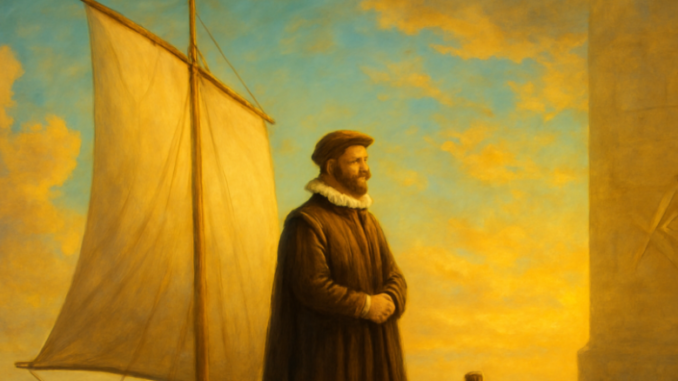
Imagine sitting at your desk, pen in hand, asking yourself what it truly means to write honestly. Not to impress, not to burnish your reputation, but to reveal something genuine about who you are. That is precisely the question Michel de Montaigne wrestled with when he composed his thirty-ninth essay — a reflection on Marcus Tullius Cicero. Behind that seemingly simple question lies a rich web of philosophical traditions, from Stoicism to Renaissance humanism, that connects with surprising directness to the way Freemasons pursue self-knowledge and ethical growth today.
The Question That Drove Montaigne
In his “Consideration upon Cicero,” Montaigne focuses on what appears to be a minor subject: the letters Cicero left behind and the vanity that shines through them. But beneath that critique lies a deeper philosophical inquiry. Montaigne wanted to know: how does a writer relate to his own honesty? Is it possible to speak about yourself without sliding into self-glorification? These questions did not arise from nowhere. They were nourished by decades of reading, reflection, and — above all — by the philosophical traditions Montaigne had absorbed like a sponge in his tower library in the Dordogne.
Seneca and the Stoic Demand for Sincerity
The most direct influence on this essay comes from Lucius Annaeus Seneca. Where Cicero’s letters often revolved around his own political standing and legacy, Seneca wrote his moral letters to Lucilius with an entirely different purpose: to give an honest account of his own inner life. Montaigne admired that Stoic attitude. The Stoa taught that authentic living begins with understanding your own motives. Seneca warned repeatedly against the dangers of vain glory and superficial virtue. Montaigne applied that lesson directly to Cicero, whom he considered far too preoccupied with how the outside world perceived him and far too little concerned with who he truly was.
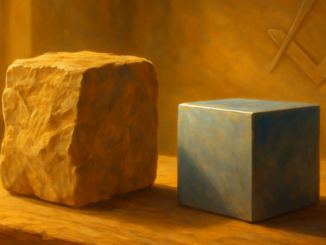
For anyone familiar with the working methods of Freemasonry, something resonates here. Ritual work in the lodge does not call for outward display but for inner honesty. Working the rough ashlar is not meant to impress others — it is meant to refine yourself. That is exactly the distinction Montaigne draws when he places Seneca above Cicero as a letter writer.
Plutarch and the Art of Comparison
Alongside Seneca, Plutarch was a constant companion for Montaigne. Plutarch’s Lives and Moralia offered him a method: by placing two figures side by side, the character of each becomes clearer. Montaigne used precisely this technique when he set Cicero alongside Seneca and also Pliny the Younger. By comparing how each of them wrote about himself, Montaigne revealed not only something about those writers but also something about his own ideal of honest self-expression.
Plutarch also taught Montaigne that virtue need not be abstract. It shows itself in daily choices — in the way you write a letter, address a friend, or process a loss. That practical ethics permeates the essay on Cicero and elevates it beyond a literary exercise. It becomes a guide for anyone who wants to live honestly.
Skepticism as a Liberating Method
Montaigne was also deeply influenced by Pyrrhonian skepticism, the philosophical current that fundamentally questions the human capacity to attain certain knowledge. Through the work of Sextus Empiricus, which became newly available in the sixteenth century, Montaigne learned that dogmatic claims about truth and virtue are always vulnerable. His famous motto “Que sais-je?” (“What do I know?”) reflects that stance.
In the essay on Cicero, this skepticism operates in a subtle way. Montaigne does not condemn Cicero harshly. He observes, weighs, and lets the reader draw conclusions. That method of careful judgment — of suspending definitive pronouncements — is also recognizable in the Masonic tradition. In the lodge, debate is not conducted to win but to understand. Every brother brings his own perspective, knowing that absolute truth lies beyond our grasp.
Anyone who writes honestly about himself, without needing applause, practises the same inner discipline that Freemasonry asks of its members: know thyself — not to be admired, but to become better.
Renaissance Humanism: The Human Being as Measure
Montaigne did not write in a vacuum. He was a child of Renaissance humanism, the broad intellectual movement that placed the human being at the centre and rediscovered classical antiquity as a source of wisdom. Thinkers such as Desiderius Erasmus and Francesco Petrarch had paved the way by venerating Cicero as a stylistic model. Montaigne knew that tradition well but dared to push against it. He valued Cicero’s style yet rejected the vanity that lurked behind it. In doing so, he demonstrated what humanism at its best can achieve: taking the ancients seriously without following them uncritically.
That attitude is directly applicable in daily life. How often do we adopt ideas simply because an authority figure has voiced them? Montaigne invites you to test everything for yourself. Read Cicero, read Seneca, read Plutarch — but with every insight, ask: does this ring true for me? Do I recognize it in my own experience? Only when you take that step does philosophy become more than theory and transform into the art of living.
What You Can Take Away Today
The philosophical background of Montaigne’s essay on Cicero is not only of interest to academics. It offers concrete guidance for anyone who wants to live and communicate more consciously. Here are three steps you can apply right away:
First, write a letter or message to someone without worrying about how you come across. Focus entirely on what you truly want to say, as Seneca did in his letters to Lucilius. Second, practise Plutarch’s method of comparison: when you encounter two opposing viewpoints, hold them side by side before choosing. Notice what each perspective reveals — not just about the subject, but about your own assumptions. Third, embrace the Skeptic’s pause. Before declaring a position with certainty, ask yourself Montaigne’s own question: “What do I know?” That moment of humility can save you from dogmatism and open the door to genuine understanding.
Montaigne’s reflection on Cicero is far more than a sixteenth-century literary critique. It is an invitation — one as relevant today as it was then — to examine how honestly we present ourselves, to value sincerity over spectacle, and to pursue self-knowledge not for admiration but for genuine growth. These are ideals that Freemasons recognize immediately, woven as they are into the very fabric of Masonic work. Whether you are a seasoned brother or simply a seeker of wisdom, the lesson is the same: the truest form of writing, speaking, and living begins with an unflinching look at yourself.
Copyright text & image: devrijmetselaar.nl
Texts are based on the ideas and content of the author of devrijmetselaar.nl, reviewed, corrected, and supplemented with the assistance of OpenAI. Images are created based on the ideas of the author of devrijmetselaar.nl using OpenAI/DALL-E.
Frequently Asked Questions
What is the main philosophical question Montaigne explores in his essay on Cicero?
Montaigne wrestles with the question of how to write honestly about oneself without sliding into self-glorification or vanity. He examines whether it is possible to reveal something genuine about who you are through writing, rather than writing merely to impress or burnish one's reputation.
How does Seneca's Stoicism influence Montaigne's critique of Cicero?
Montaigne was deeply influenced by Seneca's Stoic philosophy, which emphasizes authentic living through understanding one's own motives and warns against vain glory. Where Cicero's letters focused on his political standing and legacy, Seneca wrote moral letters with honest accounts of his inner life. Montaigne applies this lesson to criticize Cicero for being too preoccupied with external perception and too little concerned with inner truth.
What is the connection between Montaigne's ideas and Freemasonry?
The essay's emphasis on inner honesty and self-refinement resonates with Masonic practice. Ritual work in Freemasonry calls for inner honesty rather than outward display, and working the rough ashlar is meant to refine oneself from within—a distinction that directly parallels Montaigne's preference for Seneca's inward-focused authenticity over Cicero's concern with external image.



Be the first to comment