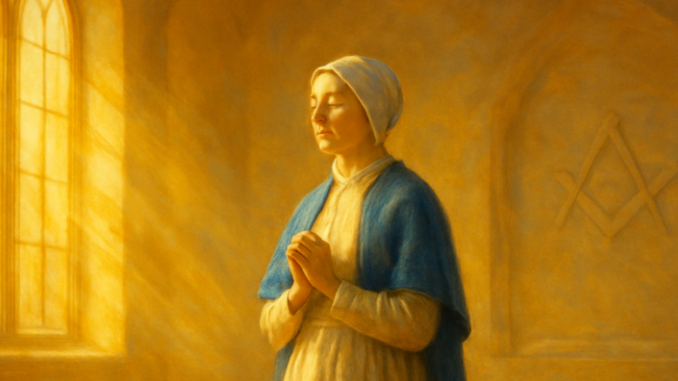
Imagine a room with no altar, no pulpit, no minister. People sit in a circle and say nothing. No one signals the beginning; no one announces the end. The silence is not emptiness — it is a living presence. This is the worship of the Quakers, one of the most radical forms of spiritual gathering in the Western tradition. What makes it especially compelling is that Freemasonry, too, assigns a profound role to silence. Two distinct traditions, centuries of history, and yet a remarkable kinship in the way they approach the inner voice.
The Quakers and Their Silent Worship
The Religious Society of Friends — better known as the Quakers — emerged in mid-seventeenth-century England. Its founder, George Fox, broke radically with the ecclesiastical conventions of his day. He believed that no minister, no sacrament, and no written creed was necessary to encounter the Divine. Every human being, Fox maintained, carried a spark of the divine within — a principle he called the Inner Light.
Silent worship is the practical expression of that belief. When Quakers gather, they take their seats in a simple room, often arranged in a circle or rectangle, without any hierarchical ordering. There is no liturgy, no music, no prepared sermon. The meeting begins the moment the first person sits down and turns inward. The silence is only broken when someone feels that a thought or insight is not meant for them alone, but needs to be shared with the group. That speaking is not rehearsed — it arises from what Quakers understand as the working of the Inner Light.
What Is the Inner Light?
The concept of the Inner Light refers to the conviction that something of the divine is present in every person, regardless of origin, gender, or background. George Fox drew partly on the Gospel of John, which speaks of “the light that enlightens everyone.” But the concept reached well beyond a strictly Christian interpretation. Over the centuries, Quakers have understood the Inner Light in increasingly broad terms: as conscience, as moral intuition, as the quiet voice that offers direction when we are willing to listen.
This conviction had far-reaching consequences. If every person is a bearer of the divine, then the distinction between clergy and layperson collapses. No intermediary is needed. Seventeenth-century Quakers famously refused to remove their hats for anyone, because they believed all people were fundamentally equal before God. This radical egalitarianism made them suspect in the eyes of both Anglicans and Puritans alike.
Silence in Freemasonry
Freemasonry has its own distinct tradition of silence. Within the ritual, silence occupies a role that is both functional and deeply symbolic. The candidate who enters the lodge for the first time does so blindfolded and in silence. This moment of sensory deprivation marks a transition — from the outer world to an inner space. The silence here is not empty; it is charged with meaning. It invites the candidate to listen to what is not being said, to reach beyond words.
During regular lodge work as well, there are deliberate moments of collective silence. The Chain of Union, in which brethren stand hand in hand in shared stillness, is a communal experience of silence that bears a striking resemblance to the Quaker meeting. In both traditions, silence is not the absence of communication — it is its most concentrated form.
Two Worlds Side by Side
At first glance, the Quakers and the Freemasons seem to have little in common. The Quakers are a religious society with roots in Christianity. Freemasonry emphatically does not consider itself a religion, but rather a fraternity open to people of all faiths and philosophies. Yet they share striking common ground when it comes to the role of silence and inner reflection.
Both traditions regard silence not as passivity, but as an active search for insight. Both emphasize that true knowledge comes from within, not imposed by external authority. Both cherish the equality of their members as a foundational principle. And both emerged or were formalized in the seventeenth century — an era of religious and intellectual upheaval.
There are also essential differences. Where the Quaker waits in silence for divine guidance, the Freemason seeks in silence for self-knowledge and moral depth. The Quaker Inner Light carries an explicitly theological charge; the inner work of the Freemason deliberately leaves the nature of the higher open to personal interpretation. The philosopher Baruch Spinoza, a contemporary of George Fox, wrote about a concept of God that might resonate with both Quakers and Freemasons: a divine order not separate from the world, but inseparably woven into it. His thinking on the unity of mind and nature echoes through both traditions, without belonging exclusively to either.
What Both Traditions Teach Us
In an age when silence has become scarce — when every second is filled with information and opinion — both the Quakers and the Freemasons offer a counterweight. They remind us that the most valuable insights often arise when we stop speaking. Quaker silent worship demonstrates that a community can exist without words. Masonic ritual shows that silence can provide a framework for personal transformation.
Silence is not emptiness — it is the space in which the inner light becomes visible, whether we call that light divine or human.
The Quaker Inner Light and the Freemason’s inner work ultimately point toward the same conviction: that every person possesses the capacity to see beyond the surface — provided they are willing to be still. In an increasingly noisy world, both traditions stand as quiet testaments to the power of listening — not to voices outside, but to the one within.
Copyright text & image: devrijmetselaar.nl
Texts are based on the ideas and content of the author of devrijmetselaar.nl, reviewed, corrected, and supplemented with the assistance of OpenAI. Images are created based on the ideas of the author of devrijmetselaar.nl using OpenAI/DALL-E.
Frequently Asked Questions
What is Quaker silent worship and how does it work?
Quaker silent worship is a form of spiritual gathering where people sit together in silence without a minister, altar, pulpit, or prepared sermon. The meeting begins when the first person sits down and turns inward. Silence is only broken when someone feels moved by the Inner Light to share a thought or insight with the group. This spontaneous speaking arises from genuine spiritual conviction rather than rehearsal, reflecting the Quaker belief that every person has direct access to the divine.
What does the Inner Light mean in Quaker theology?
The Inner Light is the Quaker conviction that something divine is present within every person, regardless of their origin, gender, or background. Inspired by the Gospel of John's reference to 'the light that enlightens everyone,' founder George Fox taught that no intermediary or clergy is needed to encounter the Divine. Over centuries, Quakers have understood the Inner Light in broader terms—as conscience, moral intuition, and the quiet inner voice that offers guidance when we listen to it.
How does the Inner Light concept relate to Quaker egalitarianism?
The belief that every person carries the divine within them led to radical egalitarianism in Quaker tradition. If all people are bearers of the divine, then the distinction between clergy and layperson collapses, and no spiritual intermediary is necessary. This conviction had profound social consequences: seventeenth-century Quakers famously refused to remove their hats for anyone, as a symbol of their belief that all people are fundamentally equal before God.


Be the first to comment