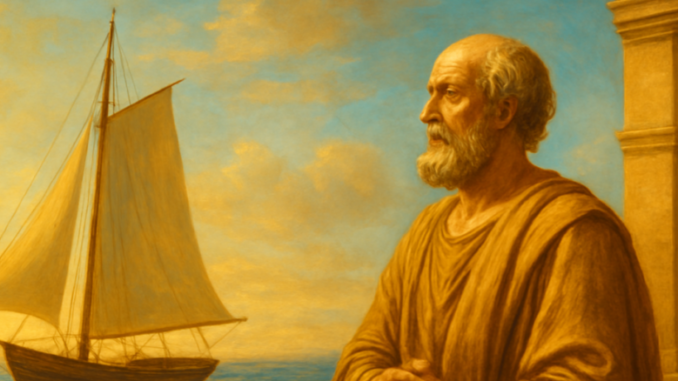
A hammer strikes stone. The sound echoes through a workshop where rough blocks await the hand that will shape them. For Lucius Annaeus Seneca, this was no ordinary scene of craftsmanship — it was an image that cut to the heart of an ancient philosophical debate: is true civilization the work of inventors and builders, or of thinkers who shape the human soul? In his ninetieth letter to Lucilius, Seneca draws a sharp line between technical progress and moral wisdom. That line runs like a thread through the entire Western philosophical tradition, and it touches something deeply familiar to Freemasons.
The Hammer and the Conscience: Seneca’s Central Question
Letter XC revolves around a deceptively simple question: who brought about civilization? Seneca’s interlocutor is the Stoic philosopher Posidonius, who had argued centuries earlier that philosophers stood at the cradle of every great invention, from agriculture to architecture. Seneca pushes back forcefully against this view. For him, the philosopher is not an inventor of tools but a guide to the inner life. The hammer that shapes stone is valuable, but the conscience that directs the hand holding the hammer is infinitely more so.
This distinction is no mere rhetorical exercise. It touches a fault line within the Stoic school itself and reflects broader philosophical tensions that had been raging since classical antiquity.
Posidonius and the Broad Stoa: Wisdom as Universal Principle
Posidonius of Apamea was one of the most versatile thinkers of the Middle Stoa. He combined philosophy with geography, astronomy, and historiography. His vision of civilization’s origins was optimistic and expansive: in the Golden Age, he argued, the first human communities were led by sages who both built houses and established laws. Philosophy and technology, in his view, were two hands of the same body. This perspective aligned with the legacy of Chrysippus and Cleanthes, who had shaped Stoicism as a system in which ethics, physics, and logic were inseparably intertwined.
Seneca acknowledges the greatness of Posidonius but rejects his conclusion. Where Posidonius sees the sage as a universal master builder, Seneca limits the philosopher’s role to the domain of virtue. In doing so, he returns to the stricter views of the early Stoa and to a vision that bears strong kinship with the thinking of Socrates and Plato.
Socrates, Plato, and the Primacy of the Soul
When Seneca argues that technical progress does not truly improve humanity, he echoes a thought that stretches back to Socrates. In Plato’s dialogues — particularly the Gorgias and the Republic — the point is made repeatedly that outward success, material prosperity, and even political power are worthless without inner justice. The craftsman who forges a magnificent sword is not necessarily a good person. The architect who raises a palace may be housing a tyrant.
Seneca consciously places himself within this tradition. For him, the rough stone of human character is the only material the philosopher may work upon. All other construction is secondary. This position carries profound implications for how we view civilization: not as an accumulation of technical achievements, but as an ongoing moral project.
The Cynic Undercurrent: Diogenes and the Rejection of Luxury
There is also a Cynic undertone running through Letter XC that should not go unnoticed. Seneca refers repeatedly to the idea that the earliest humans were happier in their simplicity, before inventions like brick architecture and refined clothing kindled the desire for luxury. This echoes Diogenes of Sinope, the most radical of the Cynics, who regarded every form of civilization as superfluous.
Seneca, however, does not go as far as Diogenes. He does not reject civilization, but he refuses to equate it with wisdom. The difference is subtle but crucial: the Cynic rejects the hammer outright; the Stoic asks what you intend to use it for. Within that question lies an ethic that Aristotle, too, would recognize — for whom virtue was always a matter of right action in the right circumstances.
The Rough Stone and the Masonry of the Soul
It is precisely this distinction between the tool and the purpose it serves that resonates so deeply within Freemasonry. The rough ashlar that occupies a central place in the lodge is never intended as building material for a physical structure. It represents the unworked self — the character that must be shaped through reflection, discipline, and brotherly counsel into a perfect ashlar, fit to take its place in the greater edifice of human community.
Seneca would have endorsed this idea without hesitation. His ninetieth letter is essentially a plea for exactly this type of inner architecture. The hammer, the chisel, the square — these are instruments that gain meaning only when they are employed in the service of moral growth. The philosopher in Seneca’s vision and the Freemason share a common calling: not to furnish the world, but to shape the person who inhabits it.
True civilization is not the building of houses, but the forming of people who are worthy of living in them.
Epicurus as an Unexpected Ally
Remarkably, Seneca also quotes Epicurus in Letter XC — typically the Stoics’ philosophical rival. Epicurus’s emphasis on simplicity and the avoidance of unnecessary desires fits seamlessly into Seneca’s argument in this context. Both share the conviction that the good life is achieved not by multiplying possessions but by limiting desires. It is a rare moment of philosophical rapprochement: the Stoic and the Epicurean find common ground in their distrust of material abundance as a measure of human happiness.
This willingness to look beyond the boundaries of one’s own school is characteristic of Seneca’s thinking. He was no dogmatist but a seeker — someone who valued truth over tribal loyalty. For Freemasons, this open-minded approach will feel familiar. The lodge, too, is a place where men of different backgrounds and convictions meet not to enforce a single doctrine, but to pursue shared principles of self-improvement and moral clarity.
Seneca’s Letter XC remains a powerful reminder that the measure of civilization is not found in its monuments but in the moral character of its people. The rough stone awaits the hand of the builder — but the most important building project is always the one that takes place within. In a world that often confuses progress with accumulation, Seneca’s voice cuts through with a clarity that feels as urgent today as it did two thousand years ago. For the Freemason, the message is unmistakable: we are not called to reshape the world, but to reshape ourselves — and in doing so, to become living stones worthy of the temple we aspire to build.
Copyright text & image: devrijmetselaar.nl
Texts are based on the ideas and content of the author of devrijmetselaar.nl, reviewed, corrected, and supplemented with the assistance of OpenAI. Images are created based on the ideas of the author of devrijmetselaar.nl using OpenAI/DALL-E.
Frequently Asked Questions
What is the main distinction Seneca makes in Letter XC?
Seneca distinguishes between technical progress and moral wisdom. He argues that while tools and inventions like the hammer are valuable for shaping stone and building civilization, the conscience and virtue that direct their use are infinitely more important. The philosopher's true role is to guide the inner life and soul, not to invent tools.
Who was Posidonius and what was his view on civilization?
Posidonius of Apamea was a versatile Middle Stoic philosopher who believed that in the Golden Age, sages both built houses and established laws. He saw philosophy and technology as inseparably connected—two hands of the same body. He argued that philosophers were the originators of every great invention, from agriculture to architecture, representing an optimistic and expansive vision of civilization.
How does Seneca's view connect to earlier philosophical traditions?
Seneca returns to the stricter views of the early Stoa and aligns himself with Socratic and Platonic thinking about the primacy of the soul. By limiting the philosopher's role to virtue rather than universal mastery of all disciplines, Seneca rejects Posidonius's broader approach and emphasizes that true civilization is built on moral wisdom and the development of the human soul rather than mere technical achievement.

Be the first to comment