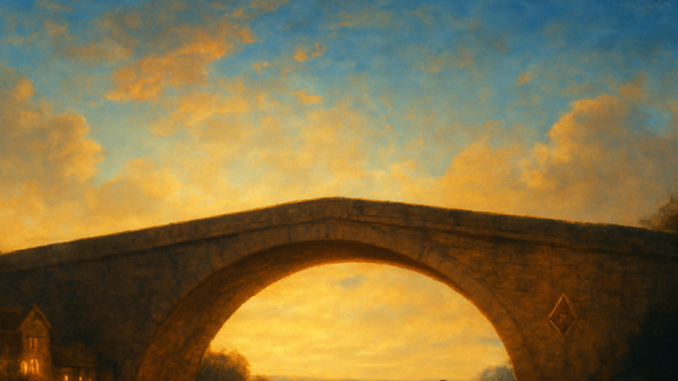
A small country on the edge of Europe is being pulled in two directions. Moldova, wedged between Romania and Ukraine, has been living under geopolitical pressure for years. A prominent Dutch security expert recently warned once again that the Russian president is keeping a close eye on this vulnerable nation. But behind the spotlight of power politics lies a deeper question: what does it truly mean to be brothers, and how do you prevent division from tearing a community apart? That question strikes at the heart of both geopolitics and Freemasonry.
Two Perspectives on a Divided Country
Look at Moldova through the lens of geopolitics, and you see a chessboard. The region of Transnistria has effectively broken away, propped up by Russian support. The rest of the country is orienting itself ever more firmly toward Europe. Power dynamics, spheres of influence, and strategic interests dominate the picture. A security analyst sees troop movements, energy dependencies, and propaganda campaigns. It is a world of opposition, distrust, and calculation.
But there is another way to look at the same country. View it through the eyes of someone who holds brotherhood as a guiding principle, and the picture shifts entirely. You no longer see chess pieces — you see people. Families living on either side of a border they never drew. Villages where Romanian speakers and Russian speakers lived side by side for generations. The question is no longer who wins, but how connection can endure when the world polarizes.
The Geopolitical View: Divide and Conquer
The mechanism of divide and conquer is as old as civilization itself. In the time of the Roman Empire, Julius Caesar described how he played Gallic tribes against each other to consolidate his own power. Centuries later, Niccolò Machiavelli analyzed the same principle in his famous treatise on statecraft. For those in power, division is often more useful than unity — a divided people does not resist. The pressure on Moldova fits this pattern perfectly: by stoking internal tensions, an outside power maintains its grip on a sovereign nation.
This perspective is analytical, cool, and strategic. It explains much, but it offers little hope. Because if the world revolves solely around the balance of power, then brotherhood is a naive illusion. Neighboring countries are not brothers but rivals. Trust is not a virtue — it is a vulnerability.
The Masonic View: Building Unity
Freemasonry takes a fundamentally different view of division. Since its founding years in the eighteenth century, when James Anderson and Jean-Théophile Désaguliers drafted the first Constitutions, the principle of brotherhood transcending origin, language, and religious belief has been central. In an era of religious wars and rigid class structures, this was a radical idea: that people of different backgrounds could come together in one space as equals.
Voltaire, who was initiated as a Freemason in 1778 at the Parisian lodge Les Neuf Soeurs, embodied this ideal. He spent his entire life fighting religious intolerance, championing a world in which reason and mutual respect prevailed. Johann Wolfgang von Goethe, also a Freemason, wrote about the necessity of inner growth as the foundation for a just society. For both men, brotherhood was not a vague sentiment but a workable principle.
Brotherhood is not the denial of difference — it is the conscious choice to build together despite difference.
What Both Perspectives Share
It would be easy to dismiss the geopolitical view as cynical and the Masonic ideal as lofty. But the reality is more nuanced. Both perspectives acknowledge the same truth: that human communities are vulnerable to division. Geopolitics recognizes this as a fact and exploits it. Freemasonry recognizes it too, but formulates a response.
In the rituals of the lodge, a candidate is not welcomed as a perfect human being, but precisely as someone who still has work to do on themselves. The rough ashlar, as described in Masonic tradition, must be shaped into a smooth cube that fits into a greater whole. That greater whole is the temple of humanity — a metaphor for a society in which everyone has a place. It is precisely this idea that becomes relevant when we look at a country like Moldova, where communities risk fracturing along lines reinforced from the outside.
Lessons for Today
What can we learn from placing these two worlds side by side? Geopolitical analysis teaches us sobriety: division is real, power interests are real, and anyone who ignores that becomes naive. But the Masonic perspective teaches us something geopolitics cannot offer — that an ethical choice exists. We do not have to follow the logic of divide and conquer. Every community, every country, and every brotherhood can choose to build bridges instead of walls.
Immanuel Kant wrote in his famous treatise on perpetual peace that lasting peace is only possible when states recognize each other as equals and cooperate on the basis of law rather than power. That thought resonates powerfully with the Masonic ideal. Brotherhood does not demand uniformity. It demands the willingness to see the other as an equal, even when language, culture, or geopolitical loyalty differs.
The Power of Shared Ritual
In times of tension, people seek stability and meaning. Freemasonry offers that stability not through political positions, but through the shared experience of ritual and reflection. Geopolitics analyzes division; brotherhood answers that division with connection. Power-based thinking regards trust as weakness; Freemasonry sees it as a foundation. Divide and conquer is a strategy; building together is a choice.
The lodge room is a space where the noise of the outside world falls silent, where brothers from different walks of life meet as equals, and where the work of self-improvement becomes a model for collective progress. It is not an escape from reality — it is a laboratory for a better one.
Moldova’s struggles are a mirror held up to the world: division is easy, connection is hard. The geopolitical lens helps us understand why countries fracture. The Masonic lens reminds us that fracture is not inevitable. Wherever people choose to see each other not as pawns in someone else’s game but as fellow builders of a shared temple, the logic of division loses its power. Brotherhood is not naivety — it is the most deliberate and courageous answer to a world that profits from keeping us apart.
Copyright text & image: devrijmetselaar.nl
Texts are based on the ideas and content of the author of devrijmetselaar.nl, reviewed, corrected, and supplemented with the assistance of OpenAI. Images are created based on the ideas of the author of devrijmetselaar.nl using OpenAI/DALL-E.
Frequently Asked Questions
What geopolitical challenges is Moldova currently facing?
Moldova is a small country located between Romania and Ukraine that has been under significant geopolitical pressure for years. The region of Transnistria has effectively broken away with Russian support, while the rest of the country is moving toward European orientation. This division reflects broader power dynamics and strategic interests in the region, with external powers attempting to maintain influence over this vulnerable nation.
How does the geopolitical view differ from the Masonic perspective on Moldova's division?
The geopolitical view treats Moldova as a strategic chessboard where power dynamics, troop movements, and spheres of influence dominate. It operates on principles of divide and conquer, where division serves those in power. In contrast, the Masonic view focuses on people and community rather than strategy, emphasizing brotherhood, connection, and unity as solutions to division. While geopolitics sees neighbors as rivals, Freemasonry views them as brothers who can maintain connection despite polarization.
What is the historical basis for the divide and conquer strategy mentioned in the article?
The divide and conquer strategy is traced back to ancient times, with Julius Caesar using it to play Gallic tribes against each other during the Roman Empire. The principle was later analyzed by Niccolò Machiavelli in his treatise on statecraft. The strategy works because a divided people does not resist unified power, making it an effective tool for those seeking to maintain control over a region or nation.



Be the first to comment