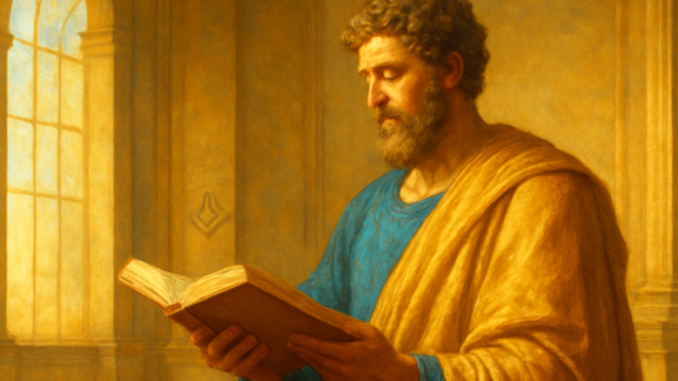
In the year 170 AD, amid grueling military campaigns along the Danube frontier, the Roman Emperor Marcus Aurelius sat down in the solitude of his army tent and wrote some of the most penetrating reflections ever composed on what it means to be connected to our fellow human beings. Book VI of his Meditations, nearly two thousand years later, still speaks powerfully to anyone who contemplates brotherhood, community, and the art of living together.
The Historical Context of Book VI
Marcus Aurelius ruled as emperor from 161 to 180 AD, a reign marked by wars, plagues, and political turmoil. Yet this philosopher-king found time to examine his inner life with remarkable honesty. Book VI was most likely composed during the Marcomannic Wars, when the emperor was confronted daily with the rawest dimensions of human existence — violence, betrayal, and death. It was precisely under these harsh conditions that he developed his deepest insights into human connection.
The Stoic philosophy in which Marcus Aurelius had been educated by teachers such as Junius Rusticus and Apollonius of Chalcedon formed the bedrock of his thinking. The Stoics taught that all human beings are part of a single cosmic community, bound together by the rational faculty that dwells within each of us. This was a radical proposition in a society that drew sharp distinctions between citizen and barbarian, free and slave — and it remains a radical proposition in many ways today.
The Core Idea: Human Beings Are Made for Each Other
The central theme running through Book VI is the fundamental interconnectedness of all people. Marcus Aurelius writes repeatedly that we are “born for one another” and that supporting our fellow human beings is not a burden but the fulfillment of our true nature. He compares humanity to the limbs of a single body: just as a hand cannot refuse to help a foot without damaging the entire organism, so a person cannot ignore the needs of others without harming himself.
“We were born to work together, like feet, like hands, like eyelids, like the rows of upper and lower teeth. To act against one another is contrary to nature.”
This idea has echoed through the centuries in every tradition that places brotherhood at its center. The notion that human beings do not exist as isolated individuals but as parts of a greater whole is a timeless truth — one that is continually rediscovered by those who reflect seriously on community and connection. Freemasons will recognize in these words a resonance with the Craft’s own emphasis on the brotherhood of man and the duty we owe to one another.
Practical Wisdom: Preparing to Meet Difficult People
Marcus Aurelius does not remain in the realm of abstraction. He illustrates his philosophy with concrete examples drawn from daily life. He describes how each morning he mentally prepares himself for encounters with difficult people — the ungrateful, the arrogant, the dishonest. Rather than allowing himself to be irritated by their shortcomings, he reminds himself that they too belong to the same human family. Their faults arise from ignorance, not from malice.
A recurring image in Book VI is the metaphor of the beehive. Just as a bee cannot flourish apart from the hive, a human being cannot thrive without community. What is good for the swarm is good for the individual bee. Marcus Aurelius warns that whoever separates himself from the community cuts himself off from the very source of human happiness.
For those who practice the Masonic virtues of tolerance and charity, this teaching is deeply familiar. The Lodge itself functions as a kind of hive — a place where individuals come together not despite their differences but because of a shared commitment to something greater than themselves.
From Ancient Rome to the Modern Lodge: Enduring Relevance
The lessons of Book VI transcend their historical context. In an age when individualism is often celebrated above all else, Marcus Aurelius reminds us that true fulfillment lies in our relationships with others. His insights resonate with later thinkers who reflected on community and fraternal bonds. Montaigne, who explored the value of human connection in his own essays centuries later, would surely have recognized a kindred spirit in the emperor’s words.
The Stoic emphasis on cosmopolitanism — the idea that all human beings are citizens of the world — finds a powerful echo in every tradition that strives for universal brotherhood. It matters not where a person comes from or what background they carry; the fundamental humanity we share transcends all superficial differences. This principle stands at the very heart of Freemasonry, which has always sought to unite men of every country, sect, and opinion in the bonds of brotherly love.
Inner Transformation as the Key
What makes Book VI especially remarkable is its emphasis on inner transformation rather than external rules. Marcus Aurelius does not prescribe laws or regulations; he advocates a change of perspective. Whoever truly understands that all human beings are connected will naturally move through life with greater patience, understanding, and goodwill. It is not a matter of dutiful compliance but of genuine insight.
He writes that anger toward a fellow human being is as pointless as anger toward one’s own limb. When someone insults or injures us, we should remember that this person acts from a limited understanding of reality. Our response should not be retaliation but instruction and patience — much as an elder brother guides a younger one along the path.
This idea mirrors the Masonic concept of self-improvement through reflection. The rough ashlar is not shaped by external force alone but by the inner commitment of the craftsman to refine himself, day after day, interaction after interaction.
Key Takeaways from Book VI
The essential teachings of Marcus Aurelius in Book VI can be distilled into several guiding principles that remain as relevant today as they were on the banks of the Danube:
Human beings are social creatures by nature, designed to work together rather than in opposition. Humanity forms one body; harm done to another is harm done to oneself. The faults of others arise from ignorance, not from deliberate evil, and should be met with compassion. True wisdom lies in recognizing our mutual connection and acting accordingly. Patience and understanding are the proper responses to human imperfection.
Book VI of the Meditations offers no abstract philosophical system. It is a practical guide for daily life — an invitation to see every encounter, every conflict, and every shared joy in the light of our common humanity. For anyone who regards brotherhood not as a lofty ideal but as a living reality, the reflections of this Roman emperor remain as vital and challenging as the day they were written.
The meditations of Marcus Aurelius in Book VI demonstrate that brotherhood is no modern invention but an insight rediscovered across the ages by anyone who looks honestly at the human condition. In a military tent along the Danube, an emperor set down words that still offer direction to all who seek meaningful connection with others. His message is simple yet demanding: we are made for one another, and every moment of our lives is an opportunity to live that truth. For Freemasons and thoughtful seekers alike, there is no more enduring — or more necessary — lesson.
Copyright text & image: devrijmetselaar.nl
Texts are based on the ideas and content of the author of devrijmetselaar.nl, reviewed, corrected, and supplemented with the assistance of OpenAI. Images are created based on the ideas of the author of devrijmetselaar.nl using OpenAI/DALL-E.
Frequently Asked Questions
What is the main theme of Marcus Aurelius's Book VI of Meditations?
The central theme of Book VI is the fundamental interconnectedness of all people. Marcus Aurelius emphasizes that human beings are born for one another and that supporting fellow humans is not a burden but the fulfillment of our true nature. He uses the metaphor of a body's limbs to illustrate how people cannot ignore the needs of others without harming themselves, as all humans are part of a single community bound by reason.
Under what historical circumstances did Marcus Aurelius write Book VI?
Book VI was most likely composed during the Marcomannic Wars (around 170 AD) while Marcus Aurelius was camped along the Danube frontier. Despite facing grueling military campaigns, plagues, and political turmoil during his reign from 161 to 180 AD, the philosopher-king found time in his army tent to reflect deeply on human connection and brotherhood during these harsh conditions.
How does Stoic philosophy relate to the concept of brotherhood in Book VI?
Marcus Aurelius was educated in Stoic philosophy by teachers such as Junius Rusticus and Apollonius of Chalcedon. The Stoics taught that all human beings are part of a single cosmic community, bound together by the rational faculty within each person. This was a radical idea in Roman society, which distinguished sharply between citizens and barbarians, free and enslaved people, and it remains relevant today as a foundation for understanding universal brotherhood.


Be the first to comment