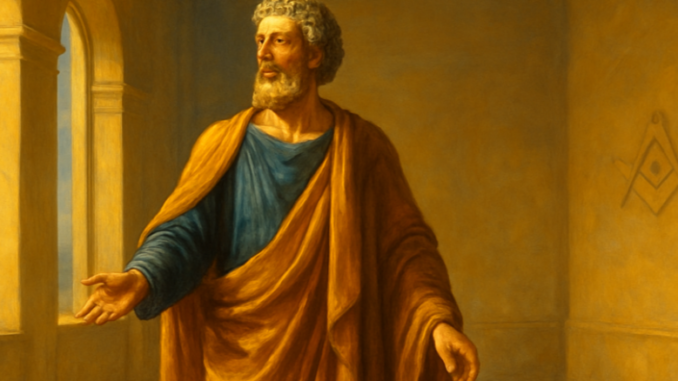
When Marcus Aurelius writes about withdrawing into oneself in the fourth book of his Meditations, he draws on a rich philosophical heritage stretching back centuries before his time. This Roman emperor, who ruled amid wars and plague, found solace in ideas rooted in the early Stoa of Athens. But how do these ancient teachings relate to the Freemason’s quest for self-knowledge? The uninitiated may see nothing more than a historical curiosity; the initiated recognizes a timeless method for inner transformation.
The Stoa: A School Born from Crisis
Around 300 BCE, Zeno of Citium founded his philosophical school in the Stoa Poikile — the painted colonnade of Athens. Greece was in political turmoil following the death of Alexander the Great. The old certainties of the city-state were crumbling. In this climate of uncertainty, Zeno developed a philosophy that placed individual resilience at its center, independent of external circumstances. The Stoics taught that virtue is the only true good, and that while fate lies beyond our control, our response to it does not.
Marcus Aurelius did not inherit this tradition directly from Zeno, but through a chain of thinkers who refined and expanded Stoic doctrine over the centuries. Chrysippus systematized the school’s logic and ethics. Panaetius brought the Stoa to Rome and made it accessible to the Roman elite. Posidonius incorporated elements from other traditions, including Platonic insights about the soul. By the time Marcus Aurelius lived, Stoicism had become the dominant philosophical current among Rome’s ruling class.
Epictetus: The Freed Slave as Master Teacher
No philosopher exerted greater influence on Marcus Aurelius than Epictetus. This former slave, who had been crippled by his master, developed a practical philosophy centered on the distinction between what lies within our power and what does not. His Enchiridion and Discourses, recorded by his student Arrian, served as the direct source for many of Marcus Aurelius’ reflections. The idea of an inner sanctuary where no one can reach us finds its most explicit formulation in the teachings of Epictetus.
The inner retreat is not an escape from the world, but a deliberate choice to act from the very core of one’s being.
Where the outsider might see only passivity or resignation in this ideal of withdrawal, the Freemason recognizes something altogether different. It is not about indifference, but about cultivating an interior space in which sound judgment and virtuous action become possible. Epictetus compared the philosopher to a gatekeeper who determines which impressions gain access to the soul. Marcus Aurelius applied this image to his own life as the administrator of a vast empire — an emperor who needed inner clarity precisely because the stakes of his decisions were so immense.
Seneca and the Art of Returning to Yourself
Alongside Epictetus, Marcus Aurelius drew from the work of Seneca, the Roman statesman and tragedian who lived a generation earlier. Seneca wrote extensively about otium — philosophical leisure — as a counterbalance to the demands of public life. In his Letters to Lucilius, he describes how the wise person can withdraw into their own mind, even amid the bustle of city life. This correspondence, rich in practical advice, provided a model for the kind of self-examination that Marcus Aurelius practiced in his own private notebooks.
Seneca’s essay On the Shortness of Life emphasizes that time is our most precious possession, and that most people squander their lives on matters of no real consequence. This theme resonates powerfully in Book IV of the Meditations, where Marcus Aurelius reminds himself of the transience of fame, possessions, and even the body itself. Both thinkers share the conviction that true wealth consists in the possession of oneself — a principle that any Freemason committed to self-improvement will immediately recognize.
Platonic Echoes in Stoic Thought
Although Marcus Aurelius was primarily a Stoic, his thinking also contains elements that trace back to Plato. The idea that the soul can perceive a higher reality beyond the world of the senses, that there exists an ideal toward which we can strive, echoes through his descriptions of the inner sanctuary. Plato’s Phaedo and Phaedrus, with their imagery of the soul as a prisoner in the body longing for liberation, found their way into the Meditations through the later Stoic tradition.
The Middle Platonists of the first and second centuries — contemporaries of Marcus Aurelius — sought to reconcile Platonic and Stoic insights. Plutarch, whose moral essays were widely read among educated Romans, addressed themes like self-mastery and inner peace from a perspective that honored both traditions. This syncretic intellectual atmosphere explains why the Meditations are not dogmatically Stoic but remain open to insights from related schools of thought. For the Freemason, this openness is familiar: the Craft has always drawn wisdom from multiple philosophical and spiritual traditions, weaving them into a coherent path of moral development.
Two Perspectives on Inner Freedom
How differently do the initiated and the uninitiated view this concept of inner retreat? The outsider might assume it involves escaping responsibility — turning away from the world and its problems. The Freemason, however, recognizes in this practice the necessary precondition for conscious action. Without a moment of reflection, without stepping back from the daily storm, no genuine judgment can be formed. Action without introspection is mere reaction.
The lodge itself functions as a space for precisely this kind of withdrawal. When the door closes and the ritual work begins, the brethren enter a different world — not to flee from reality, but to see it with clearer eyes upon their return. Marcus Aurelius had no lodge, but his daily practice of self-examination served a remarkably similar purpose. Both practices acknowledge a fundamental truth: the outer world can only be truly served when the inner world is properly ordered.
This parallel is no coincidence. The Masonic tradition, with its emphasis on the rough and perfect ashlar, on the transformation of the self through disciplined inner work, shares deep philosophical DNA with the Stoic tradition. Both insist that the unexamined life — to borrow Socrates’ famous phrase — is not worth living. And both provide structured methods for conducting that examination.
The philosophical roots of Marcus Aurelius’ concept of inner retreat reveal a tradition far older and richer than any single thinker. From Zeno’s colonnade in Athens to Epictetus’ humble lecture hall, from Seneca’s study to the emperor’s military tent on the Danube frontier, the same essential insight was refined across centuries: that true freedom begins within. For the Freemason, these ancient teachings are not mere historical artifacts. They are living tools — part of the same perennial quest for self-knowledge, moral clarity, and purposeful action that continues every time a lodge opens its doors and the brethren turn their gaze inward before turning it back toward the world.
Copyright text & image: devrijmetselaar.nl
Texts are based on the ideas and content of the author of devrijmetselaar.nl, reviewed, corrected, and supplemented with the assistance of OpenAI. Images are created based on the ideas of the author of devrijmetselaar.nl using OpenAI/DALL-E.
Frequently Asked Questions
What is the connection between Marcus Aurelius and Stoic philosophy?
Marcus Aurelius inherited Stoic philosophy through a chain of thinkers spanning centuries, including Chrysippus, Panaetius, and Posidonius. While he did not study directly under Zeno of Citium (the founder), Stoicism had become the dominant philosophical current among Rome's ruling class by Marcus Aurelius' time. He was particularly influenced by Epictetus, whose teachings on inner resilience and the distinction between what is within our control and what is not directly shaped Marcus Aurelius' Meditations.
How does the Stoic concept of the 'inner sanctuary' relate to Freemasonry?
The inner sanctuary represents a deliberate choice to cultivate an interior space independent of external circumstances where one can act from the core of one's being with sound judgment and virtue. Freemasons recognize this as more than passivity or resignation—it is a practical method for self-knowledge and inner transformation. Rather than an escape from the world, it is a deliberate withdrawal into oneself to maintain resilience and moral clarity amid life's challenges.
Who was Epictetus and why was he significant to Marcus Aurelius?
Epictetus was a former slave who became a master teacher of Stoic philosophy, exerting greater influence on Marcus Aurelius than any other philosopher. Despite being crippled by his master, he developed a practical philosophy centered on the distinction between what lies within our power (our judgments and responses) and what does not (external events). His works, the Enchiridion and Discourses, served as direct sources for many of Marcus Aurelius' reflections on the inner retreat.

Be the first to comment