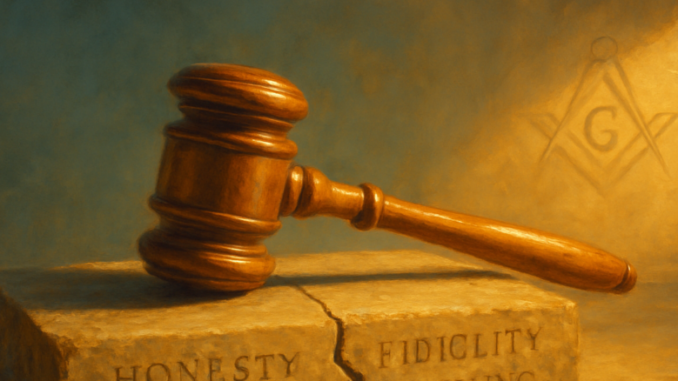
A professional association suspends a dentist over involvement in cage fights organized by neo-Nazis. It sounds like a headline you have to read twice. Yet this case touches on a question far older than today’s news cycle: where do the boundaries of brotherhood lie? And what do you do when someone within your ranks acts in ways that undermine everything your community stands for? It is precisely the question Freemasonry has grappled with for centuries — and for which it has developed remarkably clear answers.
What Separates Brotherhood from Complicity?
Let’s start at the heart of the matter. Brotherhood is a word that evokes warmth: solidarity, trust, mutual support. But brotherhood without ethical boundaries quickly devolves into something else entirely. It becomes a closed front, a wall of silence, a protective structure shielding behavior that cannot withstand scrutiny. That distinction is crucial in this week’s news. A professional body found itself compelled to suspend a colleague — not for a medical error, but for association with a movement that stands diametrically opposed to the fundamental values of human dignity.
The question this raises is not only relevant to dentists or their professional organization. It concerns every organization that considers itself a community. And it certainly concerns Freemasonry, which counts brotherhood among its most essential principles.
Has Freemasonry Ever Faced This Kind of Dilemma?
The short answer: yes, and more than once. The history of Freemasonry shows that the fraternity has repeatedly had to define the limits of membership. When James Anderson published the first Constitutions in 1723, he codified something that was revolutionary for its time: a Freemason is bound by the moral law, regardless of his personal religious beliefs or social standing. That moral law was not a casual recommendation. It implied that anyone guilty of conduct contrary to the fundamental principles of the brotherhood could be removed from it.
During the darkest period of the twentieth century, as National Socialism rose to power in Germany, Masonic lodges were banned and persecuted by the Nazi regime. Freemasonry stood in direct opposition to the ideology of racial hatred and blind obedience. This was no accident. The principles of tolerance, equality, and free thinking made the fraternity a natural enemy of every totalitarian system. Johann Wolfgang von Goethe, himself a Freemason, wrote in the eighteenth century about the importance of a moral compass that does not bend to the will of the crowd. That stance nearly proved fatal for the lodges, but it simultaneously demonstrated the value of a brotherhood that refuses to abandon its principles when doing so becomes dangerous.
Isn’t Exclusion at Odds with the Ideal of Tolerance?
This may be the sharpest question of all. Freemasonry preaches openness, tolerance, and respect for every individual’s conscience. How, then, can it justify excluding someone? The answer lies in a subtle but essential distinction. Tolerance does not mean that everything must be tolerated. There is a profound difference between respecting another’s point of view and tolerating behavior that actively undermines the dignity of others.
The philosopher Voltaire, closely connected to the Enlightenment ideals that shaped Freemasonry, warned that unlimited tolerance ultimately leads to the destruction of tolerance itself. True brotherhood requires the courage to set boundaries — precisely because its foundation, the equal worth of every human being, is non-negotiable.
In Masonic ritual, a candidate is asked during his initiation whether he is willing to improve himself and to contribute to the betterment of society. This is not an empty formality. It is a promise that carries consequences. Anyone who turns against the fundamental principles of human equality breaks that promise. In that context, exclusion is not an act of intolerance — it is an act of faithfulness to the fraternity’s own foundation.
What Can We Learn from This Today?
The case of the suspended dentist exposes something that extends well beyond a single profession. In an era when extremist ideologies sometimes hide behind the language of camaraderie and community, it is essential that organizations take their own values seriously. Not as slogans on a website, but as living criteria with real consequences.
Freemasonry offers a historically tested model here. Its lodges function as workshops for personal growth, but those workshops have rules. These rules are not designed to judge political opinions or religious beliefs, but they do draw a clear line at behavior that violates human dignity. Marcus Aurelius, the Stoic emperor whose writings have inspired many Freemasons, wrote that the value of a community lies not in its size, but in the sincerity with which its members uphold shared principles.
How Does a Lodge Handle a Transgression in Practice?
Unlike a professional association that operates through formal disciplinary law, Freemasonry has its own internal procedures. When a member acts in violation of the fraternity’s principles, the leadership of a lodge or the Grand Lodge can initiate an investigation. This is done carefully and without haste, because an accusation is not yet proof. The individual involved is given the opportunity to be heard. Only after a considered judgment can a sanction follow, ranging from a reprimand to suspension or full expulsion.
What stands out is that this process deliberately mirrors the structure of a fair trial. It reflects a deeply rooted conviction: even when someone has crossed a line, they deserve due process. That conviction is itself an expression of the very same values the fraternity exists to uphold. Justice and fairness do not get suspended just because someone else has fallen short of them.
This internal balance — between protecting the community and treating each individual with dignity — is one of the most underappreciated aspects of Masonic governance. It shows that drawing boundaries and exercising compassion are not opposing forces. When done well, they are two sides of the same coin.
Brotherhood that cannot say “no” is not brotherhood at all — it is complicity dressed in warmer clothing. The strength of any fraternal bond lies not in its unconditional acceptance of all behavior, but in its unwavering commitment to the values that give that bond meaning. Freemasonry’s centuries-long practice of drawing ethical lines while maintaining respect for the individual offers a powerful lesson: true tolerance is not passive. It demands courage, discernment, and the willingness to act when foundational principles are at stake. In a world where extremism increasingly wraps itself in the language of loyalty and belonging, that lesson has never been more relevant.
Copyright text & image: devrijmetselaar.nl
Texts are based on the ideas and content of the author of devrijmetselaar.nl, reviewed, corrected, and supplemented with the assistance of OpenAI. Images are created based on the ideas of the author of devrijmetselaar.nl using OpenAI/DALL-E.
Frequently Asked Questions
What is the difference between brotherhood and complicity in Freemasonry?
Brotherhood in Freemasonry represents solidarity, trust, and mutual support, but it must be built on ethical boundaries. Without these boundaries, brotherhood becomes complicity—a protective structure that shields unethical behavior. True Freemasonry requires that members uphold fundamental values of human dignity and moral law, meaning that actions contrary to these principles can result in removal from the fraternity.
Has Freemasonry ever suspended or removed members for unethical conduct?
Yes. Since James Anderson published the first Constitutions in 1723, Freemasonry has recognized that members bound by moral law can be removed for conduct contrary to the fraternity's fundamental principles. This was not merely theoretical—Masonic lodges were persecuted by the Nazi regime in the twentieth century precisely because Freemasonry's principles of tolerance, equality, and free thinking stood in direct opposition to totalitarian ideologies and racial hatred.
What are the core principles that Freemasonry uses to determine membership boundaries?
Freemasonry's core principles include the moral law, tolerance, equality, free thinking, and human dignity. These principles form the ethical foundation that all members must uphold regardless of personal religious beliefs or social standing. Any conduct that contradicts these fundamental values—such as association with movements promoting racial hatred or totalitarian ideologies—can be grounds for suspension or expulsion from the fraternity.

Be the first to comment