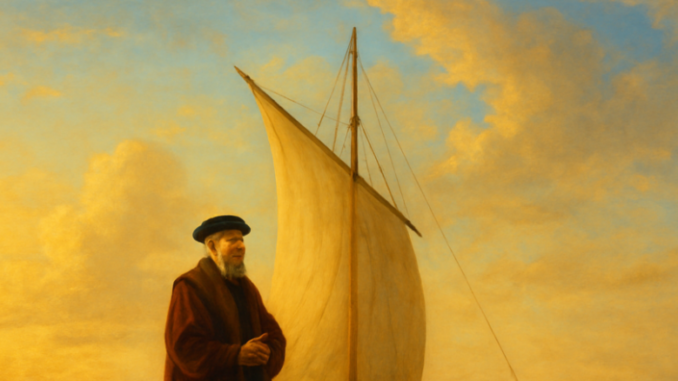
It is late in the evening. Somewhere in a Masonic lodge, a brother sets aside his gloves after the ritual work and takes his seat at the festive board. Wine is poured, toasts are raised. Someone at the table mentions that Michel de Montaigne, the great sixteenth-century essayist, devoted an entire essay to drunkenness. A brief silence falls, followed by a knowing smile. Because anyone familiar with Montaigne knows that he had a gift for uncovering the deepest questions about human nature in the most ordinary of subjects. What follows is a summary and exploration of his essay ‘On Drunkenness,’ the second essay from the second book of his celebrated Essays.
The Heart of the Essay: Temperance as a Virtue
In ‘On Drunkenness,’ Montaigne examines humanity’s relationship with its own weaknesses, using intoxication as his starting point. The essay does not open with condemnation but with a nuanced question: are all human failings equally grave, or do they come in degrees? With this, Montaigne positions himself in a philosophical debate that stretches back to antiquity. The Stoics — Chrysippus and Seneca in particular — considered all vices equally reprehensible. Montaigne distances himself from this view, aligning instead with Aristotle, who argued that virtues and vices differ in degree and context.
Montaigne argues that drunkenness, while an ugly and numbing vice, is in his estimation less harmful than many others. It is a failing that primarily affects the drinker himself, whereas dishonesty, cruelty, or betrayal directly harm others. This ranking is characteristic of Montaigne’s ethics: he consistently weighs the consequences for one’s fellow human beings rather than judging from abstract moral laws.
Historical Examples and Personal Confession
As is his custom throughout the Essays, Montaigne draws freely from classical antiquity. He references the drinking habits of great military leaders and philosophers to show that drunkenness was not considered a mortal sin in many cultures. The Spartans, for instance, deliberately made their slaves drunk so that their children could witness the repulsiveness of excessive drinking. Julius Caesar and Cato the Elder are cited as men who could drink heavily without lasting damage to their reputation or judgment. Montaigne also invokes Plato, who argued that wine in moderate quantities softens the spirit and makes the mind more receptive to education and conversation.
Particularly disarming is Montaigne’s personal confession. He writes that he was never much of a drinker himself and that his stomach could barely tolerate wine. Yet he refuses to condemn the habit outright. He recounts how his father told him of his travels through Germany and Italy, where he encountered vastly different drinking cultures — places where the ability to hold one’s liquor was regarded as a mark of manhood. This anecdote illustrates Montaigne’s core method: he places personal experience and family history alongside philosophical tradition to arrive at a layered, honest judgment.
Self-Knowledge and the Loss of Reason
The central point Montaigne makes touches on a theme that runs through his entire body of work: self-knowledge. For him, drunkenness is not merely a physical phenomenon but above all a moral problem, because it disables reason. The person who is drunk loses the ability to know and govern himself. He becomes a stranger to his own being. Montaigne describes how intoxication clouds the memory, muddles judgment, and undermines the will. Body and mind become uncoupled, causing a person to regress into a state he compares to that of an animal.
Montaigne does not regard drunkenness as the gravest of sins, but he sees it as a treacherous vice that robs a person of his most precious possession: the capacity to know himself. This is a crucial insight. Montaigne is not interested in moralizing about alcohol; his concern is with anything that distracts a person from honest self-examination. In this sense, the essay stands in direct line with the famous motto Montaigne had engraved above his study, borrowed from the Oracle at Delphi: ‘Know thyself.’ Seneca, whom Montaigne quotes frequently, wrote likewise that no progress is possible for anyone who will not face himself honestly.
For Freemasons, this resonance is unmistakable. The injunction to ‘know thyself’ is woven into the very fabric of Masonic philosophy. The rough ashlar that must be shaped into a perfect cube is, at its core, a metaphor for the same inner work Montaigne describes — the ongoing, unflinching effort to confront one’s weaknesses and refine one’s character.
The Paradox of Pleasure and Peril
What makes this essay so compelling is Montaigne’s refusal to pass simple judgment. He freely acknowledges that wine brings joy, enlivens conversation, and can strengthen the bonds between people. The festive board — the shared meal after the work is done — is in many traditions a moment of connection and fellowship. Montaigne invokes the philosopher Epicurus, who taught that pleasure is not inherently reprehensible, provided it does not enslave us. The paradox lies in the fact that the very substance that fosters togetherness can also pave the way to a loss of dignity and self-control.
Montaigne also describes how certain peoples used drunkenness ritually: as a means of pushing boundaries, of speaking truths that are unspeakable when sober, or of creating a temporary equality between ranks. He refers to the ancient Persian custom of making important decisions twice — once while drunk and once while sober. Only when both judgments aligned was the decision ratified. It is a wonderful example of how Montaigne uses cultural relativism to question Western assumptions and certainties.
Why This Essay Still Speaks to Us
‘On Drunkenness’ is far more than a moralistic tract about alcohol consumption. It is an inquiry into the limits of human self-control, the value of temperance as a conscious way of life, and the courage required to acknowledge one’s own weaknesses rather than conceal them. Montaigne holds up a mirror and asks: do you truly know yourself, or are there forces, habits, and appetites that govern you without your awareness?
For anyone on a path of self-improvement — and particularly for Freemasons, who commit themselves to the lifelong work of shaping the inner self — Montaigne’s essay is a quiet but powerful reminder. Temperance is not the same as abstinence. It is the art of remaining present, of keeping reason and self-awareness intact even in moments of ease and celebration. The festive board is richer, the fellowship deeper, when every brother at the table remains truly himself.
Montaigne’s genius lies in his honesty. He does not preach from a pulpit; he sits beside you at the table, glass in hand, and asks the questions that matter. In doing so, he demonstrates what the best Masonic education also aspires to: not rigid doctrine, but the gentle, persistent encouragement to look inward with courage and humility.
Montaigne’s essay ‘On Drunkenness’ endures because it addresses something far more fundamental than the act of drinking. It speaks to the universal human struggle between pleasure and self-mastery, between indulgence and awareness. In the Masonic tradition, where self-knowledge is the cornerstone of all moral architecture, Montaigne’s reflections serve as both a mirror and a compass — reminding us that the truest measure of character is not found in the avoidance of temptation, but in the wisdom to know oneself deeply enough to remain free.
Copyright text & image: devrijmetselaar.nl
Texts are based on the ideas and content of the author of devrijmetselaar.nl, reviewed, corrected, and supplemented with the assistance of OpenAI. Images are created based on the ideas of the author of devrijmetselaar.nl using OpenAI/DALL-E.


Be the first to comment