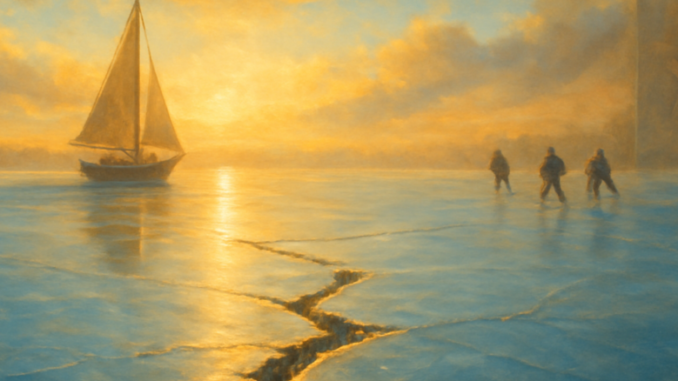
A flawless sheet of ice. Dozens of speed skaters preparing for battle. And then, mid-race, a crack. The ice breaks, the race is halted, and everyone is forced to wait. What follows isn’t chaos — it’s regrouping. After the pause, skaters Groenewoud and Ten Cate go on to win as though the interruption made them stronger. Hidden within that crack in the ice lies a truth that reaches far beyond any skating rink — a truth that Freemasons have practiced for centuries: the art of beginning again after a break, and doing so better than before.
The Ice Beneath Our Feet
We skate through life on surfaces we assume to be solid. The ground beneath our feet feels stable: our careers, our health, our relationships, the social order that supports us. We trust that the ice will hold. But anyone who looks honestly knows that every surface can crack — sometimes subtly, sometimes with a jolt that brings everything to a standstill.
During a mass-start event on November 15th, that reality became literally visible. A crack in the ice forced organizers to halt the race. Skaters who were deep in their rhythm had to stop, wait, and find their focus again. It’s precisely this kind of moment that separates winners from losers. Not speed on the ice, but mental resilience during the standstill determined the outcome.
The Pause as a Workshop
In Freemasonry, the lodge is called a workshop — and that word is chosen deliberately. It’s not a salon where people casually exchange opinions, but a space where inner work is performed. And that work often begins with an interruption: a moment when ordinary life falls silent and space opens up for reflection. The philosopher Blaise Pascal once wrote that all of humanity’s unhappiness stems from our inability to sit quietly in a room. In the lodge, that sitting — that silence — is used as a tool.
Groenewoud and Ten Cate demonstrated what happens when you treat a forced pause not as a loss, but as an opportunity. While others may have lost their focus, they regrouped. In Freemasonry, we call this squaring your actions once more — returning to the core, back to what is right and true, before you set yourself in motion again.
True resilience isn’t the ability to avoid fractures. It’s the willingness to begin again after every crack with more wisdom than you had before.
Cracks in Society
The crack in the ice is more than a sporting incident. It’s a metaphor for what’s happening across our broader society. Our world is constantly showing fractures: economic uncertainty, political division, ecological crises, social inequality. Just like that mass-start race, we are regularly forced to stop and reassess the situation. The question is never whether cracks will appear, but how we deal with them.
The Enlightenment thinkers who stood at the cradle of modern Freemasonry understood this well. Voltaire, himself a Freemason, lived in a time of enormous societal fractures. The old feudal order was crumbling, and new ideas about human rights and citizenship were causing upheaval across Europe. Yet he saw in those fractures not a reason for despair, but an invitation to rebuild. James Anderson’s Constitutions of 1723, the foundational document of speculative Freemasonry, was written during a period of deep religious division in England. The answer was not to deny that division, but to create a space where men of different backgrounds could meet as brothers.
The Japanese Art of Golden Repair
There’s a Japanese tradition called kintsugi, in which broken pottery is repaired with gold. The object isn’t discarded when it breaks. The cracks aren’t hidden — they’re highlighted, making the piece more beautiful and more valuable than it was before. This philosophy aligns seamlessly with the Masonic principle of the rough stone. Every person begins as a rough ashlar: unworked, angular, full of imperfections. The Freemason’s task is to shape that stone — to polish it, to refine it. But that work doesn’t happen without fractures. Every blow of the hammer can cause a crack. The art lies in seeing those cracks not as failure, but as part of the formation process.
Marcus Aurelius, the Stoic emperor-philosopher, wrote in his Meditations that the obstacle becomes the way. What blocks us, shapes us. The crack in the ice ended some skaters’ chances of victory. For Groenewoud and Ten Cate, the obstacle became the path to triumph. That difference doesn’t reside in the legs — it lives in the mind. In the willingness to use the pause as a moment of inner rebuilding.
What the Skating Rink and the Lodge Share
Both demand discipline and preparation, but also adaptability when circumstances change. Both have rules and rituals that provide structure, yet it’s the inner attitude that makes the difference. In both cases, the journey matters more than the destination — the process of falling, rising, and continuing forms the core. And both remind us that no surface lasts forever, and that within that impermanence lies the invitation to grow.
Beginning Again as a Way of Life
Johann Wolfgang von Goethe, Freemason and literary giant, had his Faust declare that “in the beginning was the deed.” But perhaps it’s precisely the other way around: it’s in the re-beginning that true resolve reveals itself. Not the first step onto the ice is the hardest, but the step after the crack. That step requires courage, trust, and the ability to let go of what was.
Our society desperately needs this capacity today. We live in a time when cracks appear faster than ever — in public discourse, in communities, in the trust between people. Freemasonry offers no magic formula to prevent those cracks. What it does offer is a centuries-old practice of meeting them with intention: pausing, reflecting, squaring one’s actions, and beginning again. Not despite the fractures, but through them.
The ice will always crack. That is not a failure of the ice — it is its nature. What matters is what happens in the pause that follows. Will we stand frozen in frustration, or will we use the stillness to regroup, refocus, and return stronger? The skating rink teaches us this. The lodge teaches us this. And life, if we are willing to listen, teaches us this every single day. The crack is not the end of the race. It is the beginning of the real one.
Copyright text & image: devrijmetselaar.nl
Texts are based on the ideas and content of the author of devrijmetselaar.nl, reviewed, corrected, and supplemented with the assistance of OpenAI. Images are created based on the ideas of the author of devrijmetselaar.nl using OpenAI/DALL-E.
Frequently Asked Questions
What does Freemasonry teach about dealing with interruptions and setbacks?
Freemasonry teaches that the lodge is a workshop for inner work, and that interruptions should be treated as opportunities for reflection rather than losses. The concept of 'squaring your actions' means returning to your core values and what is right and true before moving forward again. True resilience isn't avoiding fractures, but beginning again after them with more wisdom than before.
How does the ice skating incident illustrate the connection between mental resilience and success?
During a mass-start event on November 15th, a crack in the ice forced the race to halt. Skaters Groenewoud and Ten Cate won the race by treating the forced pause not as a loss but as an opportunity to regroup and refocus. This demonstrates that mental resilience during a standstill, rather than pure speed, determines the outcome of challenges.
Why is silence and pausing important in Freemasonry practice?
In Freemasonry, the principle of sitting quietly in a room is used as a tool for inner work and reflection. The philosopher Blaise Pascal noted that unhappiness stems from humanity's inability to sit quietly. The Masonic lodge deliberately creates space for this silence, allowing members to disconnect from ordinary life and perform the inner work necessary for growth and wisdom.

Be the first to comment