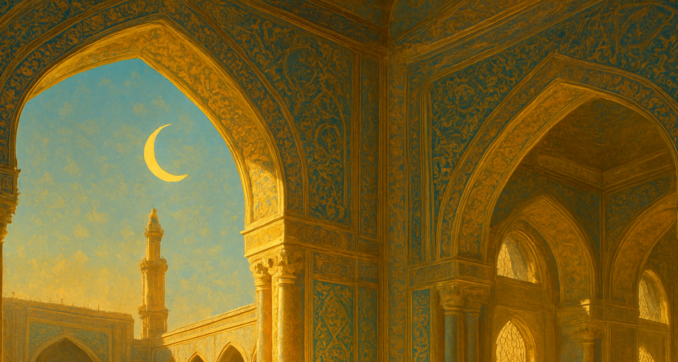
On a clear night, far from the glow of city lights, the sky reveals more than scattered points of light. The stars arrange themselves into patterns that humanity has tried to interpret for thousands of years. In the eighty-fifth chapter of the Quran, known as Al-Burooj — The Constellations — the text opens with a solemn oath sworn by the heaven and its towers of light. This image of an ordered firmament, a kind of cosmic architecture stretched above our heads, speaks to a deep longing that also lives at the heart of Freemasonry: the search for a higher order behind visible reality.
A Gaze Upon the Night Sky
Imagine standing outside, far from any city, as the sky opens above you like an infinite vault. The constellations appear as familiar figures — recognizable patterns against the overwhelming expanse of infinity. This concrete moment, the simple act of looking upward, is the starting point of Surah Al-Burooj. The text begins with a solemn oath sworn by the heaven that possesses towers. Those towers, called “burooj” in Arabic, refer to the great constellations that mark the night sky like celestial fortresses. It is an image that invites us to contemplate the architecture of the universe itself.
The starry sky has never been neutral ground. For the ancient Egyptians, the stars were the dwelling places of the gods. Plato described in his dialogue Timaeus the cosmos as a living being, created by a divine craftsman — the Demiurge — who fashioned order out of chaos. Aristotle saw in the regular movements of celestial bodies the proof of an unmoved mover. And in the Islamic tradition, the stars are seen not only as tools of navigation but as signs pointing toward a creative intelligence. The sky, across all these traditions, is an open book for those willing to read.
The Heart of the Surah: Steadfastness Under Fire
After its celestial opening, Surah Al-Burooj turns to a gripping account of believers who were persecuted for their faith. It speaks of trenches filled with fire into which people were cast, simply because they held fast to their convictions. The text describes how tyrants watched as the faithful burned, and it sets against this scene a powerful counter-truth: true power does not belong to the persecutors, but to the Creator of the starry heavens. The contrast is striking — the unwavering order of the cosmos stands opposed to the cruelty of human tyranny.
Within that contrast lies the surah’s central message. Those who follow their inner compass, who remain faithful to their deepest convictions, find an anchor stronger than any earthly threat. The night sky reminds us that there exists an order greater than human caprice, and that loyalty to one’s inner truth is the deepest form of spiritual strength.
Celestial Architecture and the Inner Temple
The word “towers” in the opening verses is remarkable. The sky is not described as an emptiness, but as a structure — complete with formations that offer orientation and support. For the Freemason, this is a deeply familiar image. The entire tradition of the Craft is steeped in architectural metaphors: the rough ashlar that must be shaped, the Temple of Solomon as an ideal, the compass and square as instruments of inner order. When the Quran describes the heavens as a construction fitted with towers, it touches the same primordial idea: the universe is not a random collection of matter but a purposeful design. And if the cosmos is a building, then the human being is called to erect their own inner temple with equal care and deliberation.
Isaac Newton, who was as much a profound student of biblical texts and cosmic order as he was a physicist, saw in the laws of nature the fingerprints of a divine architect. Johann Wolfgang von Goethe, himself a Freemason, wrote of nature as a veil behind which the divine conceals itself. Both thinkers shared the conviction that the visible world is a gateway to deeper truth. The constellations invoked in this surah function in the same way — they are not ends in themselves but signposts pointing beyond.
Fire as Trial and Purification
The fire in Surah Al-Burooj is more than a historical account of persecution. In virtually all spiritual traditions, fire carries a dual meaning: it destroys, but it also purifies. The alchemists, whose symbolic language is deeply interwoven with Freemasonry, regarded fire as the element that burns away impurities and reveals the essence beneath. In the Masonic ritual, the symbolism of light and darkness plays a comparable role. The candidate who enters the lodge finds himself first in darkness. The moment of illumination — the receiving of the light — marks not the end of the journey but its beginning. The fire of trial, in this sense, is not punishment but an invitation to transformation.
Fire as destruction represents the fear of losing what is familiar. Fire as purification speaks to the burning away of impurities in character and spirit. Fire as light symbolizes the transition from ignorance to insight. And fire as testimony embodies the courage to stand for what one believes — even at great personal cost.
The Witness and the Conscience
A striking detail in the surah is the role of the witnesses. The persecutors are described as spectators to the suffering they themselves caused. This raises an uncomfortable question: what does it truly mean to be a witness? In Freemasonry, the conscience is regarded as the inner witness — the silent observer who sees and judges everything. The ritual reminds the Brother that even when no one else is watching, he is always observed by his own higher self.
Montaigne wrote in his Essays that the conscience furnishes us with a thousand witnesses, even in solitude. The surah seems to touch on the same truth: no act goes unnoticed, for the cosmic order itself bears witness. This is a profoundly Masonic insight — the idea that moral accountability is not merely a social contract but a fundamental law woven into the fabric of the universe.
The Preserved Tablet and the Longing for Eternal Truth
The surah closes with a reference to a “Preserved Tablet” — al-Lawh al-Mahfuz — the concept of an eternal, inviolable record upon which all truth is inscribed. This idea resonates powerfully with the Masonic quest. Freemasonry does not claim to possess ultimate truth, but it does cultivate a deep longing for it. The symbols in the lodge — the Volume of the Sacred Law open upon the altar, the blazing star, the all-seeing eye — all point toward a reality that transcends the material and the temporal.
The Preserved Tablet suggests that beyond the flux and chaos of human history, there exists an unchangeable truth. For the Freemason, this idea mirrors the concept of the Grand Architect of the Universe — not as a dogmatic proposition, but as a symbol of the belief that meaning and order are not human inventions but fundamental properties of existence. The constellations that open the surah are, in this reading, both literal and symbolic: they are patterns in the sky that point to a pattern in reality itself.
Both traditions — the Quranic and the Masonic — invite the seeker not to accept easy answers but to keep looking upward, to keep building inward, and to trust that the cosmos is not indifferent to the human search for meaning.
Surah Al-Burooj and the symbolism of Freemasonry may emerge from different traditions, but they converge on a shared insight: the universe is not chaos but architecture, and the human soul is called to align itself with that greater design. The constellations are more than astronomical phenomena — they are invitations to contemplation, reminders that order, beauty, and truth are woven into the very fabric of existence. Whether one reads the night sky through the lens of scripture, philosophy, or Masonic ritual, the message endures: look upward, build inward, and remain faithful to the light that guides you — even through fire.
Copyright text & image: devrijmetselaar.nl
Texts are based on the ideas and content of the author of devrijmetselaar.nl, reviewed, corrected, and supplemented with the assistance of OpenAI. Images are created based on the ideas of the author of devrijmetselaar.nl using OpenAI/DALL-E.
Frequently Asked Questions
What does 'Al-Burooj' mean and why does the Quran open Surah 85 with an oath about the heavens?
Al-Burooj means 'The Constellations,' and it refers to the great constellations that mark the night sky like celestial fortresses. The Surah opens with a solemn oath sworn by the heaven and its towers of light because the constellations represent an ordered cosmic architecture. This imagery invites contemplation of the universe's structure and reflects the Islamic tradition of viewing stars not only as tools of navigation but as signs pointing toward a creative intelligence.
How do Freemasonry and the Quranic constellations share a common theme?
Both Freemasonry and Surah Al-Burooj share a deep longing for understanding a higher order behind visible reality. The ordered firmament depicted in the Quran—a kind of cosmic architecture—speaks to Freemasonry's search for meaning and order in the universe. This common thread reveals how different spiritual and philosophical traditions have sought to interpret the cosmos as an expression of divine design and wisdom.
What is the central message of Surah Al-Burooj, and how does it relate to the constellations?
The Surah's central message concerns steadfastness under persecution—it describes believers who maintained their faith despite being cast into trenches of fire by tyrants. The key contrast is between the unwavering, eternal order of the cosmos (represented by the constellations) and the temporary cruelty of human tyranny. This juxtaposition emphasizes that true power belongs to the Creator of the starry heavens, not to earthly persecutors.



Be the first to comment