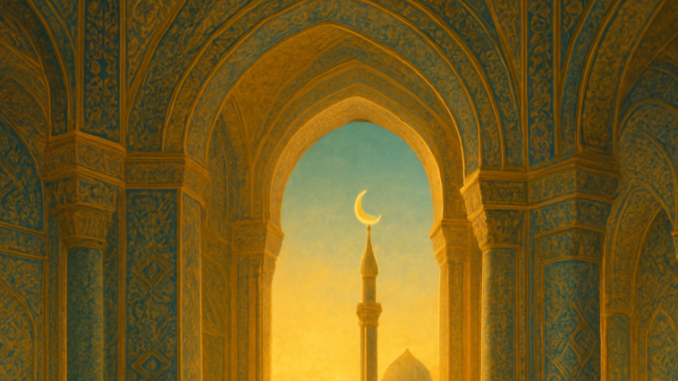
On a clear winter night, they reveal themselves: constellations shining above us in luminous patterns, unchanging yet perpetually rediscovered as the earth turns beneath them. These celestial signs have captivated humanity for millennia. The eighty-fifth surah of the Quran bears their name — Al-Buruj, “The Constellations” — and opens with a solemn oath sworn by the heaven adorned with stars. But what lies behind these cosmic images? And why does this ancient text touch on the very same questions that Freemasons contemplate when they gaze upward at the starry vault in their lodge?
The Firmament as Mirror
Imagine stepping outside on a cold evening and tilting your head back. Above you stretches the vault of heaven, scattered with points of light. Some cluster together, forming figures we recognize as constellations. These are not random groupings — the human eye instinctively seeks order, narrative, structure. The night sky becomes a mirror of our deepest longing: the desire to find meaning in what at first appears chaotic.
This very longing lies at the heart of Surah Al-Buruj. The text opens with a ceremonial reference to the heaven with its towers of light, to the promised day, and to the witness and the witnessed. It is a compact, powerful surah of twenty-two verses that tells of believers persecuted for their convictions, of the trial of steadfastness, and of a divine justice that transcends all earthly power. The constellations here are no astronomical curiosity. They are witnesses — silent sentinels overseeing eternity while humanity below struggles with faithfulness to conscience.
The Trial by Fire and the Unwavering Witness
At the center of this surah stands the story of the People of the Trench. Believers were tested by rulers who demanded they renounce their faith. The text describes how those who held firm were not broken by the flames. The fire here is not merely physical — it is a symbol of every trial a person may endure when holding fast to what they believe to be true and just, even when the world pressures them to bend.
This theme of trial by fire resonates deeply with philosophical traditions that also play a significant role in Freemasonry. The Stoic philosopher Marcus Aurelius wrote in his Meditations that fire does not destroy what it touches but transforms it. For the Stoics, adversity was not punishment but an opportunity to demonstrate inner strength. Spinoza, who in his Ethics regarded reason as the highest good, likewise emphasized that true freedom is not the absence of coercion, but the ability to remain faithful to one’s own insight — even under duress.
The Starry Vault in the Lodge
Anyone who has ever entered a Masonic lodge recognizes the image immediately: the ceiling is often painted as a night sky, strewn with stars. This starry vault is no mere decoration. It reminds the Freemason that his work takes place beneath the infinite canopy of the universe, that his search for truth is part of a cosmic order greater than himself. Just as the Quran swears by the heaven full of constellations, so Freemasonry places the human quest within a celestial framework.
The parallel runs deeper than the visual. In Masonic ritual, light plays a decisive role. The candidate begins his journey in darkness and moves step by step toward the light. This transition from dark to light mirrors precisely the dynamic of Surah Al-Buruj: out of the darkness of persecution and trial rises the light of steadfastness and inner conviction. These are the same archetypal movements humanity has recognized since antiquity, whether in the Greek Mysteries of Eleusis, Plato’s allegory of the cave, or the initiatory journeys of Freemasonry.
The constellations in the Quran and the starry vault in the lodge tell the same story: that a person truly finds light only when they remain steadfast in the darkness of trial.
Fidelity as a Building Block of Conscience
Surah Al-Buruj poses a sharp question: what do you do when your faith, your convictions, or your moral compass is put to the test? The answer the text offers is not vengeance or violence, but perseverance and trust in a higher justice. The believers in the story do not resist with weapons. Their strength lies in their fidelity to what they experience as truth.
In Freemasonry, this inner fidelity is symbolized by the rough ashlar that must be worked into a perfect cube. It is a process that demands effort, chiseling and grinding, but that ultimately produces something worthy of a greater edifice. Just as the Master Builder Hiram Abiff, according to Masonic tradition, chose death rather than betray the secrets of his craft, so Surah Al-Buruj shows that there are moments when loyalty to inner knowing outweighs self-preservation. This theme runs through religious and philosophical traditions alike.
Shared Values, Different Languages
It would be wrong to claim that the Quran and Freemasonry say the same thing. They do not. The Quran is a sacred book within a religious tradition; Freemasonry is a brotherhood dedicated to moral and spiritual development without binding itself to any particular creed. But it is precisely in that difference that something beautiful emerges: both speak of the same human experiences — courage, integrity, the search for light, and the endurance of darkness — only in a different language.
The great thinker Johann Wolfgang von Goethe, himself a Freemason, once wrote that in all sacred writings one can recognize the reflection of the same eternal truth. Not because all religions are identical, but because human beings everywhere grapple with the same fundamental questions: Who am I? What do I owe to truth? And how do I remain upright when the storm rages?
The constellations above us have witnessed every generation’s struggle with faith, conscience, and courage. Whether read in the verses of Surah Al-Buruj or contemplated beneath the painted starry vault of a Masonic lodge, their message endures: true light is not found by avoiding darkness, but by standing firm within it. In the end, both traditions invite us to look upward — not to escape the trials of the human condition, but to remember that our search for truth is woven into the very fabric of the cosmos.
Copyright text & image: devrijmetselaar.nl
Texts are based on the ideas and content of the author of devrijmetselaar.nl, reviewed, corrected, and supplemented with the assistance of OpenAI. Images are created based on the ideas of the author of devrijmetselaar.nl using OpenAI/DALL-E.
Frequently Asked Questions
What is Surah Al-Buruj and why is it significant in the Quran?
Surah Al-Buruj, meaning 'The Constellations,' is the eighty-fifth chapter of the Quran. It is a twenty-two verse surah that opens with a solemn oath sworn by the heaven adorned with stars. The surah is significant because it tells the story of believers persecuted for their convictions, emphasizing themes of trial, steadfastness, and divine justice. The constellations mentioned are not merely astronomical references but serve as silent witnesses to human faithfulness and divine eternity.
How do constellations function symbolically in both the Quran and Freemasonry?
In both traditions, constellations represent more than just celestial objects. They serve as mirrors of humanity's desire to find meaning and order in the universe. The starry vault becomes a symbol of divine witness and cosmic order. In Freemasonry, gazing at the starry vault in the lodge reflects the same contemplative practice of seeking spiritual understanding and connection to the transcendent that is found in Quranic references to the constellations.
What is the significance of the 'trial by fire' mentioned in Surah Al-Buruj, and how does it connect to philosophical traditions?
The trial by fire in Surah Al-Buruj describes believers who remained steadfast in their faith despite persecution and threats. The fire symbolizes any trial or adversity a person endures when holding fast to their beliefs and convictions. This theme resonates with Stoic philosophy, particularly Marcus Aurelius's concept that fire transforms rather than destroys, and with Spinoza's emphasis on reason as the highest good. These philosophical traditions align with Masonic teachings about inner strength and moral character development through adversity.

Be the first to comment