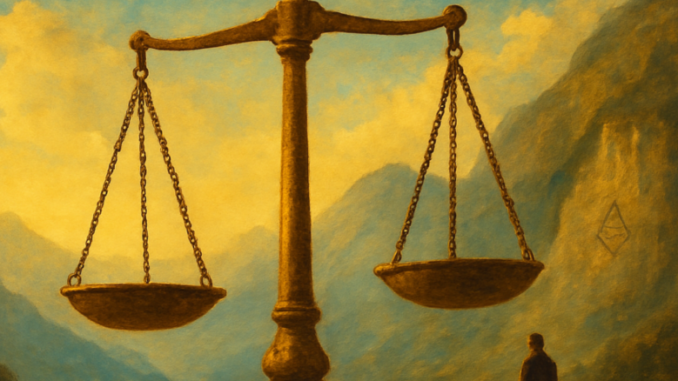
Can justice truly be served when the person held responsible is no longer alive? A recent case in Amsterdam — where a fatal accident at a climbing gym led to a trial that has now stalled due to the death of the gym’s owner — forces us to confront a deeply uncomfortable tension. Society demands closure, a verdict, a sense that justice has been done. But what does justice mean when the accused is no longer present to receive it? This question strikes at the heart of what Freemasonry teaches us about fairness, mortality, and the inherent limits of human judgment.
The Paradox of a Deferred Verdict
Our legal system is built on a foundational principle: the accused must face the charges against them, must be given the opportunity to mount a defense, and must be present to accept or challenge the verdict. When that person dies, the very foundation crumbles. In the Amsterdam climbing gym case, the appeal process cannot continue because the defendant simply no longer exists to participate in it. The victim’s family is left with an incomplete procedure — a deferred judgment that may never arrive.
This raises a profound question: is justice merely a transaction between living parties, or is it a larger principle that transcends the individuals involved? Aristotle distinguished between distributive and corrective justice in his ethical works. The first distributes goods and burdens fairly; the second restores what has been distorted by wrongdoing. But both forms presuppose that there are parties to receive or to make whole. What remains when one party vanishes entirely?
Freemasonry and the Measure of Righteousness
Within Freemasonry, justice holds a central place — but in a way that diverges significantly from legal thinking. The square, one of the Craft’s most recognizable symbols, represents rectitude: the capacity to act rightly in all circumstances, regardless of whether anyone is watching or judging. This is not a form of justice that depends on a courtroom or a sentence. It is an internal standard, an ethical compass that each Mason carries within.
True justice is not a punishment imposed from without, but an equilibrium pursued within one’s own conscience.
Marcus Aurelius wrote in his Meditations that we have no control over the actions of others — only over our own responses and choices. This Stoic insight resonates deeply with the Masonic understanding that justice is primarily a matter of personal integrity. Society can pursue institutional justice through its courts and procedures, but the deepest form of righteousness unfolds in the heart of the individual — even when that individual can no longer be called to account.
The Human Need for Closure
Yet there is something deeply unsatisfying about leaving the matter at philosophical abstraction. The victim’s family is not only seeking inner peace — they are seeking public acknowledgment of the wrong that was done to them. A trial serves not only to punish but also to recognize. It establishes an official narrative in which guilt is assigned and responsibility is affirmed. When that process is cut short, a painful void remains.
Montaigne, whose essays have inspired reflection on this site before, wrote extensively about the arbitrariness of fate and humanity’s inability to fully control the outcomes of its endeavors. A trial that never reaches its conclusion is a stark reminder of that fundamental uncertainty. Death respects no court calendar, no human need for closure, no sense of fairness. This is a hard truth, difficult to accept, but one that Freemasonry teaches us we must face squarely — pun, perhaps, intended.
Beyond the Verdict: Alternative Paths to Justice
Perhaps situations like these compel us to think about justice beyond the verdict. Are there other ways that right can be done when the formal legal path has been closed off? Many cultures and traditions practice forms of restorative justice, where the focus shifts from punishment to the healing of relationships and communities. Freemasonry, with its emphasis on brotherhood and mutual support, offers a framework in which justice can also be understood as a collective responsibility.
This does not mean that the death of the accused undoes the wrong that was committed. It does mean, however, that the community — society at large — can step in to care for those left behind, to improve the conditions that led to the accident, and to learn and prevent. Justice then ceases to be an endpoint and becomes an ongoing process of attention, accountability, and improvement.
The Unresolved Question
The climbing gym case leaves us with more questions than answers. Can there be justice without a living person to hold responsible? Is the need for a verdict ultimately a need for control over what is inherently uncontrollable — the randomness of life and death? And when the formal legal system falls short, what responsibility falls upon us as a community to fill the void it leaves behind?
Freemasonry offers no definitive answers to these questions, but it does offer a method: the willingness to face difficult questions honestly, to reflect on one’s own conduct, and to strive for a form of justice that begins in the personal and radiates outward into the social. Perhaps that is the only justice truly within our reach — regardless of the outcome of any particular trial.
The stalling of this appeal due to the gym owner’s death is more than a legal obstacle. It is a mirror that confronts us with the limits of our desire for justice and closure. Freemasonry invites us to look beyond the verdict — to recognize that while courts may reach their limits, our personal and collective pursuit of righteousness need never be adjourned. The square reminds us that the measure of justice we apply to ourselves is the one that matters most, and it is the one that death can never take from us.
Copyright text & image: devrijmetselaar.nl
Texts are based on the ideas and content of the author of devrijmetselaar.nl, reviewed, corrected, and supplemented with the assistance of OpenAI. Images are created based on the ideas of the author of devrijmetselaar.nl using OpenAI/DALL-E.


Be the first to comment