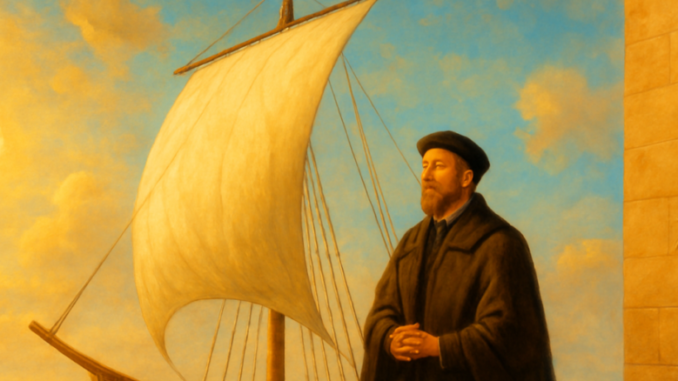
What if the deepest truth about human nature is our own inconsistency? Michel de Montaigne wrote about it more than four centuries ago, yet his observation strikes a nerve that resonates powerfully within Freemasonry. This article is not a dry treatise — it is a conversation at the table, with questions that matter and answers that invite further thought.
Why Should a Freemason Read Montaigne?
The question may seem odd at first. Michel de Montaigne was not a Freemason. He lived in the sixteenth century, well before the founding of the first Grand Lodge in 1717 under the guidance of figures like James Anderson and Jean Théophile Desaguliers. Yet Montaigne was very much a kindred spirit. His entire life’s work revolved around self-reflection — the honest examination of one’s own soul. And isn’t that precisely what a Freemason does when he enters the lodge? The first tool the Mason learns to use is not the gavel or the square, but the mirror of his own conscience.
In his essay “Of the Inconsistency of Our Actions,” Montaigne observes that human beings are fundamentally fickle. We act with courage today and cowardice tomorrow. We are generous at breakfast and miserly at supper — not because we are wicked, but because we are composed of contradictions. This observation is not a cynical verdict. It is an invitation to gentleness, to suspending our quick judgments of others and of ourselves.
If We Are So Inconstant, Does Virtue Still Matter?
This is the central question Montaigne’s essay raises, and it is extraordinarily relevant to Freemasonry. The entire Masonic tradition is built on the pursuit of moral perfection. The rough ashlar must be shaped into a perfect cube. But what if that stone keeps shifting its form? What if yesterday’s careful work already shows cracks today?
Montaigne would answer that this is precisely where the value lies. Working the stone is not a one-time project with a finished result. It is an ongoing process, a daily exercise. Aristotle wrote that virtue is not a state but an activity — a habit that must be practiced continuously. Montaigne radicalizes that insight by showing that even habit cannot fully protect us from contradiction. We must choose again and again, moment by moment.
The inconstancy of the human being is not a failure. It is the starting point of all genuine self-reflection and true brotherhood.
What Does Inconstancy Have to Do With Brotherhood?
Here we touch on something essential. Brotherhood in Freemasonry is not based on the idea that all Brethren are perfect. Quite the opposite. It is precisely because every human being falls short, precisely because we are all creatures of contradiction, that we need one another. The lodge is a space where imperfection may be acknowledged without condemnation. This stands in stark contrast to many social settings where inconsistency is seen as weakness and punished without mercy.
Montaigne understood this deeply. His famous friendship with Étienne de La Boétie was built on exactly that foundation: complete honesty about one’s own flaws, combined with unconditional connection. “Because it was he, because it was I,” Montaigne wrote of their bond. There was no condition, no demand for consistency. There was acceptance of the whole person, contradictions and all.
Self-Reflection and the Search for Light
Freemasonry speaks of the search for light and knowledge. But what kind of light do we actually mean? It is not an external revelation handed down from above. It is the light that emerges when someone dares to look at himself honestly. Montaigne was a master of this. His motto — “Que sais-je?” (What do I know?) — was not an expression of nihilism but of intellectual honesty. What do I truly know? What do I know about my own drives, my own motives?
Socrates, who turned Greek philosophy on its head with his declaration that he only knew that he knew nothing, would have recognized Montaigne as a fellow traveler. Freemasonry stands in that same tradition. The ritual is not designed to provide answers but to raise questions. The true seeker is not the one who arrives at a destination but the one who keeps walking, knowing that the path winds and that he himself will change along the way.
The Ethical Heart: Suspending Judgment
One of the most practical lessons Montaigne’s essay offers the Freemason is the discipline of suspended judgment. If we acknowledge that we ourselves change from moment to moment, how can we pass a definitive verdict on another person? Marcus Aurelius wrote in his Meditations that we should consider how much we ourselves have changed over the course of our lives before condemning a fellow human being. Montaigne adds that such change does not only occur between life stages — it happens from hour to hour.
For brotherhood within the lodge, the implications are immediate. When a Brother says or does something that surprises or disappoints us, Montaigne invites us to take a step back. Not to excuse everything, but to understand that this Brother — just like ourselves — is a shifting interplay of moods, insights, and impulses. Real connection does not arise in spite of these fluctuations but through them.
What Remains When Everything Changes?
If everything shifts, if we constantly contradict ourselves, what then is the fixed point? Montaigne would say: the striving itself. The willingness to look again, to practice again, to reach out to the other once more. Freemasonry calls this the perpetual labor on the rough stone. It is work that is never finished. It is a way of life.
And perhaps this is the deepest connection between Montaigne and the Masonic tradition. Both refuse the illusion of perfection. Both embrace the process over the product, the journey over the arrival. In a world obsessed with certainty and final answers, both Montaigne and Freemasonry offer something far more honest — and far more human: the courage to remain a work in progress.
Montaigne never wore an apron or stood in a lodge, yet his philosophy speaks directly to the Masonic heart. His unflinching honesty about human inconstancy is not a counsel of despair — it is a call to compassion, to humility, and to the kind of brotherhood that does not demand perfection but embraces the whole, imperfect human being. The next time you pick up your working tools, remember: the rough stone was never meant to become flawless. It was meant to be worked, with patience, with honesty, and always in the company of Brothers.
Copyright text & image: devrijmetselaar.nl
Texts are based on the ideas and content of the author of devrijmetselaar.nl, reviewed, corrected, and supplemented with the assistance of OpenAI. Images are created based on the ideas of the author of devrijmetselaar.nl using OpenAI/DALL-E.
Frequently Asked Questions
Why should a Freemason study Michel de Montaigne if he wasn't a Freemason?
Although Montaigne lived in the sixteenth century before Freemasonry's formal founding in 1717, he was a kindred spirit who centered his life's work on self-reflection and honest examination of one's soul—the very same mirror of conscience that Masons use when entering the lodge. His insights into human nature are deeply relevant to Masonic practice and self-improvement.
If humans are fundamentally inconsistent, does pursuing virtue still matter in Freemasonry?
Yes. According to Montaigne and Aristotelian philosophy, virtue is not a final state but an ongoing activity and habit that must be practiced continuously. The rough ashlar's transformation into a perfect cube is not a one-time project but a daily exercise. Inconstancy is not a failure but the starting point for genuine self-reflection and the foundation upon which true brotherhood is built.
How does understanding human inconstancy strengthen Masonic brotherhood?
Recognizing that all humans are composed of contradictions—capable of both courage and cowardice, generosity and miserliness—invites gentleness and suspends quick judgment of others and ourselves. This understanding fosters compassion and authentic connection among brothers, making brotherhood not about perfection but about shared acknowledgment of our mutual human complexity.


Be the first to comment