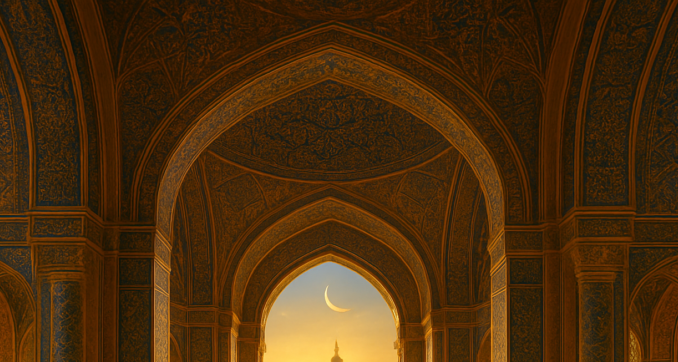
In 632 CE, the Prophet Muhammad passed away in Medina, leaving behind a body of scripture that continues to inspire billions of people to this day. Among the 114 surahs of the Quran lies a remarkable chapter that opens with an oath sworn upon the scattering winds. This fiftieth surah, known as Adh-Dhariyat, speaks of cosmic forces, divine providence, and the sacred duty of hospitality. For Freemasons — seekers who look for universal spiritual truths across all traditions — this ancient text offers surprising and illuminating parallels with their own pursuit of light and moral elevation.
A Historical Glimpse: Life Among the Desert Winds
The Arabian desert of the seventh century was a world in which the wind was far more than a meteorological phenomenon — it was a force that governed life and death. Caravans depended on intimate knowledge of wind patterns, and seasonal gales brought both blinding sandstorms and merciful relief from the heat. When the opening verses of this surah speak of “the winds that scatter” and “the clouds that carry water,” the first listeners understood immediately. These words pointed to an invisible yet omnipresent power that shaped every dimension of their existence.
These verses were not revealed in a vacuum. The early Muslim community was wrestling with profound questions about providence, the justice of fate, and the meaning of suffering. The surah answers these questions not with abstract theology but with vivid imagery drawn from nature. It is an approach we also find among the Greek Stoics — Marcus Aurelius, for instance, who in his Meditations likewise treated the natural order as a school for the human soul. Nature as teacher, the cosmos as moral classroom: this is an idea that transcends any single religious tradition.
The Heart of Adh-Dhariyat: Scattering and Hidden Order
The surah opens with four powerful oaths: by the winds that scatter, by the clouds that bear their burden, by the ships that glide with ease, and by the angels that distribute all affairs. These four form a cosmic hierarchy of forces, all operating under divine direction. The central theme is unmistakable: behind apparent chaos lies a deeper order. What seems random to the human eye — sand dispersed by wind, clouds drifting in and out of view — follows a design that mortals can only partially fathom.
The scattering winds remind us that we do not need to understand everything in order to trust in a greater coherence. This is a powerful insight, and one that resonates deeply with the Masonic experience of working with symbols whose full meaning may only unfold over the course of a lifetime.
Further into the surah, the focus shifts to the story of Abraham and his angelic guests. This narrative, which also appears in the Hebrew Bible, presents the patriarch as the epitome of hospitality: he rushes to prepare a fattened calf for his unknown visitors without hesitation or question. The lesson is clear — true spirituality does not manifest in words alone, but in concrete acts of service toward others.
Freemasonry and the Wind as Symbol
For Freemasons, the image of the wind immediately evokes the invisible forces that are nonetheless powerfully at work. In Masonic ritual, “light” is the most familiar metaphor for knowledge and insight, but the wind can serve equally well as a symbol for the spirit that blows where it will. The eighteenth-century Enlightenment thinkers who helped shape modern Freemasonry — among them Voltaire and Goethe — were fascinated by the tension between the visible and the hidden, between reason and mystery.
The scattering winds of this surah call to mind a core Masonic conviction: that the building blocks of a good life are often invisible. Character, integrity, brotherly love — these are forces that cannot be weighed or measured, yet they form the very foundation upon which a just society rests. Just as the wind carries seeds that bloom in distant places and future seasons, the Freemason spreads ideals that may not bear fruit until generations later.
Abraham as a Model of Brotherhood
The story of Abraham’s hospitality, which occupies a central place in this surah, resonates deeply with the ethics of the Craft. In the lodge, hospitality is not treated as optional politeness — it is a fundamental duty. Welcoming the stranger, offering rest to the traveler, greeting the newcomer with genuine warmth: these are concrete expressions of the fraternal ideal. Abraham, revered as a patriarch in the Islamic, Jewish, and Christian traditions alike, transcends religious boundaries and stands as a universal symbol of selfless service.
Consider the principles embedded in Abraham’s example: hospitality expressed through action rather than mere words; treating unknown visitors as potential brothers; serving without expectation of reward; and recognizing the sacred in the everyday. Every one of these principles finds a direct counterpart in Masonic teaching. The Entered Apprentice who first crosses the threshold of the lodge experiences precisely this kind of unconditional welcome — a welcome that echoes across millennia.
From Ancient Desert to Modern Lodge: What Can We Learn Today?
A natural question arises: what does a seventh-century text about desert winds have to say to a modern seeker? The answer lies in the universality of its themes. We, too, live in a world that often seems chaotic — a world in which information rages over us like sandstorms and coherence often feels impossible to find. The surah invites a kind of contemplative trust: the conviction that behind apparent randomness there exists an order that humanity cannot always comprehend but can always serve.
For the Freemason, this is not passive resignation. It is a call to action. When you believe that your actions form part of a greater whole, you approach the work of shaping your own “rough ashlar” with greater care and intentionality. The scattering winds become a metaphor for the dissemination of goodness itself: every act of charity, every gesture of hospitality, is a seed carried by the wind to take root somewhere else, at some other time.
Spirituality Without Borders
Freemasonry has always drawn from diverse spiritual sources. The Volume of the Sacred Law, which occupies a central place in every lodge, may be the Bible — but it may equally be the Quran, the Torah, the Vedas, or another holy scripture. This openness reflects a profound conviction: that truth is not the monopoly of any single tradition. By studying Adh-Dhariyat, the Freemason enriches his understanding of universal principles — principles that underpin every great spiritual tradition and that lie at the very heart of the Craft.
The willingness to explore wisdom from the Islamic tradition, just as one might study the Psalms or the Bhagavad Gita, is not eclecticism for its own sake. It is a disciplined practice of seeking light wherever it may be found. The scattering winds of Surah Adh-Dhariyat carry seeds of truth that belong to no single people or era — they belong to every sincere seeker who has ever looked beyond the visible world and asked, “What lies beneath?”
Surah Adh-Dhariyat offers the Masonic seeker a compelling mirror: invisible forces sustaining a visible world, hospitality as the highest expression of spiritual life, and the faith that behind all scattering there lies a gathering. In a time when division and fragmentation dominate the headlines, these ancient verses remind us that the work of the builder has always been the same — to find order within chaos, to spread goodness like seeds on the wind, and to welcome every stranger as a brother. The winds scatter, but the harvest is sure.
Copyright text & image: devrijmetselaar.nl
Texts are based on the ideas and content of the author of devrijmetselaar.nl, reviewed, corrected, and supplemented with the assistance of OpenAI. Images are created based on the ideas of the author of devrijmetselaar.nl using OpenAI/DALL-E.



Be the first to comment