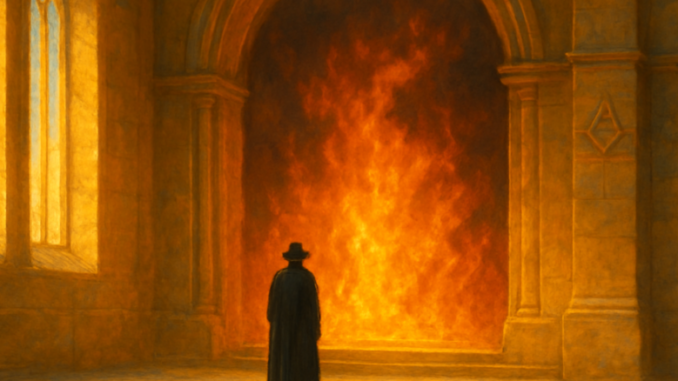
Few books have shaped the popular image of secret societies as powerfully as the novels of Dan Brown. In his thriller Inferno, readers are swept into a plot where a shadowy organization is willing to do the unthinkable to “save” humanity from overpopulation. The unsettling thesis worth exploring here is this: the picture that fiction paints of secret brotherhoods is often more potent than reality itself. And it is precisely there that a philosophical problem begins — one that has accompanied Freemasonry for centuries.
The Power of Fiction
In Inferno, Dan Brown constructs a world in which a brilliant scientist becomes convinced that the earth is irreversibly headed toward catastrophe due to overpopulation. To prevent this, he entrusts his plan to a clandestine consortium — an organization that operates beyond every law and moral boundary. The secret society in Inferno is no benevolent brotherhood; it is a ruthless machine driven by the conviction that the end justifies the means. It is exactly this kind of fiction that fuels the imagination of millions of readers and, at the same time, distorts the public image of real organizations like Freemasonry.
The problem is not that Dan Brown writes poorly. The problem is that he writes extraordinarily convincingly. The line between fact and fiction is deliberately blurred in his novels. After closing the pages of Inferno, readers can effortlessly believe that organizations truly exist that make decisions about the fate of humanity in back rooms. This image existed long before Dan Brown, but his work brought it to a vast new audience.
What Freemasonry Actually Is — And Is Not
A fundamental distinction must be made here. Freemasonry is not a secret society in the sense that Dan Brown’s Inferno suggests. Freemasonry is a fraternity with a long history, roots in the Enlightenment, and a tradition of moral self-improvement. It has rituals and customs that are not shared publicly, but its existence, its lodges, and its members generally are. The difference between a secret organization and an organization with certain confidential practices is essential — yet popular culture systematically ignores it.
Freemasonry is not a conspiracy behind closed doors, but an age-old practice in self-knowledge, brotherhood, and moral conduct — open to anyone who sincerely seeks it.
Where the consortium in Inferno operates from fear and control, Freemasonry has historically been rooted in the opposite: trust in human reason and the capacity for improvement. Thinkers like Voltaire and Johann Wolfgang von Goethe were Freemasons not despite, but precisely because of, their belief in human progress. Wolfgang Amadeus Mozart let the Masonic ideals of wisdom, beauty, and strength shine through in his opera The Magic Flute. These men did not strive for secret power — they pursued shared enlightenment.
Overpopulation Anxiety and the Philosopher as Dreamer
The fear of overpopulation that drives the plot of Inferno is in itself a fascinating philosophical theme. The idea that the earth has a limit to the number of people it can sustain goes back to Thomas Malthus, the eighteenth-century British thinker whose work on population growth influenced generations. Malthus argued that population grows faster than food production, and that famine and disease are inevitable corrective mechanisms. In Inferno, this idea is taken to a morally extreme conclusion.
But here an important difference with the Masonic tradition reveals itself. Freemasonry has never adopted a collective position on population policy, environmental issues, or any societal question. This is not an accidental omission — it is a deliberate choice. The lodge is a space for personal growth and brotherly dialogue, not a political platform. Where the fictional consortium in Inferno believes it has the right to act on behalf of humanity, Freemasonry recognizes that no society possesses that right.
The Allure of the Conspiracy
Why are conspiracy theories about secret societies so persistent? The philosopher Baruch Spinoza pointed out as early as the seventeenth century that people are inclined to seek simple explanations for complex phenomena — preferably explanations that presuppose human intention. It is more comforting to believe that someone is pulling the strings, even if that someone is malevolent, than to accept that the world is fundamentally unpredictable and chaotic. Dan Brown’s novels play masterfully on this psychological need.
Inferno reinforces a pattern that recurs throughout Brown’s earlier novels: the idea that behind the visible world lies a hidden layer of power and knowledge. It is a compelling narrative, but it is also one that distorts the true nature of organizations like Freemasonry. The Masonic tradition does indeed contain layers of meaning and ritual. But those layers are not instruments of power — they are tools for reflection. The difference is like that between a mirror and a weapon: both may be made of glass, but their purposes are entirely opposite.
Fiction as Mirror, Not as Source
This brings us to a paradox that Michel de Montaigne would have appreciated. In his essays, Montaigne wrote about humanity’s tendency to believe in its own convictions as though they were truths. Fiction like Dan Brown’s functions as a mirror: it shows us what we want to believe about the world. That makes fiction valuable, but also dangerous when it silently takes the place of actual knowledge.
Throughout its existence, Freemasonry has repeatedly contended with suspicion fueled by fiction, rumor, and misunderstanding. The irony is that the Masonic tradition itself places great value on critical thinking and the questioning of assumptions — the very skills that would help readers distinguish between the world Dan Brown creates and the world as it actually is. Novels like Inferno deserve to be enjoyed for what they are: masterful thrillers that raise profound questions. But they should never be mistaken for an accurate portrait of Freemasonry or any real fraternal organization.
Dan Brown’s Inferno is a powerful reminder of fiction’s ability to shape perception. The shadowy organizations in his novels make for gripping reading, but they bear little resemblance to the reality of Freemasonry — a centuries-old brotherhood dedicated to self-improvement, moral reflection, and the Enlightenment ideals of reason and human dignity. The next time you encounter a conspiracy theory about secret societies, it may be worth pausing to ask: am I looking into a mirror of my own assumptions, or am I truly seeing the world as it is?
Copyright text & image: devrijmetselaar.nl
Texts are based on the ideas and content of the author of devrijmetselaar.nl, reviewed, corrected, and supplemented with the assistance of OpenAI. Images are created based on the ideas of the author of devrijmetselaar.nl using OpenAI/DALL-E.
Frequently Asked Questions
Is Freemasonry a secret society like the one depicted in Dan Brown's Inferno?
No. Freemasonry is a fraternity with publicly known lodges and members, not a secret conspiracy. While it has certain rituals and practices that are not shared publicly, there is a fundamental difference between an organization with confidential practices and a truly secret organization that operates beyond law and morality. Freemasonry is rooted in trust in human reason and moral self-improvement, not in fear and control.
How has Dan Brown's fiction influenced public perception of Freemasonry?
Dan Brown's novels, particularly Inferno, have powerfully shaped the popular image of secret societies by blurring the line between fact and fiction so convincingly that readers often believe these shadowy organizations actually exist. While the image of secret brotherhoods existed before Brown, his work brought these misconceptions to a vast new audience, distorting the real nature of organizations like Freemasonry.
What are the actual roots and purpose of Freemasonry?
Freemasonry is a fraternity with deep historical roots in the Enlightenment tradition. It is centered on self-knowledge, brotherhood, and moral conduct, and is open to anyone who sincerely seeks it. Rather than operating through conspiracy and control, Freemasonry is built on the principle of trust in human reason and the capacity for moral self-improvement.

Be the first to comment