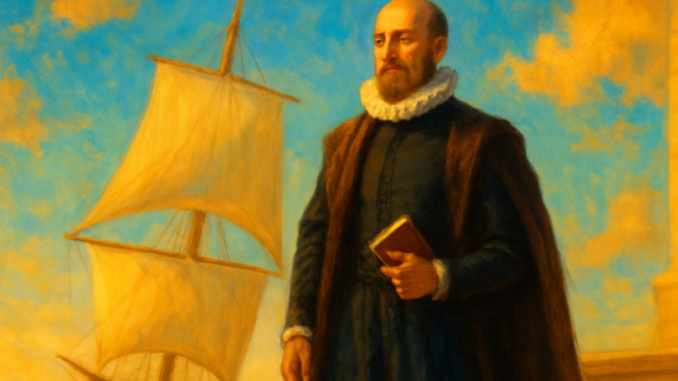
There is an everyday object that everyone knows but rarely considers with any depth: the mirror. We stand before it every morning, check our appearance, and move on. But anyone who truly looks into a mirror — with the courage to see not just the face but the character behind it — encounters something unsettling. The image shifts. Not merely because of the light, but because of who we are in that particular moment. Michel de Montaigne wrote about precisely this phenomenon in the first essay of his second book: the inconstancy with which we act, think, and feel. His observation, more than four centuries old, remains as sharp as the mirror itself.
The Heart of the Essay: We Are Not a Unity
In ‘Of the Inconstancy of Our Actions,’ Montaigne examines a question that sounds simple but carries far-reaching consequences: why do people behave so contradictorily? He argues that we are not the consistent, rational beings we take ourselves to be. Instead, we are composed of shifting moods, impulses, and circumstances. The person who is brave today may act like a coward tomorrow. The one who gives generously now may cling to every penny an hour later. This is not a moral failing, Montaigne writes — it is a fundamental characteristic of human nature.
Montaigne opens the essay by asserting that those who judge us on the basis of isolated acts rarely succeed in painting a coherent portrait. A general who fights heroically on the battlefield may be utterly indecisive at home. A philosopher who preaches wisdom may be governed by petty jealousy in his private life. Montaigne does not call this hypocrisy — he calls it human. He invites the reader not to condemn this fickleness, but to examine it.
The Mirror as a Metaphor for Self-Examination
Imagine a mirror that shows not only your outward appearance but also your inner state at that very moment. Every time you look into it, you see a different person. That is precisely what Montaigne describes. The mirror here is not merely a surface that reflects — it is an instrument of honesty. In the philosophical tradition of ‘know thyself,’ championed by Socrates and inscribed on the Temple of Delphi, the mirror serves as an invitation to radical truthfulness. Montaigne places himself in that tradition but adds something essential: even those who look at themselves honestly find no fixed point. The self is not a statue — it is a river.
This is a powerful insight. We are not figures carved in stone but rivers that continually shift their course. True self-knowledge begins not with finding a fixed identity, but with accepting the movement itself. For the Freemason, this resonates deeply with the symbolism of the rough ashlar — the unworked stone that represents our unfinished, ever-changing nature. The work of shaping that stone is never truly complete, because the material itself is alive.
Historical Examples That Illuminate the Point
As in many of his essays, Montaigne draws liberally from classical antiquity to illustrate his argument. He cites Roman generals and statesmen to show how the same person, under different circumstances, made entirely contradictory choices. He points to the famous inconsistency of figures like Alexander the Great, who could be alternately generous and cruel, and the Roman Emperor Augustus, who was ruthless in his youth but came to be known as a wise and moderate ruler. Plutarch, whose ‘Lives’ Montaigne read intensively, supplies him with countless examples of contradictory behaviour among admired historical figures.
What Montaigne does with these examples is remarkable. He uses them neither to condemn nor to admire these figures, but to demonstrate that inconsistency is universal. Even the greatest heroes of history were not hewn from a single block. This recognition — that fickleness is inherently human — forms the philosophical backbone of the essay.
Daily Life as a Training Ground
Montaigne extends his observations into everyday life. He describes how we constantly display both small and large contradictions in our daily existence. We resolve to be more patient and lose our temper that very evening. We promise ourselves moderation and reach for excess at the first opportunity. This is recognisable to anyone who has ever made a resolution and broken it within a day. Montaigne sees in this not a reason for despair, but for humility. Those who acknowledge their own changeability can be gentler — both with themselves and with others.
There is a deeper layer here. The mirror in which we gaze does not only reveal our inconstancy — it also reveals our capacity for growth. Precisely because we are not fixed, we can develop. Montaigne’s insight is not fatalistic but liberating: if we are not made of stone, we can also be reshaped through conscious action, through practice, and through honest self-reflection. This is the daily work that transforms the rough stone into something closer to its intended form.
What This Essay Tells Us Today
In an age when social media invites us to present a polished, consistent self-image, Montaigne’s message is both contrarian and refreshing. He reminds us that a human being is not a brand with a fixed identity, but a creature in constant motion. The Greek philosopher Heraclitus, who famously stated that one can never step into the same river twice, would have been a kindred spirit. Both saw change not as a problem but as the very substance of existence.
The invitation embedded in this essay is one of contemplative honesty. Anyone who pauses each day to ask, ‘Am I the same person I was yesterday?’ embarks on a journey that is both unsettling and enriching. The answer is almost always no. But in that ‘no’ there is no weakness. What lies within it is the recognition that self-knowledge is not a destination but a continuous endeavour. Montaigne called his essays ‘essais’ — trials, attempts to understand himself and the world. This first essay of the second book may be the most honest attempt of all: an effort to describe the human being without pinning him down.
The Rough Ashlar of Character
For those who walk the Masonic path, Montaigne’s essay carries a particular resonance. The rough ashlar — that unworked stone placed before us at the beginning of our journey — is not merely a symbol of imperfection. It is a symbol of potential. It acknowledges that we arrive unfinished, inconsistent, full of contradictions. The work of the Freemason is not to deny this inconstancy but to engage with it, chisel in hand, day after day. Montaigne never used Masonic language, but his philosophy breathes the same spirit: the honest examination of the self is the first and most important labour.
The tools we are given — the square, the level, the plumb line — are instruments of measurement and correction, not unlike Montaigne’s essays themselves. They help us notice when we have deviated, when our actions do not align with our intentions, when the surface of the mirror shows a face we do not recognise. And each time we notice, we have an opportunity: not to despair at our inconsistency, but to pick up the chisel once more and continue the work.
Montaigne would have understood this craft. He knew that the value of self-examination does not lie in achieving perfection, but in the sincerity of the attempt. The brother who stands in lodge and reflects on his conduct does exactly what Montaigne did alone in his tower study: he looks into the mirror, accepts what he sees, and resolves to do the work again tomorrow. That willingness — to keep looking, to keep working, to keep growing — is perhaps the truest mark of both the essayist and the Mason.
Montaigne’s essay on the inconstancy of our actions is ultimately not about our failures but about our nature. We are rivers, not statues. We shift, we contradict ourselves, we surprise ourselves with both our virtues and our shortcomings. The mirror does not lie, but it never shows the same face twice. For anyone committed to the path of self-knowledge — whether through philosophy, through Freemasonry, or simply through the honest practice of living — this is not a cause for discouragement. It is the very condition that makes growth possible. The rough stone can be shaped, precisely because it is not yet finished. And the hand that holds the chisel is guided not by the illusion of perfection, but by the quiet, persistent courage to keep trying.
Copyright text & image: devrijmetselaar.nl
Texts are based on the ideas and content of the author of devrijmetselaar.nl, reviewed, corrected, and supplemented with the assistance of OpenAI. Images are created based on the ideas of the author of devrijmetselaar.nl using OpenAI/DALL-E.
Frequently Asked Questions
What is the main argument of Montaigne's 'Of the Inconstancy of Our Actions'?
Montaigne argues that humans are not consistent, rational beings as we assume ourselves to be. Instead, we are composed of shifting moods, impulses, and circumstances. He asserts that our contradictory behaviors—such as being brave one day and cowardly the next—are not moral failings but fundamental characteristics of human nature. He contends that we cannot be understood through isolated acts alone, as we are inherently inconsistent.
How does Montaigne use the mirror as a metaphor in this essay?
Montaigne uses the mirror as an instrument of self-examination and honesty, following the philosophical tradition of 'know thyself.' The mirror represents a tool that shows not only our outward appearance but also our inner state in any given moment. However, Montaigne's crucial insight is that even when we look at ourselves honestly in this mirror, we find no fixed point of identity. Instead, the self is constantly shifting, like a river rather than a statue carved in stone.
Why does Montaigne refuse to call human inconsistency 'hypocrisy'?
Montaigne refuses to label human inconsistency as hypocrisy because he sees it not as a deliberate deception or moral failing, but as a fundamental and natural aspect of human existence. He invites readers not to condemn this fickleness but to examine and understand it as inherent to the human condition. Examples like a general who is heroic in battle but indecisive at home demonstrate that these contradictions are simply part of being human, not intentional dishonesty.

Be the first to comment