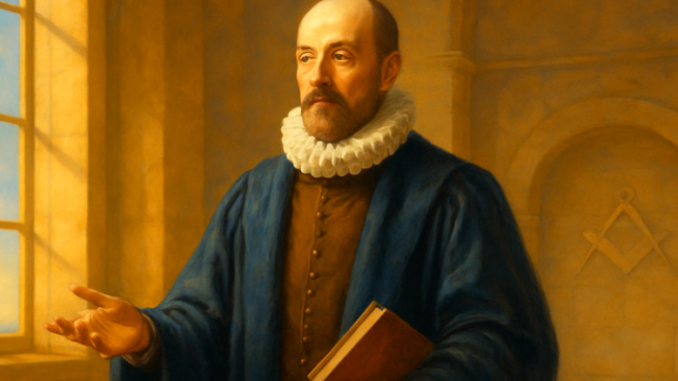
Can a person be brave and cowardly at the same time? Generous and greedy? Sincere and deceitful? Michel de Montaigne answered that question with a resolute yes. In his essay on the inconstancy of our actions, he dismantled the idea that human beings possess a single, unified core. But this insight did not emerge from a vacuum. Montaigne stood on the shoulders of ancient philosophers, Renaissance humanists, and classical moralists who gave him the language and tools to describe the human soul as an ever-shifting landscape. This article explores the philosophical roots of that insight — and asks why this particular idea has proven so fertile, especially for traditions that regard self-knowledge as the work of a lifetime.
The Paradox as a Starting Point
Montaigne’s thesis is provocative in its simplicity: we are not one person, but many. Where the traditional moral philosophy of his era assumed a stable character that could be shaped through virtue, Montaigne presented the opposite view. Human beings are capricious, changeable, and fully capable of actions that contradict their own principles. This was not nihilism — it was an invitation to honesty. It forced the reader to confront the gap between who he thinks he is and who he actually is at the moment of action.
That paradox has a long history. To understand why Montaigne was able to formulate it so powerfully, we need to return to the sources he consulted daily in his library — the round tower room whose ceiling beams were inscribed with quotations from antiquity.
Plutarch and Seneca: The Two Pillars
Montaigne repeatedly named Plutarch and Seneca as his principal guides. Plutarch, the Greek biographer and moralist, provided him with a treasure trove of examples of human contradiction. In the Lives and the Moralia, Plutarch sketched figures who acted heroically in one moment and pettily in the next. For Montaigne, these observations were not curiosities but evidence. They demonstrated that inconsistency was not the monopoly of weak minds, but a fundamental feature of human nature.
Seneca offered a different register. As a Stoic, Lucius Annaeus Seneca argued that reason should be the guiding principle of life and that the passions could be tamed. But Montaigne did not read Seneca as a dogmatist. He recognized in Seneca’s letters and treatises an ongoing struggle: even Seneca acknowledged that the ideal of the wise man was seldom attained. Montaigne adopted that honesty, but drew a more radical conclusion from it. Where Seneca saw inconstancy as a weakness to be overcome, Montaigne regarded it as an inescapable truth.
Stoicism and Skepticism: Tension as Engine
The essay on inconstancy sits at the intersection of two philosophical traditions that deeply influenced Montaigne. Stoicism — represented by Marcus Aurelius, Epictetus, and Seneca — offered the ideal of inner coherence. The Stoic strives for a life aligned with reason, regardless of circumstances. That ideal appealed to Montaigne, but he did not believe it was achievable for ordinary mortals.
Pyrrhonian Skepticism — the tradition of Pyrrho of Elis and later Sextus Empiricus — provided the counterpoint. The Skeptics argued that definitive knowledge is impossible and that human beings are better served by suspending judgment than by making pronouncements. Montaigne embraced this stance with his famous motto Que sais-je? — “What do I know?” That question applied not only to the external world but also to the self. If we cannot even be certain what we will feel or do tomorrow, how can we claim to possess a fixed character?
The tension between these two traditions is precisely what makes the essay so dynamic. Stoicism supplies the longing for unity; Skepticism delivers the sobering recognition that such unity is a construction. Montaigne moves between both poles without definitively choosing either, and it is exactly that refusal to settle that keeps his thought so alive.
Renaissance Humanism: The Human Being as Open Question
Montaigne wrote in the second half of the sixteenth century, in the midst of a period in which humanism had declared man the center of creation. Thinkers like Erasmus of Rotterdam and Giovanni Pico della Mirandola celebrated human dignity and emphasized humanity’s capacity for self-formation. In his famous Oration on the Dignity of Man, Pico della Mirandola wrote that God had given man alone no fixed nature, so that he might shape himself into whatever he wished.
Montaigne took up that premise, but reversed it. If human beings have no fixed nature, then they are not only free to form themselves — they are also condemned to inconstancy. Inconstancy, then, is not a defect but the flip side of that same dignity. This insight made Montaigne an uncomfortable humanist: he celebrated human freedom, but refused to close his eyes to the chaos that freedom inevitably brings.
From the Stoics, Montaigne inherited the desire for inner unity. From the Skeptics, he gained the courage to acknowledge that such unity is never complete. It is precisely in that tension that the invitation to lifelong self-knowledge resides.
Aristotle and the Question of Virtue
A less obvious but essential influence is that of Aristotle. In the Nicomachean Ethics, Aristotle described virtue as a habitus — an ingrained disposition acquired through repetition. A courageous person is not someone who acts courageously once, but someone who does so consistently. Montaigne knew this definition well, and posed an uncomfortable question in response: what if that consistency is an illusion? What if the same person who is brave today acts out of fear tomorrow — not from weakness, but from the sheer multiplicity of human nature?
That question does not undermine the importance of virtue; rather, it reformulates it. If character is not a fixed possession but an ongoing process, then the pursuit of virtue becomes something far more honest and far more demanding. It becomes a daily practice of self-examination — not the polishing of a statue already carved, but the patient work of someone who knows that the stone shifts beneath his chisel.
Why This Matters for the Pursuit of Self-Knowledge
For anyone engaged in a tradition that places self-knowledge at its center — as Freemasonry does — Montaigne’s philosophy of inconstancy carries a particular resonance. The Masonic injunction to “know thyself” presupposes that the self is something worth knowing. But Montaigne adds a crucial caveat: the self you discover today may not be the self you encounter tomorrow. This is not cause for despair; it is cause for humility and sustained effort.
The rough ashlar is not rough merely because it has not yet been worked. It is rough because human nature itself is uneven, contradictory, and in constant flux. The labor of self-improvement is therefore never finished — not because we are failures, but because we are alive. Montaigne understood this better than almost anyone, and his willingness to say so openly remains one of the most courageous acts in the history of Western thought.
Montaigne’s essay on inconstancy draws from Plutarch’s vivid examples, Seneca’s Stoic struggle, the radical doubt of the Pyrrhonian Skeptics, the humanist celebration of human potential, and Aristotle’s demanding vision of virtue. What makes Montaigne unique is not any one of these influences, but the way he wove them together into a philosophy that embraces contradiction rather than resolving it. For those who walk a path of self-knowledge — whether in a lodge or in the privacy of their own reflection — his message is both unsettling and liberating: you will never fully know yourself, and that is precisely why the effort matters.
Copyright text & image: devrijmetselaar.nl
Texts are based on the ideas and content of the author of devrijmetselaar.nl, reviewed, corrected, and supplemented with the assistance of OpenAI. Images are created based on the ideas of the author of devrijmetselaar.nl using OpenAI/DALL-E.
Frequently Asked Questions
What is Montaigne's main argument about human nature in his essay on inconstancy?
Montaigne argues that human beings are not unified, single entities but rather many different people. He challenges the traditional moral philosophy of his time that assumed stable character, instead presenting humans as capricious and changeable—capable of contradicting their own principles. This view was not nihilism but an invitation to honesty about the gap between who we think we are and who we actually are in our actions.
Which ancient philosophers most influenced Montaigne's philosophy of inconstancy?
Montaigne's primary influences were Plutarch and Seneca. Plutarch provided examples of human contradiction through his Lives and Moralia, showing that inconsistency was fundamental to human nature rather than a sign of weakness. Seneca, the Stoic philosopher, contributed an honest acknowledgment that the ideal wise man was rarely achieved, which Montaigne adopted and developed into more radical conclusions.
How does Montaigne's philosophy relate to self-knowledge?
Montaigne's insight that humans are inconstant and contradictory is particularly important for traditions that view self-knowledge as lifelong work. By recognizing that we contain multiple, shifting aspects and are capable of simultaneous contradictions—being both brave and cowardly, generous and greedy—we are forced to honestly confront the gap between our self-perception and our actual behavior, making genuine self-understanding a continuous, rather than completed, process.

Be the first to comment