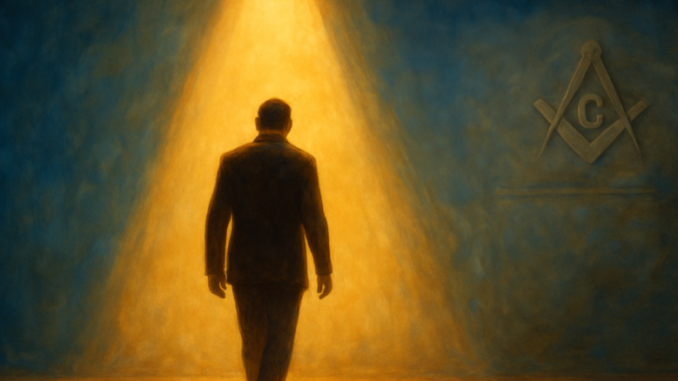
Sometimes a person disappears — not just physically, but inwardly. A young athlete withdraws from the world, overwhelmed by pressure and expectations. When he returns, he speaks openly about regret and self-awareness. This kind of story raises questions that reach far deeper than the headline itself. What does a moment of crisis actually reveal about who we truly are? And how does a Freemason view such turning points in a human life?
Why Do People Sometimes Vanish From the Stage?
The outside world tends to see a disappearance as either a mystery or a scandal. A news article presents the facts, quotes bystanders, and searches for explanations. But anyone who looks at the story from the inside recognizes something different: a human being who could no longer function under the weight of the expectations placed upon him. Pressure, perfectionism, fear of failure — these are universal themes that can touch any one of us.
For the outsider, such a disappearance is a news item. For the Freemason, it is a mirror. In the lodge, we learn that a person is never a finished work, and that every crisis contains the possibility of growth. Disappearing is not an ending — sometimes it is a necessary silence before a new beginning.
What Does a Crisis Reveal About Our True Character?
An eighteenth-century philosopher once wrote that a person only truly comes to know himself in adversity. Freemasonry embraces this insight wholeheartedly. The rituals of the lodge place a person before symbolic trials, again and again — not as punishment, but to foster self-awareness. Who are you when the spotlight fades? What remains when the world is no longer watching?
In the case of a young athlete who disappears and then returns, we see exactly this process at work. The personality he projected to the world proved unsustainable. The pressure to perform collided with an inner need he had long ignored. His disappearance was not weakness — it was an emergency brake. His return, marked by openness about regret and insight, demonstrates the courage to redefine himself.
How the World Sees It — and How the Lodge Sees It
A newspaper article offers facts and quotes. It searches for causes and consequences, for villains or heroes. Journalism serves the truth, but often from a perspective of distance. The reader judges, shares the story, and moves on with the day.
The Freemason looks at things differently. In the lodge, we do not judge the person — we consider the act. And even then, improvement is the goal, never condemnation. When a Brother struggles, no shame is cast upon him. Instead, the questions asked are: What can we learn from this? How can we offer support? The lodge is a workshop, not a courtroom.
The rough stone is not shaped by breaking it, but by chiseling it with patience.
Where Both Perspectives Meet
Both the journalist and the Freemason recognize that a human being is not a static creature. Personality is not a fixed given — it is an ongoing process. The news report captures a snapshot; the lodge offers a longer view. Both seek truth, but on different timescales.
What they share is the acknowledgment that openness takes more courage than silence. When someone publicly speaks about their own mistakes and regrets, it touches something universal. It shatters the illusion of perfection. It invites others to remove their masks as well. In the lodge, we call this working the rough ashlar: the honest confrontation with our own shortcomings as the first step toward growth.
What Can We Learn From This?
The lesson is not that crises are desirable, but that they are an inevitable part of life. The question is not whether we will stumble, but how we rise again. Freemasonry teaches us that returning is no disgrace. On the contrary — those who dare to come back, who dare to speak about their own failures, demonstrate true strength.
Consider these reflections as guideposts on the journey:
Crisis as mirror: What does a moment of intense pressure reveal about our deepest values?
Openness as virtue: Do we dare name our faults without hiding behind excuses?
Growth as purpose: Do we see the return as a final destination, or as a new beginning?
In the lodge, it is often said that the journey matters more than the arrival. A news article offers a single frame, but the Freemason knows the story is never finished. Every day presents the chance to begin again, to continue building who we wish to become.
A disappearance and a return together form a story of human vulnerability and resilience. The outside world sees a headline; the Freemason recognizes a universal struggle. Both perspectives have value. But perhaps the deepest lesson lies in the courage to be honest — with the world and with ourselves. For it is only when we dare to step away from the role others have scripted for us that we can return as who we truly are.
Copyright text & image: devrijmetselaar.nl
Texts are based on the ideas and content of the author of devrijmetselaar.nl, reviewed, corrected, and supplemented with the assistance of OpenAI. Images are created based on the ideas of the author of devrijmetselaar.nl using OpenAI/DALL-E.
Frequently Asked Questions
What does Freemasonry teach about facing personal crises?
Freemasonry teaches that crises are not endpoints but opportunities for self-discovery and growth. Through symbolic trials in the lodge, members learn that adversity reveals our true character and provides a pathway to becoming better versions of ourselves. Rather than viewing struggles as failures, the fraternity sees them as necessary steps in the ongoing process of personal development.
How does the lodge support members during difficult times?
The lodge functions as a workshop of mutual support rather than a place of judgment. When a Brother faces challenges, the focus is on learning and offering assistance, not on shame or condemnation. Freemasonry emphasizes improvement and understanding, creating a safe space where men can be honest about their struggles and receive support from their Brothers.
Why does Freemasonry believe a person is never a finished work?
Freemasonry views human development as a continuous process of refinement, much like shaping a rough stone through patient chiseling. The organization recognizes that personality and character are not fixed but evolve throughout life, and that each person has unlimited potential for growth and self-improvement through reflection and experience.
How does the Masonic perspective on crises differ from how society typically views them?
While society often judges crises through headlines and external facts, Freemasonry looks inward to understand what can be learned about ourselves and others. The lodge asks not 'Who is to blame?' but 'What can we learn from this?' and 'How can we help?' This compassionate approach recognizes that withdrawing or struggling is sometimes a necessary pause before meaningful transformation.

Be the first to comment