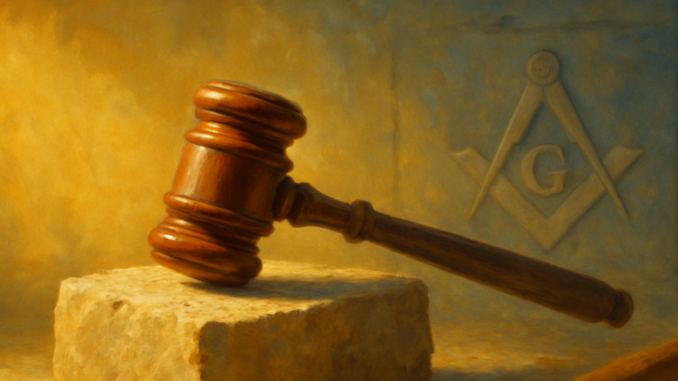
A courtroom delivers its verdict. Twenty years in prison for an act of irreversible violence. The gavel strikes wood, and in that single blow, something resonates far beyond legal statutes and procedural formality. What does justice truly mean when we look beyond the courtroom walls? In Freemasonry, the gavel is one of the most powerful working tools — not wielded to condemn, but to shape. A recent high-profile sentencing invites us to reflect on the deeper layers of guilt, restoration, and the moral responsibility every human being carries within.
The Gavel: An Instrument of Judgment and Formation
In the courtroom, the judge wields a gavel to affirm a ruling. It marks a moment of finality — a decisive conclusion. But look a little longer at this gesture, and you’ll discover that the same instrument carries an entirely different meaning in other contexts. The stonemason uses his mallet to work rough stone, slowly and deliberately shaping something that is not yet finished. In the Masonic tradition, this gavel symbolizes the willpower with which we shape ourselves, chipping away at the imperfections of our character — not through force, but through patience and self-awareness.
A twenty-year prison sentence for a violent crime confronts us with a fundamental question: where does justice end and where does formation begin? Is punishment a final destination, or a starting point? Does it serve solely as retribution, or does it also carry within it the possibility of transformation?
The Rough Stone of Human Failure
In Freemasonry, every seeker begins as a rough ashlar — unworked and full of imperfections. This image is not a condemnation but an invitation. It acknowledges that no one is finished, that every person carries flaws that call for attention. When someone commits an act that deeply wounds others or even takes a life, we witness the most extreme manifestation of what happens when that rough stone remains unworked.
Yet it is too easy to regard the perpetrator as fundamentally different from ourselves. The Freemason is taught to look inward, to acknowledge rather than deny the dark corners of the soul. Not because we are all capable of the same acts, but because we all bear the responsibility of knowing our own shadow sides. Those who do not know themselves cannot truly build a better self.
Justice Beyond Retribution
Western justice systems are rooted in principles of proportionality and fairness. A punishment must fit the crime. But behind this legal logic lies a deeper question: what do we actually hope to achieve through punishment? Different traditions offer different answers.
The true judge does not merely rule on the act but invites reflection on its origins.
In Freemasonry, retribution is not the central concern — the ongoing labor on the self is. This does not mean that actions should go without consequences. On the contrary, taking responsibility is a cornerstone of ethical conduct. But it does invite us to ask whether a society that only punishes, without offering any prospect of inner transformation, truly serves justice.
The Compasses and the Limits of Judgment
Alongside the gavel, Freemasonry also employs the compasses as a working tool. Where the gavel shapes, the compasses draw boundaries. They are the instrument with which the Master Builder determines proportions and finds the right measure. In an ethical sense, the compasses remind us that our judgment, too, has its limits. We see the outside of an act — the verdict, the headlines. But the inner world of another human being remains largely hidden from view.
This makes the act no less grave, nor the pain of the victims’ loved ones any less real. But it invites humility in our judgment of the person behind the act. The Freemason learns to distinguish between what someone does and who someone is — not to excuse, but to leave room for the possibility of change.
The Lodge as a Mirror for Society
Within the privacy of the lodge, Freemasons practice engaging with moral questions — not by prescribing answers, but by posing questions that provoke genuine thought. How do we respond to evil in the world? How do we deal with our own shortcomings? What does it truly mean to take responsibility?
Several principles emerge from this practice that are worth reflecting on:
- Responsibility demands honesty with yourself.
- Judging others requires self-reflection first.
- Justice encompasses more than punishment alone.
- Formation is a lifelong process.
These principles are not meant as definitive answers to how a society should deal with serious crime. Rather, they invite us to calibrate our own moral compass — to resist falling into easy judgments or oversimplifications.
The Silent Question Behind the Verdict
When the gavel falls and the verdict has been pronounced, silence returns. The courtroom empties, and the world moves on. But the questions linger. What drives a person to the extreme? What could others have done — what could society have done, what could the individual himself have done — sooner? These are not questions a court of law can answer. They are questions that invite each of us to look deeper, beyond the news of the day, toward the foundations upon which we build our own lives.
The judge’s gavel and the Freemason’s gavel meet in the concept of responsibility. One affirms a ruling; the other invites continuous work on the self. Both remind us that justice does not exist solely in what we impose on others, but also in how we shape ourselves. In that sense, every day is an invitation to further work the rough stone of our own character — with patience, with honesty, and with the understanding that the work is never truly finished.
Copyright text & image: devrijmetselaar.nl
Texts are based on the ideas and content of the author of devrijmetselaar.nl, reviewed, corrected, and supplemented with the assistance of OpenAI. Images are created based on the ideas of the author of devrijmetselaar.nl using OpenAI/DALL-E.
Frequently Asked Questions
What does the gavel symbolize in Freemasonry?
In Freemasonry, the gavel represents the willpower and self-awareness with which we shape ourselves and chip away at our character's imperfections. Unlike a judge's gavel which marks finality, the Masonic gavel symbolizes an ongoing, patient process of personal formation and self-improvement. It is a tool of transformation rather than condemnation.
What is a 'rough ashlar' in Freemasonry?
A rough ashlar is an unworked stone that represents every person at the beginning of their Masonic journey—imperfect and full of potential for growth. This image is not meant as a condemnation but as an invitation to acknowledge that no one is finished and that we all carry flaws worthy of attention and self-work. It emphasizes that personal transformation is possible for everyone.
How does Freemasonry view justice differently from the legal system?
While the legal system focuses on proportional punishment and retribution, Freemasonry emphasizes ongoing personal labor and self-improvement as the true measure of justice. Freemasonry teaches that taking responsibility for one's actions is essential, but it also invites deeper reflection on transformation and the possibility of becoming a better person through self-awareness and inner work.
Why does Freemasonry encourage looking inward at our own 'shadow sides'?
Freemasonry teaches that self-knowledge is essential to ethical conduct and personal growth. By acknowledging rather than denying our own imperfections and darker tendencies, we develop the awareness necessary to build a better self and understand the human condition with compassion. This inward reflection helps us grow morally and connect with our shared humanity.


Be the first to comment