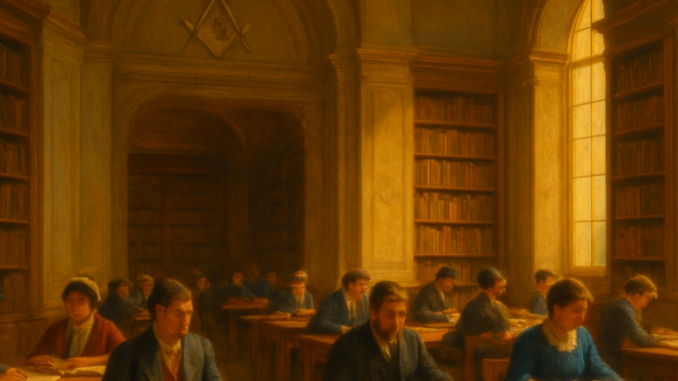
Freemasonry has always maintained a profound connection with knowledge, education, and culture. In the Netherlands, this commitment led to the establishment of libraries and cultural centers that offered far more than books — they provided spaces for dialogue, intellectual growth, and community building. Often supported by Masonic lodges, these institutions played a crucial role in making literature, science, and the arts accessible to a broad public.
The Importance of Libraries in the 19th Century
In the 19th century, libraries were rare and often exclusively accessible to the wealthy and privileged. Freemasons viewed this inequality as a significant barrier to social progress and decided to take action. They founded libraries that were open to everyone, regardless of background or social standing.
These libraries were far more than simple repositories for books. They functioned as centers of enlightenment where people could meet, share knowledge, and explore new ideas together. In an era when access to information was a luxury, these Masonic-supported institutions represented a radical commitment to intellectual freedom.
The Role of Freemasonry in Promoting Knowledge and Culture
Freemasonry played a key role in the founding of libraries and cultural centers, guided by several core principles. First and foremost was the belief in universal access to knowledge. Freemasons held that knowledge was the key to both personal development and the advancement of society as a whole. Without open access to learning, true progress was impossible.
Equally important was the promotion of culture and the arts. Many lodges actively supported cultural activities such as public lectures, musical evenings, and art exhibitions. These events enriched the intellectual life of their communities and fostered a deeper appreciation for creative expression.
Finally, these libraries and cultural centers served as meeting places for people from diverse backgrounds. Rooted in the Masonic values of respect and open dialogue, they became spaces where differences were bridged through shared curiosity and a mutual love of learning.
Practical Contributions of Freemasons to Libraries
Freemasons supported libraries and cultural institutions in a number of tangible ways. Financial support was essential — lodge members raised funds for the construction and furnishing of library buildings, ensuring they were welcoming and well-equipped spaces for learning.
Collection building was another vital contribution. Individual members donated books, manuscripts, and other materials to help establish and grow library collections. Many of these donations included rare and valuable works that might otherwise have remained in private hands.
Beyond the physical infrastructure, Freemasons organized lectures, reading groups, and educational programs within cultural centers. These initiatives fostered intellectual and creative development and helped build a culture of lifelong learning within the communities they served.
Building Toward an Accessible Future
The ideals that drove Freemasons to establish these institutions are clearly reflected in the modern concept of the public library and cultural center. While the direct involvement of Masonic lodges has diminished over time, the underlying values of inclusion, education, and cultural enrichment remain as relevant as ever.
Many of the early Masonic libraries contributed directly to the foundation of today’s public library networks. Their legacy lives on not just in the buildings and collections they helped create, but in the principle that knowledge should be freely available to all who seek it.
A Lasting Legacy of Knowledge
The contribution of Freemasons to libraries and cultural centers demonstrates the power of collaboration and idealism. These institutions didn’t just help individuals — they strengthened entire communities by making knowledge and culture accessible to people who had previously been excluded from intellectual life.
In an age when technology is rapidly transforming the way we learn and communicate, the Masonic legacy of knowledge-sharing remains a powerful source of inspiration. It reminds us that the pursuit of knowledge is not a solitary endeavor but a collective responsibility — one that enriches us all.
From the reading rooms of the 19th century to the digital libraries of today, the Masonic commitment to education and culture has left an enduring mark on society. Their vision of open, inclusive institutions where knowledge flows freely continues to shape how we think about libraries, learning, and the power of shared wisdom.
Copyright text & image: devrijmetselaar.nl
Texts are based on the ideas and content of the author of devrijmetselaar.nl, reviewed, corrected, and supplemented with the assistance of OpenAI. Images are created based on the ideas of the author of devrijmetselaar.nl using OpenAI/DALL-E.
Frequently Asked Questions
What role did Freemasonry play in making libraries accessible to the general public?
Freemasons recognized that access to knowledge was limited to the wealthy and privileged in the 19th century, which they saw as a barrier to social progress. They founded libraries open to everyone regardless of background, transforming these institutions into centers of enlightenment where people could meet, share ideas, and explore new knowledge together.
How did Freemasons financially support libraries and cultural centers?
Lodge members actively raised funds for the construction and furnishing of library buildings to ensure they were welcoming and well-equipped spaces for learning. Additionally, individual Freemasons donated books, manuscripts, and other valuable materials, including rare works that might otherwise have remained in private collections.
What cultural activities did Masonic lodges organize beyond providing books?
Freemasons organized lectures, musical evenings, art exhibitions, and reading groups within cultural centers to enrich their communities' intellectual life. These programs fostered appreciation for creative expression and helped build a culture of lifelong learning while bringing together people from diverse backgrounds.
What core principles guided Freemasonry's commitment to libraries and cultural centers?
The primary principles were universal access to knowledge, belief that learning enables personal and societal progress, and promotion of culture and the arts. Freemasons also emphasized their values of respect and open dialogue, creating spaces where people from different backgrounds could bridge differences through shared curiosity and mutual love of learning.



Be the first to comment