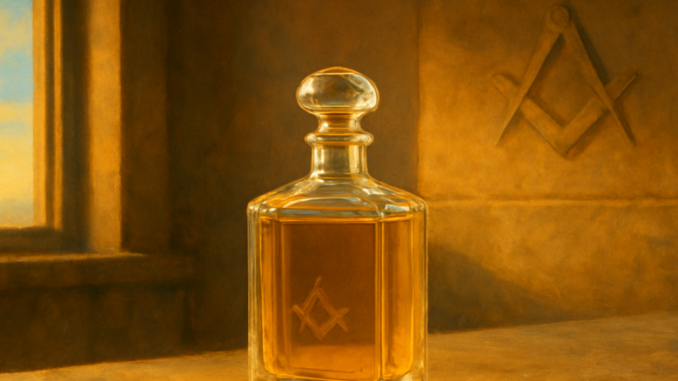
Imagine this: you have spent years building your name, your reputation, your brand. You have carefully chosen your partners, your products, the story you tell the world. Then one day, you discover that the perfume bearing your name is being sold alongside energy drinks and air fresheners at a gas station. This is exactly what happened to a famous former football player, who recently took the matter to court. The story raises a question that reaches far beyond trademark law: when does something that carries your name become unworthy of who you are? And what can Masonic ethics teach us about this?
Your Name Is More Than a Label
At its core, this legal dispute is not just about contracts or licensing agreements. It touches on a feeling most of us instinctively recognize: the experience of seeing something you care about end up in a place where it simply does not belong. Your name is on it, but you have lost control over the context in which it appears. This goes deeper than legal maneuvering — it strikes at the heart of integrity.
In Freemasonry, integrity is not an abstract ideal. It is a daily practice. Every brother is invited to reflect on a fundamental question: does my conduct align with the person I claim to be? Not because there is a penalty for falling short, but because honesty with oneself is the foundation of every meaningful life. The Scottish philosopher and Freemason Andrew Michael Ramsay wrote in the eighteenth century that the true Mason is not measured by his title or rank, but by the consistency between his words and his deeds.
The Ethics of Reputation: Lessons From the Lodge
Reputation is a theme deeply embedded in the Masonic tradition. James Anderson established in his famous Constitutions of 1723 that a Freemason should conduct himself in public in such a way that the Craft suffers no harm. Not out of fear of disgrace, but from the understanding that your name is a promise. When you attach your name to a product, an organization, or a cause, you are declaring: this is what I stand for. That principle applies to a celebrity with a fragrance line, but it applies equally to you and me.
The practical lesson is clear. Ask yourself regularly: where does my name appear, and does that context match my values? This could involve your signature on a contract, your involvement in a project at work, or even the way you present yourself online. Reputation is not vanity. It is the outward expression of your inner compass.
Determining Value: Price Versus Dignity
There is a fascinating tension at the heart of this story between two kinds of value. On one hand, there is market value: a bottle of perfume has a price, and the more points of sale, the greater the revenue. On the other hand, there is dignity — the meaning you assign to something that bears your name. The philosopher Immanuel Kant drew this distinction sharply. Things have a price, he wrote, but human beings have dignity. Dignity is irreplaceable and cannot be traded.
Ethics begins at the moment you refuse to let your name be used in a way that conflicts with your values — even when it would be financially profitable to do so.
Freemasons recognize this distinction in their daily work of self-improvement. The rough ashlar, the unworked stone that serves as a symbol for the unrefined self in the Lodge, is not polished to increase its market price. It is shaped to fit within a greater whole — a building of meaning and purpose. The value lies not in the price, but in the fitness of its place.
Three Concrete Steps to Handle Your Reputation Ethically
How do you translate these insights into your own life? Here are three actions you can take starting today.
1. Take inventory of where your name appears. Think about contracts, partnerships, online profiles, and memberships. For each one, ask yourself: if someone I deeply respect saw this, would I be proud? If the answer is no, take action.
2. Set boundaries before they are needed. The famous footballer in the news only discovered his perfume was being sold at gas stations after the fact. Ethical action is preventive. Establish in advance what may and may not be done with your name, your work, and your ideas.
3. Choose value over price. This may sound idealistic, but it is profoundly practical. A partnership that generates significant income but does not align with who you are will cost you more in the long run than it ever earns. Aristotle called this phronesis — practical wisdom, the ability to do the right thing in concrete situations.
The Gas Station as a Mirror
The gas station in this story is more than a retail location. It is a mirror. It forces us to confront the question: what am I willing to accept in exchange for reach, convenience, or money? In Freemasonry, this question is not asked just once — it is asked again and again. At every degree, at every meeting, at every moment of reflection. The French Enlightenment thinker Voltaire, himself closely connected to the Masonic tradition, put it succinctly: it is not enough to have good principles; one must also put them into practice.
The Freemason Benjamin Franklin took this a step further. He kept a daily journal in which he measured himself against thirteen virtues, including sincerity and justice. Not as punishment, but as exercise. Because ethics is not a theory you read and then forget. It is a muscle you train.
Why This Matters for Everyone
You do not have to be a celebrity to recognize something of yourself in this story. Anyone who has ever felt that their work, their name, or their effort was not properly valued knows the sting that lies beneath. Masonic ethics does not offer a ready-made answer, but it does offer a direction: be the guardian of your own name. Not out of pride, but out of respect for the edifice you are building with your life.
The next time you face a decision where your name, your energy, or your commitment is at stake, ask yourself the question that echoes in every Lodge: is this worthy of the person I am striving to become? That single question, honestly answered, is where all meaningful ethics begins.
Copyright text & image: devrijmetselaar.nl
Texts are based on the ideas and content of the author of devrijmetselaar.nl, reviewed, corrected, and supplemented with the assistance of OpenAI. Images are created based on the ideas of the author of devrijmetselaar.nl using OpenAI/DALL-E.
Frequently Asked Questions
What is the main ethical lesson from the perfume at a gas station case?
The case highlights that your name is a promise and carries responsibility beyond legal contracts. When you attach your name to a product or cause, you are declaring what you stand for. The ethical issue arises when that product ends up in a context that conflicts with your values or reputation, emphasizing that integrity means ensuring alignment between your words, deeds, and the contexts in which your name appears.
How does Freemasonry define integrity in relation to reputation?
In Freemasonry, integrity is not an abstract ideal but a daily practice rooted in self-honesty. Every Mason is encouraged to reflect on whether their conduct aligns with who they claim to be. As the Scottish philosopher Andrew Michael Ramsay wrote, a true Mason is measured not by title or rank, but by consistency between words and deeds. This means regularly examining where your name appears and whether those contexts match your values.
What did James Anderson's Constitutions of 1723 teach about a Mason's public conduct?
Anderson established that a Freemason should conduct himself publicly so that the Craft suffers no harm. This principle reflects the understanding that your name is a promise, not from fear of disgrace, but from genuine recognition that reputation is the outward expression of your inner compass. This teaching applies broadly to anyone seeking to maintain integrity in their personal, professional, and public life.



Be the first to comment