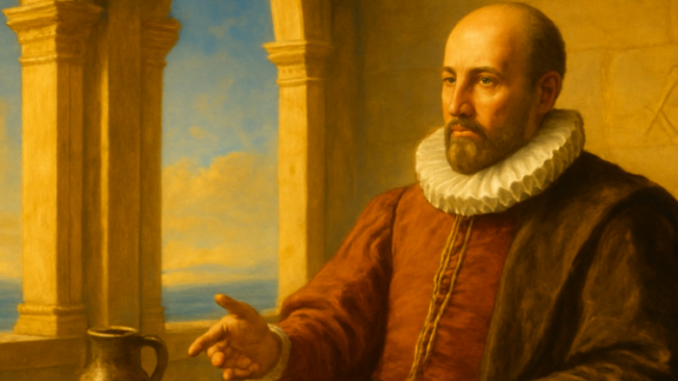
Picture the scene: you’re sitting at a table after a long day. Your glass is refilled, the conversation loosens, and slowly the sharp edge of your self-awareness begins to fade. What exactly happens to your character in that moment? Do you become more yourself — or less? Michel de Montaigne posed this very question over four centuries ago in his essay “On Drunkenness,” the second essay of the second book of his celebrated Essays. His answer is surprisingly practical and speaks directly to a question that also lies at the heart of Freemasonry: how do you come to know yourself, and how do you guard your own boundaries?
What Is the Essay Really About?
In “On Drunkenness,” Montaigne does far more than catalogue the consequences of drinking too much. He uses the subject as a lens through which to examine a much deeper question: what does the loss of self-control reveal about a person’s true character? The essay opens with the observation that certain vices are judged more harshly than others, depending on the era and the culture. Montaigne notes that drunkenness was considered a mortal sin in some civilizations, while others employed it ritually as a means of communion and even wisdom.
This is no moral sermon. It is an honest inquiry into human weakness. Montaigne openly admits that he himself drinks moderately and describes how his own habits changed over the course of his life. That personal candor is characteristic of his method: he consistently uses himself as a subject of study to uncover universal truths.
The Core Idea: Moderation as a Mirror of Character
Montaigne’s central argument is that excessive behavior — drunkenness in particular — does not create a new character but unmasks the one that already exists. When someone becomes intoxicated, they lose the thin veneer of civilization that normally regulates their conduct. What emerges is raw and unfiltered.
To support this claim, Montaigne draws on examples from classical antiquity. He cites Cato the Elder, who claimed that a person’s true nature is best revealed through wine and through play. Plato also makes an appearance: according to Montaigne, Plato saw the controlled use of wine as a useful exercise — provided it took place under supervision and in moderation.
Drunkenness reveals not who you wish to be, but who you truly are when the mask of civilization slips away. Self-knowledge begins with the honest observation of that unguarded self.
Montaigne also describes how some military commanders deliberately sent their soldiers into battle slightly drunk, on the assumption that it kindled courage. He immediately qualifies this: such false bravery is fragile, because it rests not on inner strength but on a temporary numbing of fear. True courage, he argues, arises from self-knowledge and discipline.
Key Examples and References
Montaigne draws extensively from ancient literature and historiography to strengthen his argument. Among his most striking examples are:
Julius Caesar, who according to Montaigne was known for his sobriety and thus served as a model of discipline amid luxury. The Spartan custom of deliberately making slaves drunk and displaying them to young people as a cautionary example of what excess does to a person. Seneca, who wrote that the wise man may occasionally let himself go, but must never lose possession of himself — a distinction Montaigne adopts with approval. And the story of a widow who discovered that her husband, an apparently chaste man, revealed an entirely different character when drunk — which Montaigne uses to illustrate the reality of hidden flaws.
Through these examples, Montaigne demonstrates that moderation is not merely a matter of health or decorum, but an ethical stance directly linked to self-knowledge. Those who cannot govern themselves cannot know themselves — and those who do not know themselves cannot be reliable members of any community.
Practical Lessons for Daily Life
The practical value of this essay does not lie in a plea for total abstinence. Montaigne was far too much of a realist for that. His lesson is subtler, and therefore more powerful: use moments of diminished self-control — whether caused by fatigue, emotion, or indeed one glass too many — as a mirror. What surfaces in those moments? Impatience? Unkindness? Or perhaps a warmth you normally suppress? The honest answer to that question is more valuable than any theory of virtue.
In concrete terms, you might apply this by asking yourself three questions after any social gathering: Did I say what I truly meant? Did I reveal something I would rather keep hidden? And was my behavior consistent with the person I aspire to be? This kind of self-reflection is precisely what Montaigne advocates — and it aligns seamlessly with Freemasonry, where the continual work on the rough ashlar, the unfinished self, is a daily task. Like Montaigne, Freemasonry invites us to look honestly into the mirror — not to condemn ourselves, but to improve.
Moderation as the Art of Living
Montaigne does not conclude his essay with condemnation but with a call for awareness. For him, moderation is not a rigid rule but a flexible attitude: know what you can handle, recognize your limits, and respect them. He acknowledges that it is human to occasionally overstep those limits, but emphasizes that the wise person learns from the transgression rather than ignoring it.
In Freemasonry, we find the same principle at work: perfection is not the goal. What matters is the willingness to examine yourself again and again, to keep refining and reshaping. The work on the rough ashlar never ends. Montaigne’s essay on drunkenness reminds us that the most valuable lessons often emerge from our weakest moments — provided we have the courage to look at ourselves honestly.
Whether you are a student of Montaigne, a practicing Freemason, or simply someone seeking greater self-awareness, the message is the same: moderation is not about denial. It is about paying attention. It is about understanding that every moment of vulnerability is an opportunity for insight — and that the rough stone of character is shaped not by avoiding our flaws, but by having the honesty and discipline to face them. In that ongoing work lies the truest form of wisdom.
Copyright text & image: devrijmetselaar.nl
Texts are based on the ideas and content of the author of devrijmetselaar.nl, reviewed, corrected, and supplemented with the assistance of OpenAI. Images are created based on the ideas of the author of devrijmetselaar.nl using OpenAI/DALL-E.
Frequently Asked Questions
What is Montaigne's main argument in 'On Drunkenness'?
Montaigne argues that excessive drinking does not create a new character but unmasks the one that already exists. When someone becomes intoxicated, they lose the veneer of civilization that regulates their conduct, revealing their true nature. He uses drunkenness as a lens to examine self-control and authentic self-knowledge, drawing on classical examples like Cato the Elder and Plato to support his claim that moderation serves as a mirror of one's true character.
How does Montaigne approach the topic of drunkenness in his essay?
Rather than delivering a moral sermon, Montaigne conducts an honest inquiry into human weakness using himself as a subject of study. He examines how different cultures and eras have judged drunkenness differently — from considering it a mortal sin to using it ritually for communion and wisdom. His personal candor and examination of his own habits are characteristic of his method for uncovering universal truths about human nature.
What is the connection between Montaigne's ideas and Freemasonry?
Both Montaigne's essay and Freemasonry address a central question: how do you come to know yourself and guard your own boundaries? Montaigne's exploration of self-knowledge through the loss of self-control mirrors Freemasonry's emphasis on personal development and honest self-examination. His argument that true character is revealed when civilization's mask slips away relates to the deeper self-understanding that Freemasonry seeks to cultivate in its members.

Be the first to comment