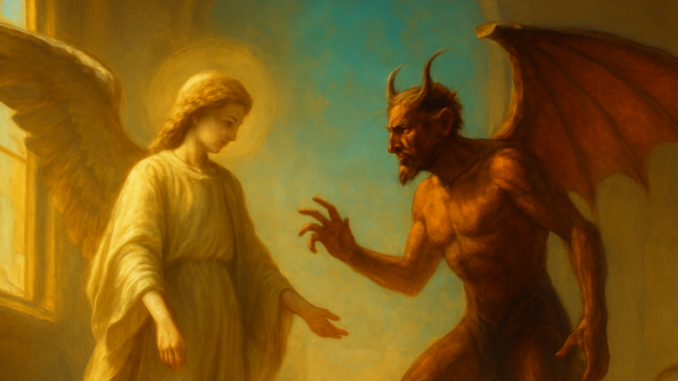
What if a thriller novel published in 2000 single-handedly convinced millions of readers worldwide that a secret society was plotting to destroy the Catholic Church? What if that same book lumped the terms “Illuminati” and “Freemasonry” together — and that cocktail of half-truths then took on a life of its own? That is precisely what happened when Dan Brown published Angels & Demons. Let’s sit down and ask the questions that really matter.
What Does Angels & Demons Actually Claim About the Illuminati?
The core premise of Dan Brown’s novel is as simple as it is explosive: the Illuminati, a historical secret society, never died out. Instead, they have been hiding in the shadows of Western civilization for centuries. Angels & Demons suggests that this brotherhood was originally founded by enlightened scientists who rebelled against the doctrines of the Church, leaving hidden traces of their existence in the art and architecture of Rome. The book paints a world in which science and faith stand as two hostile camps, with the Illuminati serving as the violent champions of reason.
It makes for a gripping story — but is any of it true? Before we answer that, let’s look at what else the book does: it conflates the historical Illuminati, founded by Adam Weishaupt in 1776 in Bavaria, with a much older and broader narrative about secret brotherhoods. Weishaupt was a professor of canon law who established a society dedicated to spreading Enlightenment ideals. His Order of the Illuminati was banned by the Bavarian government as early as 1785. In Angels & Demons, however, this short-lived historical organization is portrayed as though it never truly disappeared but continued operating underground well into the twenty-first century.
Why Are the Illuminati and Freemasonry Tangled Together in This Book?
Here we touch the heart of a persistent misconception. Dan Brown presents the Illuminati as a group that partly emerged from Masonic circles and partly went its own way. Historically, there was indeed a brief overlap: Weishaupt himself was a Freemason and attempted to recruit members of his Illuminati order from within existing lodges. But that entanglement was limited, short-lived, and viewed with suspicion by many Freemasons themselves. The novel inflates this historical footnote into a globe-spanning conspiracy, making it appear as though Freemasonry and the Illuminati are two sides of the same coin.
Is that a fair representation of Freemasonry? Not at all — and here is why. Freemasonry is a fraternity that has operated transparently for centuries, with public lodge buildings, published constitutions, and a tradition stretching back to the medieval stonemason guilds and the Constitutions of Anderson of 1723. The aims of Freemasonry — personal growth, brotherhood, tolerance — are a world away from the violent conspiracy depicted in Angels & Demons. Yet it is precisely this blending of fact and fiction that made the book so influential.
The power of Angels & Demons lies not in historical accuracy, but in its ability to weave real history and pure fiction together so seamlessly that the reader can no longer tell them apart.
How Could a Novel Have Such an Impact on the Image of Secret Societies?
Many people asked that very question after the book’s publication — and especially after the film adaptation that followed. The answer lies partly in the spirit of the times. Around the turn of the millennium, there was a growing appetite for stories about hidden powers pulling strings behind the scenes. Conspiracy theories were gaining traction on the early internet. Dan Brown played into this masterfully by opening his novel with the claim that the brotherhood of the Illuminati was a matter of fact. That rhetorical move — presenting fiction in the language of non-fiction — meant readers didn’t consume the book purely as entertainment, but as a kind of revelation.
The consequence was that terms like “Illuminati,” “all-seeing eye,” and “secret society” became inextricably linked with Freemasonry in the popular imagination, even though reality is far more nuanced. Great thinkers who were Freemasons — Voltaire, Wolfgang Amadeus Mozart, Johann Wolfgang von Goethe — would likely have been astonished by the picture Dan Brown painted of their brotherhood. They saw the lodge as a space for intellectual exchange and moral deepening, not as a breeding ground for conspiracies.
What Does This Teach Us About Fiction and Truth?
Perhaps the most important lesson of Angels & Demons is not what the book tells us about the Illuminati, but what it reveals about us as readers. We are inclined to see patterns where none exist, to draw connections between facts that merely sit side by side, and to suspect secrets behind every closed door. That inclination is deeply human. The philosopher Baruch Spinoza warned as far back as the seventeenth century about the danger of superstition that arises when fear and ignorance take the place of reason and inquiry.
Freemasonry understands the tension between openness and mystery better than most institutions. Its rituals are private — not because there is something to hide, but because the personal experience of the ritual loses its power when it is reduced to mere spectacle. That distinction, between privacy and secrecy, is precisely what gets lost in Angels & Demons. Dan Brown turns privacy into proof of malevolence, when in reality it is a form of respect for the inner journey every Freemason undertakes.
Putting the Illuminati Myth in Perspective
Let’s take stock. What does Angels & Demons claim? That the Illuminati are a living, dangerous organization with roots in Freemasonry. What does history actually tell us? That the Bavarian Illuminati were a short-lived Enlightenment society that was dissolved in 1785. While there was a brief period of overlap with Freemasonry, the two organizations had fundamentally different aims and structures. The Illuminati sought political influence; Freemasonry has always focused on the moral and spiritual development of the individual.
The gap between Brown’s narrative and documented history is vast. Yet his version has proven remarkably durable in the public mind. The lesson here is not that novels are dangerous — they are, after all, fiction — but that we as readers bear a responsibility to distinguish between a compelling story and verifiable fact. When we fail to make that distinction, we risk doing a disservice to real institutions and the real people within them.
Freemasonry continues to exist as it has for centuries: an open fraternity dedicated to self-improvement, mutual support, and tolerance. Its doors are not sealed against scrutiny; they are simply closed during moments of reflection. Understanding that difference is the first step toward seeing past the myth — and toward appreciating what Freemasonry truly offers.
Angels & Demons is a masterfully constructed thriller, but it is precisely that — a thriller. Its power to shape public perception of the Illuminati and Freemasonry is a testament to the enduring human fascination with hidden knowledge and secret powers. The real story, however, is both simpler and more profound: Freemasonry is not a shadow conspiracy but a centuries-old tradition of brotherhood, moral growth, and the pursuit of light. The next time you encounter the Illuminati myth, remember that the most important question is not whether the story is exciting, but whether it is true.
Copyright text & image: devrijmetselaar.nl
Texts are based on the ideas and content of the author of devrijmetselaar.nl, reviewed, corrected, and supplemented with the assistance of OpenAI. Images are created based on the ideas of the author of devrijmetselaar.nl using OpenAI/DALL-E.
Frequently Asked Questions
Did Dan Brown's Angels & Demons accurately portray the Illuminati?
No. While Angels & Demons claims the Illuminati never died out and have been plotting against the Church for centuries, the historical reality is quite different. The Order of the Illuminati was founded by Adam Weishaupt in Bavaria in 1776 and was banned by the Bavarian government as early as 1785. The novel conflates this short-lived historical organization with a much older narrative about secret brotherhoods, presenting fiction as fact to millions of readers.
What is the actual historical connection between the Illuminati and Freemasonry?
The connection is much more limited than Dan Brown suggests. While Weishaupt was himself a Freemason and attempted to recruit Illuminati members from within Masonic lodges, this overlap was brief, short-lived, and viewed with suspicion by many Freemasons. The novel inflates this historical footnote into a globe-spanning conspiracy, making it appear as though Freemasonry and the Illuminati are two sides of the same coin, which is not accurate.
Why did Angels & Demons have such a significant impact on public perception of secret societies?
Angels & Demons was a bestselling thriller published in 2000 that presented a compelling but largely fictional narrative about secret societies plotting against the Church. The book's gripping storytelling, combined with references to real historical organizations and actual Roman art and architecture, convinced millions of readers that the conspiracy was real. This blending of half-truths with fiction created a powerful misconception that took on a life of its own in popular culture.

Be the first to comment