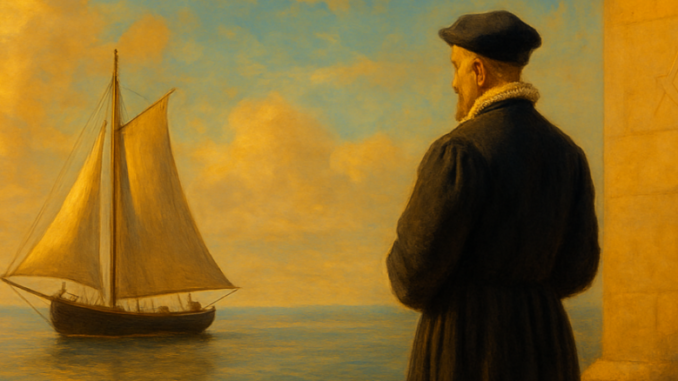
What drives a sixteenth-century nobleman to turn a fall from his horse into a philosophical laboratory? When Michel de Montaigne dissected his own near-death experience in his essay On Practice, he drew upon a rich tradition of thinkers who came before him. But which philosophers whispered to him from the shelves of his famous tower library? And why does their influence still resonate in the way we think about self-knowledge, mortality, and the boundaries of consciousness today?
Why Did Montaigne Write About Practicing Death?
To answer this question, we need to return to the heart of Stoic philosophy. The Roman thinker Seneca, one of Montaigne’s most beloved authors, wrote repeatedly in his Letters to Lucilius that practicing death is the highest form of freedom. He who learns to die, learns to live. This idea echoes throughout the entire essay On Practice. Montaigne does not merely quote Seneca as ornament — he enters into genuine dialogue with him, weighs his words, and then tests them against his own bodily experience. That is what makes this essay so remarkable: it is not an abstract treatise, but a philosophical experiment conducted on the author’s own body.
Yet Seneca was far from the only voice in Montaigne’s ear. The Stoic tradition extended well beyond Rome. Marcus Aurelius, the philosopher-emperor whose Meditations rank among the great Stoic works, stressed that a person must daily prepare for impermanence. Epictetus, the freed slave who taught philosophy as pure practice, insisted that we only have power over our own judgments — never over the events that befall us. Montaigne weaves these Stoic undertones into his essay without slavishly following them. He is not a dutiful pupil reciting lessons; he is a conversation partner who sometimes agrees and sometimes hesitates.
How Does Skepticism Shape This Essay?
This is where things become truly fascinating. Montaigne is widely regarded as the great reviver of Pyrrhonian skepticism during the Renaissance. Pyrrho of Elis, the Greek philosopher credited as the founder of this school, taught that true tranquility arises from the suspension of judgment. Sextus Empiricus, whose works Montaigne studied thoroughly, developed this into a systematic method of doubt. In On Practice, we see this skepticism return in a surprising way: Montaigne describes how, during his unconsciousness after the fall, he experienced nothing at all, and how his body seemingly continued to function without any conscious direction.
This raises a profound skeptical question: can we actually say anything reliable about the boundary between life and death, between consciousness and unconsciousness? Montaigne proves in On Practice that philosophy need not be abstraction — the deepest insights emerge precisely where personal experience and age-old wisdom meet.
Plutarch and the Classical Art of Living
Alongside the Stoics and Skeptics, Plutarch was an indispensable source for Montaigne. This Greek writer and moral philosopher, famous for his Parallel Lives and his Moralia, offered Montaigne something the strict Stoics sometimes lacked: warmth, humanity, and a deep understanding of the unpredictability of everyday life. Plutarch wrote not only about great heroes but about the small moments that reveal character.
We recognize this approach immediately in On Practice, where Montaigne does not make the fall itself the climax, but rather the confused, vulnerable moments that followed. The way he describes scratching at his doublet, thinking he was bleeding; how bystanders carried him while he drifted in and out of consciousness — this is Plutarch’s legacy: the conviction that truth resides in the seemingly insignificant detail.
Renaissance Humanism and the Living Dialogue
Montaigne wrote his essays at a time when humanism saturated the intellectual culture of Europe. Erasmus had paved the way for a rediscovery of the classics — not as dead texts, but as living conversation partners. Petrarch, who had rediscovered classical authors two centuries earlier, viewed reading Cicero and Virgil as a form of spiritual dialogue across the boundaries of time. Montaigne went a step further. Where the humanists admired the ancients, Montaigne subjected them to the test of his own experience. In On Practice, we see this humanist ideal at its sharpest: classical wisdom is not sacred dogma, but an invitation to think for oneself, to feel for oneself, to judge for oneself.
The Masonic Resonance: Testing Wisdom Through Experience
This brings us to a crucial question that also lies at the heart of Freemasonry. The lodge is, after all, a space where ancient wisdom traditions are not worshipped but tested. The ritual experience of the Freemason — in which he symbolically moves from darkness toward light — mirrors precisely what Montaigne does in this essay: engaging in a personal confrontation with the unknown, not on the basis of blind faith, but through conscious, inner practice.
Just as Montaigne did not blindly follow the Stoics but tested their insights against his own life, Freemasonry invites its members to truly live universal values rather than merely subscribe to them. The symbolic death and rebirth that runs through Masonic ritual finds a remarkable parallel in Montaigne’s near-death experience and the self-knowledge he extracted from it. Both traditions insist that understanding comes not from reading or hearing alone, but from direct, embodied experience.
What Makes This Philosophical Cross-Pollination Timeless?
The power of On Practice lies in its refusal to give any single philosophical school the final word. Montaigne was a Stoic in his courage to face death, a Skeptic in his honesty about what he could not know, and a Humanist in his conviction that the individual life is worth examining. Cicero, whom Montaigne read extensively, had already argued that philosophy is a preparation for death. But Montaigne turned this proposition on its head: perhaps death is actually a preparation for deeper living.
That insight — born from a fall from a horse on a country road in sixteenth-century France — continues to challenge and inspire us. It reminds us that the most enduring philosophy is never purely theoretical. It is lived, felt, and tested in the crucible of personal experience. Whether in Montaigne’s tower library, in the pages of Seneca and Plutarch, or within the walls of a Masonic lodge, the same principle holds: wisdom that remains untested remains incomplete.
Montaigne’s essay On Practice stands as a masterful demonstration of what happens when Stoic discipline, Skeptical inquiry, and Humanist warmth converge in a single, honest mind. His philosophical roots — Seneca, Marcus Aurelius, Epictetus, Pyrrho, Plutarch, Cicero — were not authorities to be obeyed, but companions to be questioned. For Freemasons and seekers of truth alike, Montaigne’s example endures as a powerful reminder: the deepest self-knowledge is never handed down from above. It is forged in the lived encounter between ancient wisdom and our own fragile, extraordinary experience.
Copyright text & image: devrijmetselaar.nl
Texts are based on the ideas and content of the author of devrijmetselaar.nl, reviewed, corrected, and supplemented with the assistance of OpenAI. Images are created based on the ideas of the author of devrijmetselaar.nl using OpenAI/DALL-E.
Frequently Asked Questions
What is the main philosophical tradition Montaigne draws upon in his essay On Practice?
Montaigne primarily draws upon Stoic philosophy, particularly the works of Seneca, Marcus Aurelius, and Epictetus. These thinkers emphasized practicing death as a path to freedom and understanding impermanence. Montaigne engages with their ideas not as a passive student but as a genuine dialogue partner, testing their philosophical principles against his own lived experience.
Why did Montaigne use his near-death experience from a horse fall as a philosophical experiment?
Montaigne transformed his personal trauma into a philosophical laboratory to explore self-knowledge, mortality, and consciousness. Rather than writing an abstract treatise, he conducted a genuine philosophical experiment on his own body and mind, examining how his body functioned without conscious awareness during his unconsciousness and what this reveals about the nature of human experience and death.
How does Pyrrhonian skepticism influence the essay On Practice?
Montaigne, known as the great reviver of Pyrrhonian skepticism in the Renaissance, incorporates the skeptical tradition into his essay through his examination of consciousness and judgment. His account of experiencing nothing during his unconsciousness reflects the skeptical principle that true tranquility comes from suspending judgment, and demonstrates how the body can function independently of conscious direction.


Be the first to comment