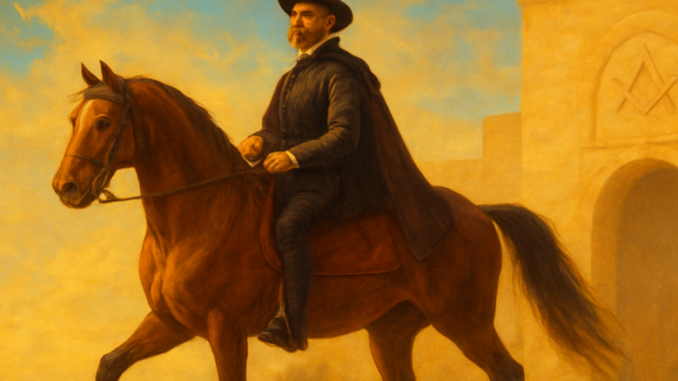
When Michel de Montaigne writes about horses in wartime, it might seem like a lightweight topic at first glance. But a closer reading reveals a text deeply rooted in ancient philosophical traditions. Two worlds converge in this essay: the practical reality of a sixteenth-century nobleman who knew horses as instruments of war, and the contemplative world of the classical philosopher who saw in every ordinary phenomenon a mirror for human character. The philosophical background of this essay shows just how much Montaigne owed to thinkers like Plutarch, Seneca, and the broader currents of Stoicism and Skepticism — currents that continue to resonate within Freemasonry to this day.
The Nobleman and the Philosopher
To understand the philosophical backdrop of this essay, it helps to hold two perspectives side by side. On one hand, there is Montaigne the French nobleman, born in 1533 at the Château de Montaigne in the Dordogne. For him, the horse was a daily reality — a means of travel, hunting, and warfare. The sixteenth century was saturated with armed conflict, and the war horse was no metaphor but a living instrument upon which lives depended. Montaigne knew that world intimately.
On the other hand, there is Montaigne the reader and thinker, a man whose library overflowed with the works of antiquity. In that world, the horse had long served as a philosophical motif. In Plato’s Phaedrus, it appears as part of the famous charioteer allegory, where two horses embody the opposing forces of the human soul: noble aspiration and untamed desire. Aristotle treated horses in his zoological works as study objects offering insight into the broader order of nature. Montaigne moved effortlessly between these two worlds, and it is precisely this duality that gives his essay its distinctive character.
Plutarch as the Primary Source
Of all the classical authors who influenced Montaigne, Plutarch is perhaps the most present in this essay. The Greek historian and moralist, who lived from approximately 46 to 120 AD, was Montaigne’s favorite reading. Plutarch’s Parallel Lives teems with anecdotes about generals and their horses. The most famous example is Bucephalus, the legendary horse of Alexander the Great, which Plutarch describes as an animal that could only be ridden by its master. Montaigne eagerly adopted these kinds of stories — not as historical curiosities, but as windows onto human virtue and character.
What Montaigne recognized in Plutarch was a method. Plutarch judged great men not solely by their military victories, but by how they engaged with the world around them: with their soldiers, their enemies, and yes, with their horses. The way a general treated his horse revealed something about his inner disposition. This idea — that the small gesture reveals the true nature of a person — runs like a thread through Montaigne’s entire body of work and is emphatically present in this forty-eighth essay.
Stoic and Skeptical Undertones
Alongside Plutarch, two philosophical currents that profoundly shaped Montaigne’s thinking resonate throughout this essay. The first is Stoicism — the philosophy of Seneca, Epictetus, and Marcus Aurelius, among others. The Stoics taught that a person should focus on what lies within their power and accept the uncontrollable with equanimity. In the context of war horses, this translates into a fundamental question: what does the rider truly control? The horse may startle, stumble, or fall. The enemy is unpredictable. What remains is the rider’s inner attitude. Seneca, whose letters Montaigne studied intensively, would have said that it is not the horse that makes the hero, but the spirit that rides it.
The second current is Skepticism, particularly the Pyrrhonism that Montaigne encountered through the works of Sextus Empiricus. The skeptical attitude permeates the essay in subtle ways: Montaigne piles up anecdotes without rendering a definitive judgment. Was Caesar a better rider than Alexander? Is it nobler to fight on horseback or on foot? Montaigne refuses to settle the matter. This suspension of judgment — the epoché in skeptical terms — is characteristic of his method and would later become one of the principles highly valued within Freemasonry: the capacity to listen and consider without rushing to a conclusion.
The philosopher and the Freemason share the same discipline: the ability to suspend judgment and to recognize the deeper question concealed within the everyday.
Renaissance Humanism as the Connecting Framework
The broader intellectual framework within which Montaigne operated was Renaissance humanism. This movement, which had originated in fourteenth-century Italy and spread across all of Europe by the sixteenth century, placed human experience at its center. Thinkers like Erasmus and Petrarch had paved the way by making classical texts accessible again and emphasizing that self-knowledge was the highest form of wisdom. The Delphic motto “Know thyself” — which also echoes through many Masonic lodges — was not an empty phrase for the humanists but a lifelong project.
Montaigne radicalized this humanist program. Where Erasmus still pursued a degree of systematic order, Montaigne chose the essay form: tentative, personal, without any pretense of completeness. An essay about war horses thus became not a treatise on cavalry tactics, but a meditation on human vanity, courage, and the limits of our control. It is precisely this approach that makes Montaigne’s work timeless and that touches on what Freemasonry strives for: not the accumulation of facts, but the cultivation of insight through reflection.
Two Worlds, One Search
What makes the interplay between the practical nobleman and the contemplative philosopher so compelling is that Montaigne never allows one perspective to silence the other. He does not retreat into pure abstraction, nor does he limit himself to mere anecdote. Instead, he moves between both registers, demonstrating that genuine wisdom arises when lived experience meets philosophical reflection. The war horse becomes more than an animal — it becomes a symbol of everything we think we control but ultimately cannot.
This dual vision — grounded in both practice and contemplation — is precisely what connects Montaigne’s thought to the Masonic tradition. In the lodge, as in Montaigne’s essays, knowledge is never purely theoretical. It must be tested against experience, weighed through dialogue, and refined through honest self-examination. The small gesture, the everyday observation, the seemingly trivial detail: these are the raw materials from which deeper understanding is built.
Montaigne’s essay on war horses is far more than a historical curiosity. It is a masterclass in the philosophical method that would later find a natural home in Freemasonry: the art of looking beneath the surface, suspending hasty judgment, and discovering in the most ordinary of subjects a profound inquiry into what it means to be human. Whether we ride horses or merely read about them, the deeper lesson endures — true mastery begins not with controlling the world around us, but with understanding ourselves.
Copyright text & image: devrijmetselaar.nl
Texts are based on the ideas and content of the author of devrijmetselaar.nl, reviewed, corrected, and supplemented with the assistance of OpenAI. Images are created based on the ideas of the author of devrijmetselaar.nl using OpenAI/DALL-E.
Frequently Asked Questions
What is the main focus of Montaigne's essay on horses in wartime?
Montaigne's essay on horses in wartime explores how a practical, sixteenth-century nobleman's experience with war horses converges with classical philosophical traditions. Rather than treating the topic lightly, Montaigne uses horses as a mirror for human character and virtue, drawing deeply from ancient philosophical sources like Plutarch, Seneca, Stoicism, and Skepticism.
How did Montaigne's background as a French nobleman influence his perspective on horses?
As a sixteenth-century French nobleman born at Château de Montaigne in 1533, Montaigne had direct, practical experience with horses as instruments of travel, hunting, and warfare during an era saturated with armed conflict. This intimate knowledge of horses as living, essential tools informed his philosophical reflections on the subject.
Why is Plutarch considered the primary philosophical influence on Montaigne's horse essay?
Plutarch was Montaigne's favorite classical author, and his works—particularly Parallel Lives—are deeply present in the essay. Plutarch's anecdotes about generals and their horses, such as Bucephalus and Alexander the Great, provided Montaigne with a method for using horse stories as windows into human virtue and character rather than mere historical curiosities.

Be the first to comment