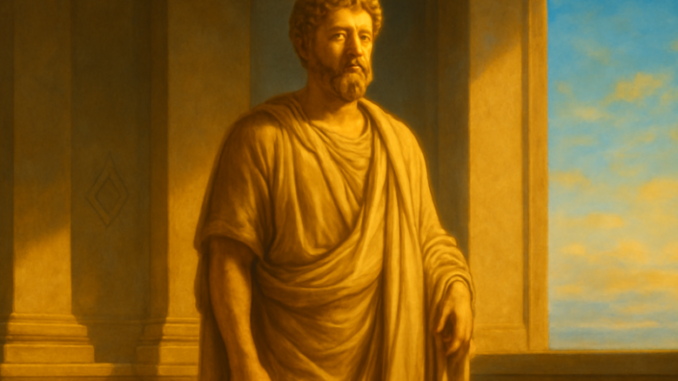
An oil lamp flickers softly as a Roman emperor, weary after a day of warfare on the northern frontiers, reaches for his writing tablet. It is deep into the night, somewhere around 170 AD. Marcus Aurelius begins to write — not for publication, but for himself. Sentences about impermanence, the present moment, the urgent need to live now. Where did these thoughts originate? What philosophical currents shaped this imperial mind that continues to inspire millions to this day?
The Stoic Roots of the Present Moment
In Book II of his Meditations, Marcus Aurelius turns with remarkable intensity to the theme of living in the here and now. This focus was no casual whim but the product of centuries of Stoic philosophical tradition. The Stoic school, founded by Zeno of Citium around 300 BC, developed a philosophy centered on mastering one’s own thinking. Marcus Aurelius inherited this tradition through a chain of teachers and writings stretching back to Greek antiquity.
At the heart of Stoic thinking about time lies a fundamental insight: only the present moment is truly ours. The past is gone and unchangeable; the future is uncertain and beyond our control. Epictetus, the former slave whose teachings Marcus Aurelius studied as a young man, drove this point home relentlessly. His Enchiridion, that essential handbook for the art of Stoic living, emphasizes that we hold power only over our own judgments and actions — here and now.
Heraclitus and the River of Time
Throughout his Meditations, Marcus Aurelius repeatedly invokes Heraclitus, the enigmatic philosopher from Ephesus who lived around 500 BC. Heraclitus’ famous declaration that one cannot step into the same river twice resonates through all of Book II. For Marcus Aurelius, this metaphor illustrates the ceaseless flow of time. Everything streams, everything changes, nothing remains. Yet this cosmic impermanence is not a source of despair — it is a source of liberation.
The realization that everything passes does not render the present moment worthless; it makes it precious. Precisely because this instant is fleeting, it deserves our full and undivided attention.
Heraclitus also introduced the concept of logos — the underlying order or reason that pervades the universe. The Stoics adopted this concept and made it a cornerstone of their philosophy. For Marcus Aurelius, living in the here and now also meant attuning oneself to this cosmic logos, acting in harmony with the natural order of things.
Seneca as a Bridge to Stoic Wisdom
Although Marcus Aurelius followed a Greek-language intellectual tradition, Stoic philosophy also reached him through Roman thinkers. Seneca, who lived roughly a century before Marcus Aurelius, had made Stoicism accessible to the Roman elite. His letters to Lucilius deal extensively with the themes of time and impermanence. In his essay On the Shortness of Life, Seneca argues that life is long enough for those who use it well. This thought echoes clearly through Book II of the Meditations.
Seneca insists that we squander our time on trivialities while neglecting the only thing of true value: the present moment. Marcus Aurelius takes up this theme but gives it his own distinctive inflection. Where Seneca can be rhetorical and dramatic, Marcus Aurelius is introspective and ruthlessly honest with himself. He writes not to persuade others but to remind himself of what he already knows yet constantly forgets.
The Lodge as a Training Ground for Attention
Freemasonry shares a striking parallel with this Stoic philosophy of presence. When a Freemason enters the Lodge, he leaves the outside world behind. The ritual space creates a bounded here and now — a sacred time set apart from the profane concerns of daily life. This is not an escape from reality but an intensification of it.
The symbols in the Lodge serve as anchors for attention. The square and compasses, the rough and polished ashlar, the plumb line and the level — these objects invite contemplation, a dwelling upon eternal truths within the fleeting present. Just as Marcus Aurelius used his meditations to bring himself back to what is essential, so the ritual brings the Freemason back to his inner work.
From Philosophical Theory to Living Practice
What sets Marcus Aurelius apart from many philosophers is his position as a practicing statesman. He wrote his Meditations while governing a world empire and waging wars. Philosophy was not an academic exercise for him but a daily necessity. Every moment brought decisions that affected lives. The here and now was not an abstract concept but the arena in which he was tested as a human being.
This connection between philosophy and daily action also lies at the heart of Freemasonry. The Craft does not ask for intellectual assent to particular doctrines; it calls for the application of virtues in lived experience. The rough stone must be worked — not in theory but in the practice of every single day. The here and now is the workshop.
Plutarch and the Moral Imagination
Another important influence on Marcus Aurelius’ thinking came from Plutarch, the Greek biographer and philosopher who lived from 46 to 120 AD. Plutarch combined Platonic and Stoic elements in his work and emphasized the power of moral examples. His Parallel Lives, in which he paired Greek and Roman statesmen for comparison, was standard reading for the Roman elite.
For Marcus Aurelius, Plutarch offered a method: meditating on the lives and deaths of great figures from the past in order to calibrate one’s own conduct. In Book II we find echoes of this practice when Marcus Aurelius reflects on the impermanence of even the mightiest emperors and philosophers. They have all passed away, and so shall we. This is not morbid fatalism — it is a call to make the most of the time that remains, to act with virtue and purpose while the present moment is still ours.
For the Freemason, this resonates deeply. The memento mori tradition within the Craft — the skull, the coffin, the hourglass — serves the same purpose as Marcus Aurelius’ reflections on mortality. These symbols are not meant to inspire dread but to sharpen awareness, to remind the Brother that life is finite and that the work upon the self must not be postponed.
The philosophical roots that nourished Marcus Aurelius’ focus on the present moment — from Zeno’s Stoicism through Heraclitus’ river of change, Seneca’s urgent call to use time wisely, and Plutarch’s moral exemplars — form a rich tapestry of thought that remains profoundly relevant. For Freemasons, these ancient insights find a living expression in every Lodge meeting, in every moment of ritual contemplation. The rough ashlar awaits our chisel not yesterday, not tomorrow, but now. As Marcus Aurelius wrote to himself nearly two thousand years ago: the present moment is the only wealth that no one can take from us. The question is whether we are truly present to receive it.
Copyright text & image: devrijmetselaar.nl
Texts are based on the ideas and content of the author of devrijmetselaar.nl, reviewed, corrected, and supplemented with the assistance of OpenAI. Images are created based on the ideas of the author of devrijmetselaar.nl using OpenAI/DALL-E.
Frequently Asked Questions
What is the connection between Marcus Aurelius and Stoic philosophy?
Marcus Aurelius inherited the Stoic philosophical tradition through a chain of teachers and writings stretching back to Greek antiquity, founded by Zeno of Citium around 300 BC. He studied under Epictetus, a former slave whose teachings emphasized that we hold power only over our own judgments and actions in the present moment. This Stoic influence shaped his Meditations, which focus intensely on living in the here and now.
Why did Marcus Aurelius emphasize the importance of the present moment?
According to Stoic philosophy, only the present moment is truly ours—the past is gone and unchangeable, while the future is uncertain and beyond our control. Marcus Aurelius drew inspiration from Heraclitus' metaphor that one cannot step into the same river twice, understanding that everything constantly changes and flows. This impermanence makes the present moment precious and worthy of our full and undivided attention.
What is the concept of logos that Marcus Aurelius valued?
Logos is the underlying order or reason that pervades the universe, a concept introduced by Heraclitus and adopted as a cornerstone of Stoic philosophy. For Marcus Aurelius, living in the here and now also meant attuning oneself to this cosmic logos and acting in harmony with the natural order of things.

Be the first to comment