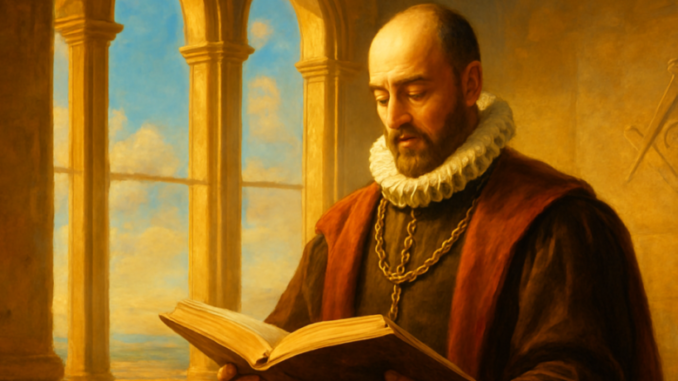
A general writes his war memoirs. Centuries later, a philosopher bends over those pages and discovers something that reaches far beyond strategy or glory. In Essay 53 of the first book of his famous Essays, Michel de Montaigne examines a remark Julius Caesar made about eloquence — and in doing so, he uncovers a deeper truth: that the way we speak and write always reveals something about who we really are. Behind the word stands the man, and behind the man stands a choice between appearance and authenticity.
The Word That Struck Montaigne
The essay opens with a deceptively simple starting point. Julius Caesar wrote in one of his works that he did in war what he did with his pen: surpass others. Montaigne seizes on this statement — not to heap praise upon Caesar, but to investigate what it means when a person describes his own deeds. Caesar was not only a military commander but also the author of accounts of his own campaigns. In that dual role, Montaigne detects a tension that fascinates him: can a person ever write honestly about himself, or does the desire for recognition inevitably distort the truth?
Montaigne admires Caesar as a stylist. He praises the clarity, directness, and power of Caesar’s prose. But at the same time, he questions the reliability of what was written. Caesar had every reason to present himself in a favorable light. His texts were not merely reports — they were political instruments. Montaigne thereby poses a question that has lost none of its sharpness across the centuries: to what extent can we distinguish between what a person says and what a person truly is?
Eloquence as Mask and Mirror
At the heart of this essay lies the ambiguous nature of language. Montaigne acknowledges that elegant words can conceal and reveal at the same time. A polished style can serve as a disguise, much like a theatrical mask hides the true expression beneath. But that same style, when born of sincerity, can also make a person’s inner world visible — like a mirror. Montaigne leans toward the latter: he believes that truly fine writing ultimately unmasks the author, even when the author tries to hide.
He extends the comparison to other ancient writers. Alongside Caesar, he mentions Cicero, whose eloquence he admires but whose vanity he sees through. Where Caesar writes with economy and directness, Cicero is expansive and self-conscious. Montaigne uses this contrast to demonstrate that style always betrays character. The way someone chooses words, the length of sentences, the degree of ornamentation — these are all traces leading to a deeper self.
Anyone who wishes to speak honestly must first summon the courage to look at himself honestly. Eloquence without authenticity is nothing more than a beautifully painted mask.
The Search for Authenticity
What makes this essay remarkable is that Montaigne applies his own method to himself. He wonders whether he, as the writer of the Essays, is not equally caught in the temptation of appearances. By writing about Caesar and Cicero, he writes indirectly about his own struggle. Montaigne consistently presents himself as someone searching for truth while remaining acutely aware of the limitations of language as a vehicle for that truth. It is precisely this humility that has made his work so compelling across the centuries.
Montaigne emphasizes that writing about oneself is an act of courage. It is easy to describe, analyze, and judge others. But turning the gaze inward — committing one’s own shortcomings and contradictions to paper — demands a kind of honesty most people would rather avoid. Caesar did it in his way, with the detached perspective of a commander. Montaigne does it in his, with the intimate, searching style that characterizes his entire body of work.
The Word as Bearer of Inner Truth
When we view this essay from a broader perspective, Montaigne touches on a theme that occupies a central place in Freemasonry as well: the relationship between the outer and the inner. In the tradition of the Craft, great value is placed on the spoken word, on the promise, on the ritual in which language is not merely a tool of communication but a bearer of meaning. Just as Montaigne argues that style and character are inseparably linked, so the Freemason recognizes the principle that words possess power only when they are carried by inner conviction.
The question Montaigne raises through Caesar is essentially the same question every seeker must ask himself: do I speak from authenticity, or do I dress my words to impress? The answer to that question is not simple — and may never be given definitively. But the very act of asking it is itself an exercise in self-reflection. In the philosophy of Socrates, whom Montaigne so admired, the maxim “know thyself” was regarded as the highest wisdom. Montaigne translates that imperative into the practice of writing and speaking, showing that every sentence we utter contains a choice: the choice to be genuine or to merely shine.
Key Themes and Examples
In summary, Montaigne addresses the following core themes in this short but rich essay:
First, the tension between eloquence and honesty when describing one’s own deeds. Second, the contrast between the writing styles of Julius Caesar — spare and direct — and Cicero — expansive and vain. Third, the idea that style always reveals character, even when the author does not intend it. Fourth, the courage required to write honestly about oneself. And fifth, the broader question of authenticity in word and deed, a theme that resonates deeply with the Socratic tradition and with the values held dear in Freemasonry.
Montaigne uses the example of Caesar not to render a historical judgment, but as a springboard toward a more fundamental inquiry — one that concerns every person who takes the time to examine the relationship between what he says and who he truly is.
Montaigne’s meditation on Caesar’s remark is far more than a literary exercise. It is an invitation to confront one of the most enduring challenges of human life: the alignment of our words with our inner truth. For Freemasons, this essay resonates with particular force. The Craft teaches that integrity begins not with grand gestures but with the smallest unit of expression — the word. Every promise spoken in lodge, every oath taken at the altar, carries weight only insofar as it reflects genuine conviction. Montaigne reminds us that the pursuit of authenticity is never finished; it is a continuous labor of self-knowledge, humility, and moral courage. In the end, it is not the beauty of our language that defines us, but the truthfulness behind it.
Copyright text & image: devrijmetselaar.nl
Texts are based on the ideas and content of the author of devrijmetselaar.nl, reviewed, corrected, and supplemented with the assistance of OpenAI. Images are created based on the ideas of the author of devrijmetselaar.nl using OpenAI/DALL-E.
Frequently Asked Questions
What does Montaigne examine in Essay 53 of his Essays?
Montaigne examines a remark Julius Caesar made about eloquence in his war memoirs. He investigates what Caesar's statement reveals about the relationship between how we speak and write and who we truly are, questioning whether a person can write honestly about themselves or if the desire for recognition distorts the truth.
How does Montaigne view the relationship between eloquence and authenticity?
Montaigne believes that eloquence is ambiguous—it can both conceal and reveal truth simultaneously. While elegant words can serve as a disguise like a theatrical mask, he ultimately believes that truly fine writing unmasks the author's true character, even when the author attempts to hide. Style always betrays character.
How does Montaigne compare Caesar and Cicero as writers?
Montaigne admires Caesar's clarity, directness, and powerful prose style, while he praises Cicero's eloquence but sees through his vanity. He uses the contrast between Caesar's economical writing and Cicero's expansive, self-conscious style to demonstrate that the way someone chooses words ultimately reveals their character.


Be the first to comment