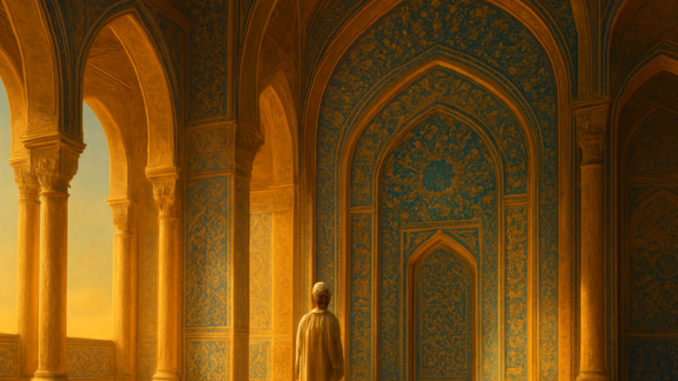
There is a moment in the Quranic tradition that is unforgettable in its simplicity. A blind man seeks spiritual guidance, but is ignored in favor of powerful dignitaries. The Prophet frowns and turns away. It is precisely this gesture — this frown — that lies at the heart of Surah 80. A holy book that corrects its own messenger opens a rare window onto a universal human theme: the temptation of pride and the necessity of humility. It is a theme that resonates as powerfully within the spiritual tradition of Islam as it does within the ritual practice of Freemasonry.
The Voice of the Surah: When the Powerful Turn Away
Surah 80, known as Abasa (“He Frowned”), is one of the shorter chapters of the Quran, consisting of 42 verses revealed during the early Meccan period. The verses describe an encounter in which the Prophet Muhammad is deep in conversation with influential leaders of the Quraysh tribe. At that very moment, a blind man named Abdullah ibn Umm Maktum approaches with sincere questions about the faith. The Prophet, absorbed in his effort to persuade the powerful, frowns and turns away from the blind man. The divine response is immediate and sharp: “He frowned and turned away, because the blind man came to him.”
What makes this passage so extraordinary is that the Quran corrects its own Prophet. It was not the blind man who failed, but the one who assumed that social rank determines who deserves the truth. The Surah then poses a fundamental question: who says the seeker with empty hands is worth less than the man of power with full pockets? The verses continue with a meditation on the origins of humanity — from a drop, from the earth — and conclude with a vision of the Day of Judgment, when every rank dissolves and each person stands alone with nothing but their deeds.
The World of the Seeker and the World of the Master
Let us place two perspectives side by side. On one hand, there is the world of Quranic revelation, where the believer is reminded of the equality of all souls before the Divine. Status, wealth, and influence are like shadows on a sunny day — they vanish the moment the light shifts. On the other hand, there is the world of the Masonic lodge, where every candidate enters the temple stripped of all distinguishing marks of social standing. In the lodge, the banker is equal to the carpenter, the professor equal to the apprentice. This equality is not a formality; it is a ritual principle that is lived and renewed at every meeting.
The moment the Prophet frowned is recognizable to anyone who has ever felt the impulse to give attention to someone who seemed important rather than to someone who was genuinely seeking. It is a human reflex, not a sin reserved for prophets. That is precisely why the correction is so powerful. In Freemasonry, this reflex is countered through the ritual practice of divesting: the candidate entering the lodge is literally and figuratively stripped of outward signs of status. What remains is the human being in their most essential state — a seeker.
Humility as Common Ground
True humility is not about making yourself smaller — it is about regarding the other as worthy enough to truly listen to, regardless of their outward condition.
What both traditions share is the insight that spiritual growth begins with the ability to look beyond the surface. In the Quranic context, the blind man is a symbol of the pure seeker — someone who literally cannot see but perceives with the heart. In Freemasonry, blindness plays a similarly significant role in ritual: the blindfolded candidate experiences during initiation that seeing with the eyes is not the same as seeing with the inner self. Both traditions use the loss of outward sight as a gateway to deeper insight.
The philosopher Plato described in his Allegory of the Cave how people who know only shadows fail to recognize true light when it appears before them. Spinoza argued that genuine knowledge comes from transcending prejudice and superficial impressions. Both thinkers, separated by centuries, touched upon the same point that Surah 80 raises: human beings tend to focus on what glitters, while the essential often presents itself in silence.
Two Traditions, One Mirror
It is important to note that comparing Quranic wisdom with Masonic ritual does not imply equivalence. The Quran is, for Muslims, the literal word of God — a revealed text with unique authority. Freemasonry is not a religion but a fraternity that pursues virtue and self-improvement, open to people of all faiths. What connects them is not a shared doctrine, but a shared mirror: both hold up to the individual the truth that their worth does not lie in their title, possessions, or position, but in the sincerity with which they meet the world and their fellow human beings.
In the lodge, this principle is embodied by the concept of the rough ashlar — the unworked stone that every Brother represents at the beginning of his journey. Shaping that stone is a lifelong process that demands honesty, self-reflection, and the willingness to recognize one’s own prejudices. Surah 80 describes that same movement: the moment of the frown is the moment the rough stone becomes visible. The correction that follows is the first blow of the gavel.
What the Frown Can Teach Us
Perhaps the most valuable lesson of Surah 80 is not that we should never frown, but that we must recognize the frown when it happens. The spiritual journey — whether it unfolds within the mosque, the lodge, or in a quiet moment of personal contemplation — does not begin with perfection but with honest self-examination. The question is not whether we ever overlook someone, because we all do. The question is whether we are willing to correct ourselves once we realize it.
Surah 80 teaches that even the most revered among us is not above correction. In Masonic philosophy, this same principle is embedded in the very structure of the Craft: every Brother, regardless of his degree or years of service, remains a student. The lodge is not a place of arrival but a workshop of continual becoming. The frown, then, is not a mark of failure — it is the raw material from which wisdom can be forged.
Both the Quran and the Masonic tradition remind us that the truest measure of a person is not how they treat the powerful, but how they treat the overlooked. The frown of the Prophet became a revelation; the rough ashlar of the Entered Apprentice becomes, through patient labor, a cornerstone. In both cases, the journey from pride to humility is not a single dramatic transformation but a daily practice — a willingness to look again, to listen more carefully, and to recognize that the person we are most tempted to dismiss may be the one with the most to teach us.
Copyright text & image: devrijmetselaar.nl
Texts are based on the ideas and content of the author of devrijmetselaar.nl, reviewed, corrected, and supplemented with the assistance of OpenAI. Images are created based on the ideas of the author of devrijmetselaar.nl using OpenAI/DALL-E.
Frequently Asked Questions
What is Surah 80 (Abasa) about?
Surah 80, known as 'He Frowned,' consists of 42 verses revealed during the early Meccan period. It describes an encounter where Prophet Muhammad is conversing with influential Quraysh leaders when a blind man named Abdullah ibn Umm Maktum approaches with sincere questions about faith. The Prophet frowns and turns away from the blind man, and the Quran immediately corrects this action, emphasizing that social rank should not determine who deserves access to truth and spiritual guidance.
Why is the Quran's correction of the Prophet significant?
The Quran's correction is extraordinary because a holy scripture directly rebukes its own messenger, teaching a universal lesson about the dangers of pride and the necessity of humility. Rather than blaming the blind man, the text focuses on the Prophet's assumption that social power and influence are more worthy of attention than sincere seekers. The Surah then reminds believers that all humans originate from humble beginnings and will stand alone on the Day of Judgment, stripped of all worldly rank.
How does this Islamic lesson relate to Freemasonry?
Both Islamic teaching and Masonic practice emphasize the equality of all souls and seekers. In a Masonic lodge, candidates enter stripped of all social distinguishing marks, making a banker equal to a carpenter and a professor equal to an apprentice. This ritual principle of equality is lived and renewed at every meeting, reflecting the same core message found in Surah 80: that a person's worth is not determined by wealth, status, or influence, but by their character and deeds.

Be the first to comment