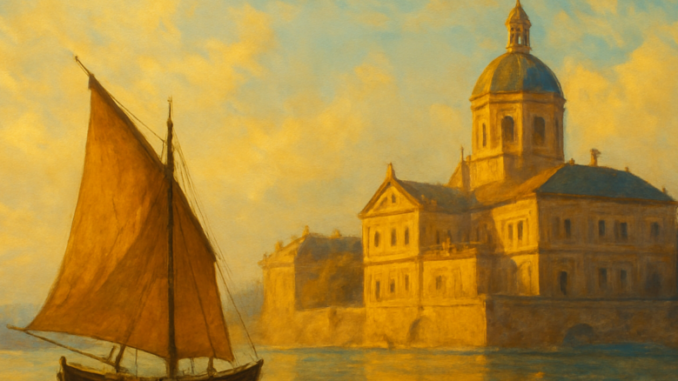
Picture this: it is the year 1600, and deep in the cellars beneath Prague Castle, the fire of a smelting furnace casts a flickering glow. A man in a worn cloak hunches over a flask of mercury, while somewhere above him an emperor awaits the impossible — the Philosopher’s Stone. This image of Prague as an alchemical epicenter has captivated imaginations for centuries, and it received renewed attention thanks to Dan Brown’s novel The Secret of Secrets. But how much of this story is actually true? And where does historical reality become entangled with literary imagination?
Emperor Rudolf II: The Historical Figure Behind the Myth
Rudolf II (1552–1612) was Holy Roman Emperor, and he chose to rule from Prague rather than the traditional imperial seat of Vienna. This is a well-established historical fact. He relocated his court to Prague Castle in 1583, where he assembled one of the most remarkable collections of art, curiosities, and scientific instruments of his era. Historians such as Robert John Weston Evans have extensively documented how Rudolf acted as a magnet for scholars, artists, and yes — alchemists from across Europe. The portrait Dan Brown paints in The Secret of Secrets of Prague as a vibrant hub of occult knowledge therefore rests on a solid historical foundation.
What is also firmly established is that Rudolf II suffered from periods of deep melancholy and increasingly withdrew from public governance. His fascination with alchemy, astrology, and the hidden sciences was not merely a pastime — it was a driving force in his life. The celebrated astronomers Tycho Brahe and Johannes Kepler both worked at his court, funded by the imperial treasury. These are not myths but well-documented facts found in countless academic sources.
The Golden Lane: Alchemist Workshop or Tourist Tale?
One of the most persistent images associated with Prague’s alchemical lore is the Golden Lane — the narrow street within the castle walls where alchemists supposedly produced gold for the emperor. Dan Brown plays cleverly on this image in The Secret of Secrets. The historical reality, however, is more nuanced. The tiny houses in Golden Lane were originally built around 1597 as quarters for the castle guard. It was not until much later, in the seventeenth and eighteenth centuries, that small craftsmen took up residence there. The story of alchemists toiling away in these workshops is most likely a romantic legend that only gained wide currency in the nineteenth century. Archaeological or archival evidence for alchemical workshops in the Golden Lane is largely absent.
That said, alchemical activities certainly did take place elsewhere on the castle grounds and throughout Prague. Edward Kelley, an English adventurer and self-proclaimed alchemist, genuinely resided in Prague and enjoyed Rudolf II’s favor for a time. His associate John Dee — the famous mathematician and occultist from Elizabethan England — also visited the court. These are historical facts. But the notion that there existed a secret network of alchemists directly linked to mystical societies, as The Secret of Secrets suggests, is not supported by primary sources.
What Is Exaggerated and What Is Pure Fiction?
Dan Brown is renowned for his ability to weave historical facts with spectacular fiction. In The Secret of Secrets, several claims are made that do not hold up under scrutiny as historical assertions:
The suggestion that Rudolf II financed a secret society that had actually discovered the Philosopher’s Stone is unsupported by any historical document. The idea that Prague’s alchemists successfully produced gold and kept it hidden from the outside world contradicts everything modern chemistry teaches us — the transmutation of base metals into gold was physically impossible with sixteenth-century means. The direct line the novel draws from Rudolf’s alchemists to later brotherhoods and societies is a literary construction, not a historical fact. And the existence of a hidden manuscript containing ultimate alchemical knowledge beneath Prague Castle belongs entirely to the realm of fiction.
At the same time, it is only fair to acknowledge that the boundaries between fact and fiction were already blurred in this era. For sixteenth-century practitioners, alchemy was not quackery but a serious pursuit of knowledge about nature. Figures like Paracelsus, who lived a generation before Rudolf, laid the experimental groundwork for what would eventually become modern chemistry. The alchemical tradition was therefore not mere charlatanism — it was a precursor to science.
The Alchemical Legacy and Freemasonry
What makes this story relevant to Freemasonry? Alchemy and Freemasonry share a fundamental conviction: that the human being is capable of self-transformation. Where the alchemist sought to turn lead into gold, the Freemason strives to refine the rough ashlar into a perfect cube. In both traditions, the ultimate goal is not literal gold but inner growth. The imperial workshops of Rudolf II were laboratories of the mind just as much as they were laboratories of matter. Isaac Newton, himself a devoted alchemist whose extensive notes were not discovered until centuries later, perhaps understood this dual nature of the quest better than anyone.
The alchemy of Prague was not a hunt for literal gold — it was a search for transformation. And that very same search forms the beating heart of Freemasonry.
It is tempting to follow Dan Brown’s lead and draw an unbroken line from the alchemists of Prague to the early modern Masonic lodges. Historically, however, such a direct connection cannot be demonstrated. The first Grand Lodge was not established until 1717 in London — more than a century after the death of Rudolf II. Yet the spiritual kinship between the two traditions is unmistakable. Both alchemists and Freemasons employed a rich symbolic language — the crucible and the furnace on one hand, the square and compasses on the other — to express truths about the inner life of the individual. Both traditions valued the transmission of knowledge through layers of meaning, accessible only to those who had been properly initiated into their mysteries.
The alchemists of Prague remind us that the search for transformation is ancient and enduring. Whether in a sixteenth-century laboratory beneath a castle or in a modern lodge room, the essential work remains the same: to take the raw material of our nature and shape it into something finer. That is neither fact nor myth — it is the timeless calling that connects seekers across the centuries.
The story of alchemy in Prague under Rudolf II is a compelling blend of documented history and enduring legend. While Dan Brown’s fictional embellishments make for thrilling reading, the genuine historical record is fascinating enough on its own. For Freemasons, the deeper lesson is clear: the real gold was never the point. The transformation of the self — the Great Work that alchemists and Masons alike have pursued through the ages — is the true treasure. In separating fact from myth, we do not diminish the mystery; we deepen our appreciation for the authentic tradition of inner refinement that continues to this day.
Copyright text & image: devrijmetselaar.nl
Texts are based on the ideas and content of the author of devrijmetselaar.nl, reviewed, corrected, and supplemented with the assistance of OpenAI. Images are created based on the ideas of the author of devrijmetselaar.nl using OpenAI/DALL-E.
Frequently Asked Questions
Was Emperor Rudolf II really interested in alchemy, or is this just a myth?
Rudolf II's interest in alchemy was very real, not merely a myth. He was Holy Roman Emperor who ruled from Prague Castle starting in 1583 and assembled one of the era's most remarkable collections of art, curiosities, and scientific instruments. His fascination with alchemy, astrology, and hidden sciences was a driving force in his life, not just a pastime. He even funded celebrated scholars like astronomers Tycho Brahe and Johannes Kepler at his court. However, the romanticized image of him desperately seeking the Philosopher's Stone in castle cellars is largely a product of literary imagination and later legend.
Is the Golden Lane really where alchemists worked to create gold for the emperor?
The Golden Lane's connection to alchemy is largely a romantic legend. Historically, the tiny houses in the Golden Lane were originally built around 1597 as quarters for castle guards, not as alchemist workshops. It wasn't until the seventeenth and eighteenth centuries that small craftsmen began living there. The famous story of alchemists toiling in these workshops to produce gold is most likely a nineteenth-century invention that gained popularity much later, not a contemporary historical reality.
How much of Dan Brown's portrayal of Prague's alchemy in 'The Secret of Secrets' is historically accurate?
Dan Brown's novel rests on a solid historical foundation regarding Rudolf II's genuine interest in alchemy and Prague as a hub of occult knowledge, which is well-documented by historians like Robert John Weston Evans. However, Brown blends historical facts with literary imagination. While Rudolf II did attract scholars, artists, and alchemists to Prague, the specific dramatic scenes — such as alchemists working in castle cellars searching for the Philosopher's Stone — are products of fiction rather than established historical fact.

Be the first to comment