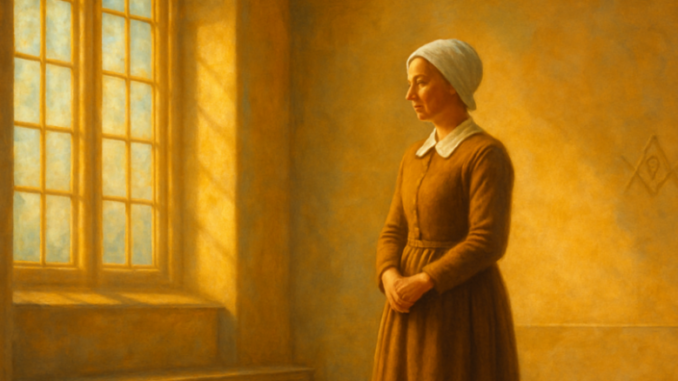
Imagine a room with no altar, no priest, no liturgy. A circle of people sitting together in silence, waiting for something that arises from within. No sermon, no music, no predetermined program — only stillness. For Quakers, this is not emptiness but the most direct path to what they call the Inner Light: a divine spark present in every human being. It is a radical idea that has fascinated thinkers for centuries, and one that reveals surprising kinship with the way Freemasons build their own inner temple.
An Empty Room as Sacred Space
A Quaker meeting begins with an empty chair — or rather, with a circle of chairs facing the center, where no one speaks unless moved by an inner calling. This practice traces back to George Fox, who broke with the established church order in mid-seventeenth-century England. Fox believed that no preacher, no book, and no ritual was necessary to experience the divine. All a person needed to do was become still and listen to the light already burning within.
That empty room is not a sign of poverty. It is a deliberate choice. By stripping away all outward forms, space is created for something beyond words. The silence here is not the absence of sound but the presence of attention. Anyone who has attended such a meeting often describes how the shared silence takes on an almost tangible density, as though the room itself begins to breathe.
The Inner Light: A Universal Concept
For Quakers, the Inner Light is no vague spiritual concept — it is a core conviction with concrete consequences. If every person carries a divine spark, then every person deserves equal dignity. This belief led Quakers to become early advocates against slavery, champions of women’s equal rights, and committed pacifists. The Inner Light was for them both a mystical experience and an ethical imperative.
Philosophically, this idea does not stand alone. The Stoics, particularly Marcus Aurelius, spoke of the logos dwelling in every rational being. Plato described in his Allegory of the Cave how humans must turn away from shadows to behold the true light. And Baruch Spinoza, who like the early Quakers operated outside the established order, saw God not as a distant creator but as the immanent force within all things. The Quaker Inner Light belongs to a long tradition of thinkers who sought the divine not above humanity, but within it.
Silence in the Masonic Lodge
Silence plays an essential role in Freemasonry as well, though in a different way. The Entered Apprentice is encouraged to remain silent and observe. This silence is not passive — it is an active exercise in receptivity. Before a candidate enters the lodge, he spends time in a dark room, the so-called Chamber of Reflection, where silence and darkness confront him with himself. Only after that inward journey does the real work begin.
Where Quakers use silence as direct access to the divine, Freemasons use it as preparation for ritual. And it is ritual itself that most clearly distinguishes the two traditions. Quakers have consciously abolished all ritual. Freemasonry, by contrast, builds its entire practice around a carefully structured ritual framework — complete with ceremonial actions, symbolic objects, and a precise sequence of words and gestures. Yet both traditions share the conviction that the ultimate goal lies not in the form itself, but in what that form awakens within the participant.
Silence is not emptiness but a workshop: both the Quaker and the Freemason understand that the deepest building takes place where words fall away.
Striking Parallels and Essential Differences
The points of contact between these two traditions are remarkable. Both Quakers and Freemasons place personal moral growth at the center of their practice. Both refuse to impose a dogmatic creed. Both view their community as a space for shared deepening rather than hierarchical instruction. And both have historically suffered persecution from religious and secular authorities suspicious of their independent spirit.
But the differences are equally instructive. Quakers choose radical openness: their meetings are accessible to everyone, decisions are made by consensus, and their records are public. Freemasonry operates with a degree of privacy: the ritual is not shown to outsiders, and the experience of initiation is by its nature personal and non-transferable. Where the Quaker shares his Inner Light by speaking when the spirit moves him, the Freemason guards certain experiences as an inner secret — not out of secrecy for its own sake, but from the understanding that some truths can only be grasped through direct experience.
Consider some of the key distinctions: Quakers reject all ritual, while Freemasons build their entire practice around it. Both traditions require no specific creed, yet Freemasonry does ask for belief in a Supreme Being. Quakers have no degrees or initiations, whereas Freemasonry uses a degree system as a path of personal development. And yet, both traditions deeply value silence as a wellspring of insight and self-reflection.
The Silent Building Site
There is something profound in the realization that two such different traditions arrive at the same primal form: a person becoming still in order to find something essential. George Fox did it in a bare room during the chaos of the English Civil War. The first speculative Freemasons did it half a century later in their newly established lodges, inspired by the ideas that James Anderson and Jean Théophile Desaguliers set down in their Constitutions. The outward form differs, but the movement is the same: turning inward so that one may afterward engage more fully with the world outside.
Whether seated in a Quaker circle or standing in a Masonic lodge, the practitioner encounters the same timeless invitation: be still, look within, and discover what waits in the silence. The Quakers call it the Inner Light. Freemasons speak of building the inner temple. The language differs, but the architecture of the soul recognizes no denominational boundaries. In a world saturated with noise, both traditions remind us that the most meaningful construction happens not in the clamor of daily life, but in the quiet spaces we dare to enter alone — and together.
Copyright text & image: devrijmetselaar.nl
Texts are based on the ideas and content of the author of devrijmetselaar.nl, reviewed, corrected, and supplemented with the assistance of OpenAI. Images are created based on the ideas of the author of devrijmetselaar.nl using OpenAI/DALL-E.
Frequently Asked Questions
What is the Inner Light in Quakerism and how does it differ from traditional religious practice?
The Inner Light is a divine spark present in every human being that Quakers believe provides a direct path to the divine without the need for priests, sermons, or elaborate rituals. Founded by George Fox in the 17th century, this practice emphasizes silent waiting and listening within to experience God directly. Unlike traditional churches with altars, liturgy, and predetermined programs, Quaker meetings gather in circles of silence, believing that stripping away outward forms creates space for genuine spiritual connection to emerge from within.
How did the Quaker belief in the Inner Light lead to social and ethical change?
The Quaker conviction that every person carries a divine spark had profound ethical consequences. This belief led Quakers to become early advocates against slavery, champions of women's equal rights, and committed pacifists. If all humans possess this Inner Light and divine dignity, then treating anyone as less than equal contradicts their core spiritual beliefs. Thus, the Inner Light served both as a mystical experience and as a direct ethical imperative to pursue justice and equality.
What is the connection between Quaker silence and Masonic practice?
While the article indicates that silence plays an essential role in both Quakerism and Freemasonry, the two traditions use silence in different ways. Quakers practice silence as the primary means of experiencing the Inner Light through shared stillness and waiting for divine guidance. Freemasons also incorporate silence into their lodge practice, though the article suggests this serves a different function within their tradition. Both traditions recognize silence as a path to inner spiritual development and deeper understanding.


Be the first to comment