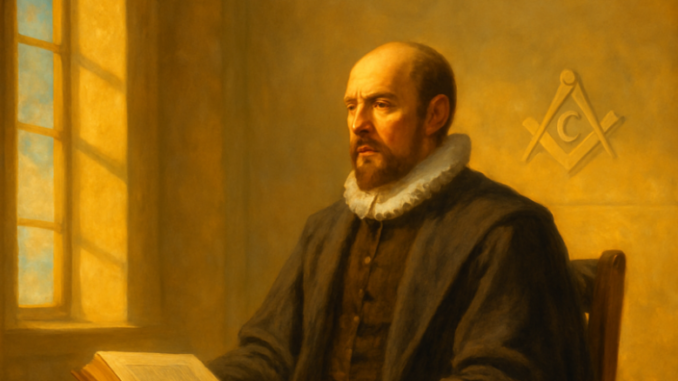
Can abundance actually isolate us? It sounds paradoxical — the more we possess, the higher the walls we build around ourselves. Michel de Montaigne posed this very question over four hundred years ago in his brief but remarkably incisive essay “On the Frugality of Our Ancestors.” His answer is not a moralistic sermon but an invitation to reflect on what truly connects us as human beings. And it is precisely there that his thinking touches the heart of Freemasonry: the conviction that inner wealth and genuine connection outweigh any outward display of status.
Possession as an Obstacle
Montaigne opens his essay by looking back at antiquity. The Roman consuls and senators he describes lived with a simplicity that would have been unimaginable to his own contemporaries. Cato the Elder, Manius Curius Dentatus, Gaius Fabricius Luscinus — all men who bore enormous responsibility, yet whose households were scarcely different from those of their neighbours. Montaigne emphasises that these ancestors were not poor out of inability but out of conviction. Their frugality was a deliberate choice, a way of life that brought them closer to their fellow citizens rather than alienating them.
A powerful thesis emerges here, one that reaches far beyond historical observation: whoever strips away unnecessary adornment lays the foundation for genuine connection. It is a thought that resonates uncomfortably in an age of material excess. Montaigne suggests that the relentless accumulation of possessions is not a sign of progress but a symptom of having lost something far more essential.
The Ancestors as a Mirror for the Seeker
What makes this essay so relevant for anyone drawn to Freemasonry? The lodge is, above all, a place where outward distinctions are set aside. Brethren meet on the level, regardless of their social position or financial standing. The apron every Freemason wears recalls the craftsman who works with his hands, not the merchant who parades his wealth. This equality is not a mere formality — it is a living principle renewed at every meeting.
Montaigne would have recognised this immediately. His admiration for the Roman ancestors was never a nostalgic sigh for times gone by but a philosophical challenge to his own era. Just as a candidate for initiation is symbolically divested of metals — of everything representing external value — Montaigne describes how the ancients possessed a moral strength through their simplicity that their successors had lost. The parallel is striking: shedding ballast as a precondition for inner growth.
A Counterpoint: Is Simplicity Truly the Way?
Honest reflection, however, compels us to consider the other side. Is simplicity a virtue in itself, or does it become one only when paired with awareness? Seneca, the Roman Stoic whom Montaigne read avidly, lived in considerable luxury while singing the praises of the simple life. Aristotle did not advocate abstinence but rather the golden mean. And within Freemasonry itself, the goal is not to reject the material world but to hold it in proper perspective.
Montaigne was keenly aware of this tension. He never idealised the ancients blindly. His method was always one of weighing and questioning, of examining every side of a matter. In the tradition of his famous motto “Que sais-je?” — What do I know? — he leaves room for doubt. And that doubt is no weakness. It is a source of strength, allowing readers to arrive at their own understanding rather than accepting a prescribed answer.
Connection does not arise from what we possess but from what we are willing to let go. That insight lies at the core of both Montaigne’s philosophy and the Masonic way of life.
The Lodge as a Training Ground for Connection
When we place Montaigne’s essay on ancestral frugality alongside the values of Freemasonry, a clear pattern unfolds. Both traditions point toward the same realisation: that true connection requires the shedding of pretence. The Roman consul who ploughed his own field and the brother who surrenders his metals at initiation are making the same gesture. They choose to present themselves as vulnerable and equal — not out of weakness, but from the understanding that this is the very ground on which authentic human encounter becomes possible.
Freemasonry provides a remarkable framework for this practice. The lodge is a protected space in which brethren work together on their inner edifice — the ongoing process of moral self-improvement. That labour is communal by definition. No brother builds alone. And just as Montaigne describes how the frugality of the ancients fostered a sense of community that luxury would have undermined, the lodge creates a space in which the ordinary hierarchies of the outside world are temporarily suspended.
The Virtue of Enough
There is a deeper layer in Montaigne’s argument that deserves attention. The frugality he describes is not merely material — it extends to thought itself. The ancestors were sparing with words, with judgements, with claims of wisdom. They acted more than they spoke. Here, too, Montaigne touches on a Masonic principle: the preference for deeds over words, for quiet labour over loud proclamation. The ritual in the lodge is steeped in this awareness. Silence plays a role every bit as important as the spoken word.
Plato wrote in The Republic that the best leaders are those who do not seek power. Montaigne would have agreed, and Freemasonry translates that ideal into the daily practice of brotherhood. The Worshipful Master in the lodge serves; he does not rule. The frugality of the ancestors was, ultimately, a form of service — the conscious act of stepping back for the benefit of the whole.
Montaigne’s brief essay on ancestral frugality continues to pose a question that every thoughtful person — and every Freemason — must wrestle with. What do we truly need to feel connected? What are we willing to release in order to meet one another as equals? The lodge does not promise easy answers, but it does offer something rare: a living space in which these questions are not merely discussed but embodied, meeting after meeting, in ritual and in silence. Perhaps the greatest lesson from both Montaigne and Freemasonry is that the path to genuine brotherhood begins not with acquiring more, but with the quiet courage of having enough.
Copyright text & image: devrijmetselaar.nl
Texts are based on the ideas and content of the author of devrijmetselaar.nl, reviewed, corrected, and supplemented with the assistance of OpenAI. Images are created based on the ideas of the author of devrijmetselaar.nl using OpenAI/DALL-E.

Be the first to comment