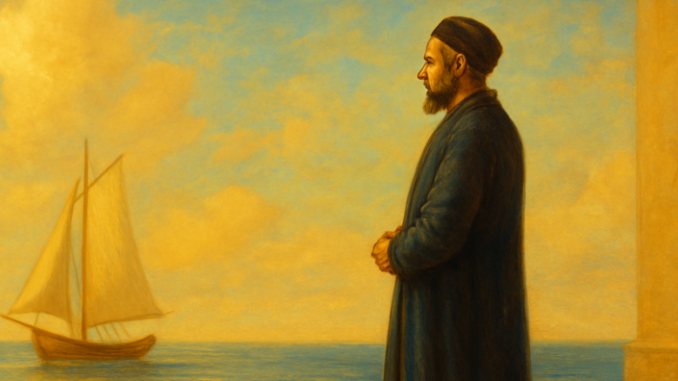
In 1580, a collection of essays appeared that would permanently reshape Western literature. Michel de Montaigne, the French nobleman and philosopher, wrote about everything that occupied his restless mind — from friendship to cannibalism. In the seventeenth essay of his first book, he turned his attention to a universal human experience: fear. This relatively short piece reveals just how profoundly Montaigne understood the human psyche, centuries before modern psychology would even begin to take shape.
The Core Idea of the Essay
Montaigne opens with a paradox that sets the tone for his entire argument: fear is the emotion he fears most. What seems like a clever play on words actually conceals a profound truth. Montaigne is not primarily concerned with the concrete dangers that threaten us, but with what fear does to the human mind. Fear robs us of our capacity for reason and strips us of our dignity. It transforms a soldier into a coward and a wise man into a fool.
The central thesis of the essay is that fear is a more powerful and more disruptive emotion than any other passion. Even anger, grief, or desire leave the human mind somewhat intact. Fear, by contrast, takes complete possession of body and soul. Montaigne describes how people under the influence of extreme terror become literally paralyzed, act irrationally, or even die when no physical danger is actually present.
Historical Examples as Mirrors
As was his custom, Montaigne drew liberally from classical antiquity to support his arguments. He references Marc Antony, who was overwhelmed by fear during battle and fled in blind panic. The Roman general was not defeated by superior enemy forces — he was defeated by the tyrannical grip of his own terror. Montaigne also recounts the story of soldiers who, in their mortal dread, embraced the enemy instead of fighting — a bizarre reaction that only becomes explicable when we understand how fear can completely shut down our faculty of judgment.
Particularly striking is the example Montaigne gives of people whose hair turned grey within hours due to extreme fear. This phenomenon, long dismissed as exaggeration, has since been confirmed by modern science. Montaigne observed in the sixteenth century what researchers have only recently been able to explain. His examples are never merely decorative — they serve as empirical evidence for his philosophical insights.
Fear as a Social Force
Montaigne did not limit himself to individual psychology. He demonstrated how fear can disrupt entire societies. In his own time, ravaged by the Wars of Religion between Catholics and Protestants, he witnessed firsthand how terror drove people to commit atrocities. Fear of the other, fear of the unknown, fear of damnation — these turned neighbors into enemies. This insight remains extraordinarily relevant today: many social tensions are rooted not in actual threats but in the fear of what might happen.
Fear is the emotion that removes us furthest from ourselves and drives us to acts we would never commit in our true state.
Montaigne drew an important distinction between fear and prudence. The wise person acknowledges dangers and takes appropriate measures but does not allow fear to rule. This distinction reflects a classical Stoic ideal that Montaigne absorbed through thinkers like Seneca and Marcus Aurelius. Reason must guide the emotions — not the other way around.
The Remedy Against Fear
Although Montaigne offers no definitive cure for fear, his essay suggests several directions. First and foremost: self-knowledge. By examining and naming our own fears, they lose a portion of their power over us. Montaigne wrote his essays as a form of self-examination, and this essay is no exception. Second: the cultivation of courage — not as the absence of fear, but as the ability to act according to reason and virtue despite being afraid.
Montaigne implicitly invoked the philosophical tradition that regards courage as a cardinal virtue. From Aristotle to the Stoics, courage was considered essential for a life of dignity. But where antiquity often linked courage to martial valor, Montaigne broadened the concept. Courage is also required to face the truth about yourself, to hold unpopular positions, and to meet death with composure. For those familiar with Masonic philosophy, this expanded understanding of courage resonates deeply — the work of self-improvement and honest self-reflection demands a bravery that has nothing to do with the battlefield and everything to do with the inner life.
Lasting Relevance
The essay “On Fear” has remained surprisingly current. In an age when fear is frequently deployed as a political instrument and media floods us daily with reports of threats, Montaigne’s analysis provides a vital counterweight. He invites us to look critically at our own anxieties: are they grounded in real dangers, or are they phantoms of our own imagination?
Montaigne’s approach is remarkably humane and gentle. He does not condemn those who succumb to fear as cowards. On the contrary, he acknowledges that we are all vulnerable to this powerful emotion. His essay is not a manual for fearlessness but an invitation to honest self-examination. By understanding our own fears, we may be able to loosen their grip on us.
A Summary
In Essay 17 of his first book, Michel de Montaigne investigates the workings and consequences of fear. He argues that fear is the most disruptive of all emotions because it robs us of our capacity for reason. Drawing on examples from classical antiquity, he illustrates how fear leads to bizarre, irrational, and sometimes fatal actions. Montaigne distinguishes fear from sensible caution and implicitly advocates for the cultivation of courage and self-knowledge as counterbalances. More than four centuries later, the essay remains a striking analysis of an emotion that touches us all.
Montaigne’s essay “On Fear” is far more than a historical curiosity. It is a mirror that confronts us with our own vulnerabilities and invites us toward genuine self-reflection. In a world increasingly shaped by anxiety, his centuries-old wisdom reminds us that the most important battle is not waged against external threats but against the fears that cloud our judgment from within. For anyone on a path of self-improvement — Freemasons and seekers alike — Montaigne’s gentle yet unflinching honesty about human frailty offers both consolation and a call to cultivate the courage that true self-knowledge demands.
Copyright text & image: devrijmetselaar.nl
Texts are based on the ideas and content of the author of devrijmetselaar.nl, reviewed, corrected, and supplemented with the assistance of OpenAI. Images are created based on the ideas of the author of devrijmetselaar.nl using OpenAI/DALL-E.
Frequently Asked Questions
What is the main thesis of Montaigne's Essay 17 on fear?
Montaigne argues that fear is the most powerful and disruptive emotion, capable of taking complete possession of both body and soul. Unlike other passions such as anger or grief, fear robs people of their capacity for reason and dignity, transforming them into irrational beings who may become paralyzed, act bizarrely, or even die without any actual physical danger present.
What historical examples does Montaigne use to support his argument about fear?
Montaigne references Marc Antony, who was overwhelmed by fear during battle and fled in panic despite facing no superior enemy forces. He also describes soldiers who embraced their enemies instead of fighting due to mortal dread, and recounts cases of people whose hair turned grey within hours from extreme fear—a phenomenon that modern science has since validated.
How does Montaigne's understanding of fear relate to modern psychology?
Montaigne's observations about fear were made centuries before modern psychology emerged, yet they demonstrate profound psychological insight. His examples, such as people experiencing physical changes from terror or becoming paralyzed by fear, have since been confirmed by modern scientific research, showing that his empirical observations were ahead of his time.


Be the first to comment