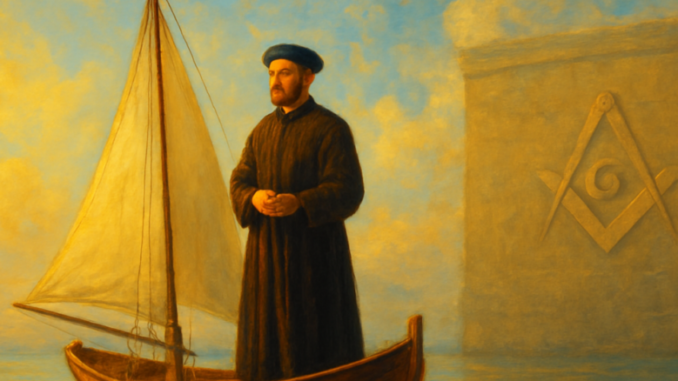
You probably know the feeling: you’re in a conversation where someone keeps dancing around the truth. Words are twisted, intentions disguised, and you sense the other person isn’t truly present — they’re performing. It’s precisely this kind of unease that Michel de Montaigne captures so brilliantly in his essay ‘On Vain Cunning.’ But while Montaigne exposes the hollowness of clever tricks, he simultaneously points toward something far more profound: the value of genuine human connection. It’s a theme that resonates deeply with the very heart of Freemasonry.
When Cleverness Becomes an Obstacle
In Essay 54 of the first book of his celebrated Essais, Montaigne examines the phenomenon of vain cunning — the clever manoeuvre, the elaborate scheme, the trick that seems brilliant on the surface but ultimately destroys more than it achieves. Drawing examples from classical antiquity and military history, he shows how generals and rulers undermined themselves by placing too much trust in deception and stratagem. His conclusion is sobering: those who constantly manoeuvre lose touch with reality — and with the people around them.
That insight extends far beyond the battlefield or the diplomatic table. You can probably recognise it in your own life. How often do you try to steer a situation by saying what the other person wants to hear rather than what you actually think? Montaigne invites us to face that tendency honestly — not with an accusing finger, but with the gentle curiosity that is so characteristic of his writing.
Sincerity as the Foundation of Brotherhood
This is where Montaigne’s thinking touches one of the central pillars of Freemasonry: brotherhood. True brotherhood is impossible without sincerity. In the lodge, brethren meet as equals, stripped of the masks they wear in daily life. This is not an abstract ideal — it is a living practice. When you move through a ritual together, when you stand in silence beside another, when you speak words you truly mean, something emerges that no amount of cunning could ever produce: trust.
Montaigne would have recognised this immediately. In describing his famous friendship with Étienne de La Boétie, he spoke of a bond so deep that words fell short. “Because it was he, because it was I,” he wrote. There was no strategy in it, no calculation — only the naked truth of two people who saw each other fully. That is the kind of connection Freemasonry aspires to: not superficial, not transactional, but essential.
The Search for Truth Begins Within
Another Masonic theme that echoes through this essay is self-reflection. Montaigne was a master at examining his own motives. Why do I say this? Why do I do that? What truly drives me? He asked himself these questions relentlessly and was never afraid to find uncomfortable answers. In Freemasonry, this is known as working the rough stone — the continual refining of one’s own character, the honest confrontation with one’s shortcomings.
Genuine connection only becomes possible when we set aside the mask of cleverness and find the courage to truly meet ourselves and each other.
When Montaigne dissects the vain cunning of military leaders, he holds up a mirror to anyone who treats life as a chess game in which the goal is to outmanoeuvre the opponent. His message is clear: real victory lies not in being clever, but in being authentic. That thought is timeless and runs like a thread through both the humanist tradition and Freemasonry.
From Cunning to Light: An Inner Journey
In Freemasonry, the concept of ‘light’ plays a central role. It represents knowledge, insight, and moral clarity. The journey from darkness to light is a metaphor for the inner growth every Freemason pursues. Montaigne’s essay fits seamlessly into that image. Vain cunning is a form of darkness: it clouds relationships, sows distrust, and isolates the deceiver from those around him. Sincerity, by contrast, brings light. It reveals what is real and creates space for genuine encounter.
Consider this in your own life. Where do you choose the detour when the direct path is available? Where do you conceal your true intentions out of fear of vulnerability? Montaigne would say: that fear is understandable, but it robs you of the most valuable thing there is — the experience of real connection with another human being.
Virtue as a Compass in Uncertain Times
Both Montaigne and Freemasonry place virtue above cleverness. While the world around us often rewards those who manoeuvre most skilfully, both traditions choose a different compass. The virtuous person is neither naive nor unworldly. On the contrary: someone who lives virtuously understands the cunning of the world but consciously chooses not to employ it. That takes courage, and it takes practice. In the lodge, you practise that courage in a protected space, alongside others who have made the same choice.
It is no coincidence that thinkers like Aristotle and Seneca — whose works Montaigne quoted extensively — shared this same conviction. Virtue is not weakness; it is strength. It is the foundation on which lasting communities are built, whether that community is a friendship, a family, or a brotherhood of Freemasons.
Montaigne’s essay on vain cunning is ultimately not an accusation but an invitation — an invitation to descend to the core of who you are and to meet the world from that place. That is precisely what Freemasonry offers as well: not a system of answers, but a path of questions; not a recipe for success, but an exercise in humanity. If you are willing to let go of the tricks and connect with what is real, then the true work begins. And that work — however humble it may seem — is the most meaningful journey you will ever undertake.
Copyright text & image: devrijmetselaar.nl
Texts are based on the ideas and content of the author of devrijmetselaar.nl, reviewed, corrected, and supplemented with the assistance of OpenAI. Images are created based on the ideas of the author of devrijmetselaar.nl using OpenAI/DALL-E.


Be the first to comment