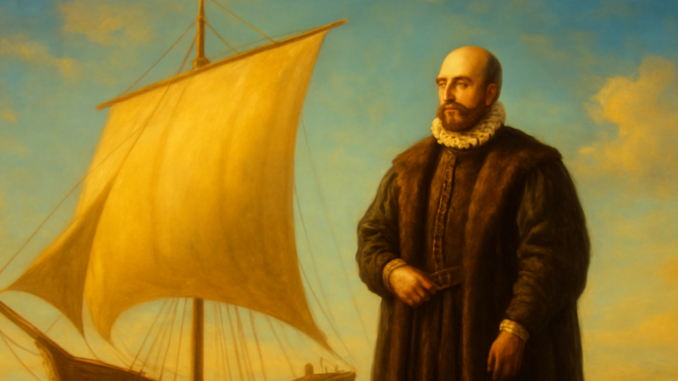
Imagine you’re in a conversation and you notice the other person putting a clever spin on their words. They’re not outright lying, but they’re bending the truth just enough to tilt things in their favor. You feel it instantly: distance creeps in, and trust begins to crack. This exact mechanism fascinated Michel de Montaigne in his essay “On Vain Stratagems,” where he demonstrates that artificial cleverness doesn’t connect people — it isolates them. And it’s precisely here that his thinking touches something Freemasons have cherished for centuries: genuine connection can only flourish where sincerity reigns.
The Illusion of the Clever Trick
In Essay 54 of the first book of his celebrated Essays, Michel de Montaigne examines a series of historical military stratagems and diplomatic ruses. He describes how generals and statesmen attempted to outsmart their opponents with elaborate schemes. At first glance, these stories seem to be about tactics and strategy. But Montaigne digs deeper. His real question is: what happens to a person who constantly resorts to cunning? What becomes of the relationship between people when craftiness replaces honesty?
Montaigne arrives at a surprisingly clear answer. Most stratagems are vain — not only because they often fail, but because they erode the bond between people. Anyone who tries to outwit another places themselves outside the circle of trust. And trust, as Montaigne well understood, is the foundation upon which every human community rests. Without trust there can be no friendship, no cooperation, no brotherhood.
Sincerity as the Foundation of Brotherhood
Here, Montaigne’s thinking aligns remarkably with the core principles of Freemasonry. Within the lodge, sincerity is not an optional ideal — it is a prerequisite. When brethren come together, they set aside the masks of everyday life. The purpose is not to impress or outdo one another, but to seek truth and growth together. That requires vulnerability, and vulnerability is the very opposite of the stratagem.
Montaigne would have felt at home in such an atmosphere. His entire philosophical project revolved around unflinching self-knowledge. In his famous words: “Que sais-je?” — What do I know? This question is not doubt for doubt’s sake but an invitation to look beyond the surface, to truly know yourself and others. Freemasonry extends the same invitation. The rough ashlar that must be shaped is not the exterior you present to the world, but the inner self you dare to confront honestly.
True connection is never forged by outwitting the other person — it emerges when you have the courage to show yourself as you truly are. Sincerity is the invisible mortar that holds brotherhood together.
What Caesar, Hannibal, and the Lodge Have in Common
In his essay, Montaigne invokes figures like Julius Caesar and Hannibal Barca — commanders renowned for their strategic genius. Yet he observes that their most enduring victories did not spring from deception, but from courage, decisiveness, and the ability to earn the trust of their men. Caesar led his legions not merely through cleverness, but through a personal bond with his soldiers. Hannibal held a diverse army together in hostile territory not through trickery, but through loyalty and shared purpose.
That lesson translates effortlessly to Freemasonry. A lodge does not function because its members approach one another tactically, but because they share a common aspiration: the search for light, for knowledge, for moral improvement. Brotherhood is not a strategic game. It is a covenant that thrives on openness and mutual respect. Montaigne would say: the moment cunning enters the meeting hall, truth slips out through the back door.
The Courage to Be Unpolished
Perhaps you recognize this in your own life. There are moments when it seems easier to say something clever than something honest. To offer a diplomatic answer instead of admitting you don’t know. To craft an impression rather than share your real thoughts. Montaigne invites you to examine that impulse. Why do you reach for the ruse? More often than not, the answer is fear — fear of rejection, of appearing weak, of losing control.
In Freemasonry, that fear is not eliminated, but it is made speakable. The ritual provides a safe space to practice honesty — not the ruthless honesty that wounds others, but the courageous honesty that exposes yourself. The philosopher Aristotle called courage the first of all virtues, because it makes every other virtue possible. Without the courage to be sincere, all other values remain a facade.
Three Insights from Montaigne for Your Own Life
First, cleverness that comes at the expense of honesty ultimately leads to isolation, not success. The short-term gain of a well-crafted ruse is always outweighed by the long-term erosion of trust.
Second, lasting connection demands vulnerability — the willingness to show yourself without embellishment. It is in our unguarded moments that we become most recognizable, and most worthy of trust.
Third, self-knowledge begins with the willingness to recognize your own stratagems and let them go. Before you can be honest with others, you must first be honest with yourself — a principle that lies at the very heart of Masonic work on the rough ashlar.
Connection as a Living Practice
Montaigne’s essay on vain stratagems is no dry historical treatise. It is a mirror held up before you. In an age when cleverness is often celebrated and sincerity is sometimes dismissed as naïveté, Montaigne reminds us that the deepest human connections are not born of tactics but of authenticity. This is precisely what Freemasonry practices — not as an abstract ideal, but as a living discipline, evening after evening, brother beside brother.
The next time you catch yourself crafting a clever response while an honest answer burns on your lips, think of Montaigne. And think of the simple yet demanding principle that real connection begins where the stratagem ends. Nearly five centuries ago, Montaigne wrote about the emptiness of cunning tricks and contrived strategies. His message remains as urgent today as it ever was — especially for those who gather in the lodge and commit, stone by stone, to building something true.
Copyright text & image: devrijmetselaar.nl
Texts are based on the ideas and content of the author of devrijmetselaar.nl, reviewed, corrected, and supplemented with the assistance of OpenAI. Images are created based on the ideas of the author of devrijmetselaar.nl using OpenAI/DALL-E.


Be the first to comment