
You’ve probably experienced it yourself: a plan that looks brilliant on paper but collapses like a house of cards in practice. Every step was mapped out, every contingency accounted for — and yet things went sideways. In the sixteenth century, Michel de Montaigne wrote a short but striking essay about exactly this phenomenon. In ‘On Vain Stratagems,’ he examines why clever tricks and overly elaborate strategies are so often doomed to fail. It’s an essay that invites you to take an honest look at your own plans and ask: at what point does cleverness become self-deception?
What Is This Essay About?
In Book 1, Essay 54 of his famous Essays, Michel de Montaigne turns his attention to military ruses, strategic tricks, and ingenious plans that backfire spectacularly in practice. The French word he uses — subtilités — refers to the refined cleverness people devise to gain an advantage, particularly in war and politics. Montaigne argues that such stratagems are often so convoluted that they overshoot their own purpose. The executor becomes tangled in his own web of deceit, and the result is precisely the opposite of what he intended.
The essay is relatively brief compared to some of Montaigne’s more expansive reflections, but it touches a theme that runs throughout his entire body of work: the dangers of overconfidence and the value of simplicity. Montaigne doesn’t draw sweeping moral conclusions. Instead, through vivid examples, he lets you think for yourself about the fine line between shrewdness and foolishness.
The Historical Examples Montaigne Uses
Montaigne was a great lover of historical anecdotes, and in this essay he draws from classical antiquity to make his point. He references military examples from the works of Plutarch and Livy, among others. A recurring pattern in his examples is that of the commander who devises a stratagem so complicated that his own troops are thrown into confusion. The enemy hardly needs to lift a finger — the damage has already been done by the schemer himself.
One of the most telling examples involves commanders who deliberately mislead their own messengers, hoping that if captured, those messengers will pass on false information to the enemy. The problem, of course, is that the same deception also sends the commander’s own forces down the wrong path. Montaigne uses this to demonstrate that deceit is a double-edged sword: anyone who sets out to mislead another always risks losing himself in the labyrinth of his own fabrications.
The Core Idea: Simplicity Over Artifice
The thread running through the essay is Montaigne’s clear preference for the straightforward over the contrived. He distrusts plans that depend on too many moving parts, too many assumptions, and too much luck. The more variables a strategy contains, the greater the chance that one of them fails and the entire structure comes crashing down. Montaigne isn’t advocating for thoughtlessness or lack of preparation — he’s calling for a kind of wise simplicity: the ability to recognize when a plan is too clever for its own good.
A stratagem that is too refined defeats not the enemy but the strategist himself. True shrewdness lies in the courage to be simple.
This insight connects seamlessly with what Montaigne writes elsewhere about honesty, self-knowledge, and the art of unaffected speech. Anyone who has read his essay on Caesar and eloquence will recognize the same fundamental attitude: trust in clarity, not in rhetorical or strategic smokescreens.
What This Essay Still Has to Say Today
You don’t need to be a military commander to recognize Montaigne’s lesson. Think of meetings where a presentation is so overloaded with arguments that no one can remember what the actual proposal was. Or relationships in which someone is so busy trying to impress that genuine connection is lost. The essay touches on something universal: the human tendency to believe that complexity equals quality, when in fact the opposite is often true.
Montaigne invites you to examine your own stratagems honestly — not to discard them all, but to test whether they truly serve what you want to achieve, or whether they mainly flatter your own sense of cleverness. Simply asking that question is already an act of self-knowledge, and self-knowledge is something Montaigne considered the very heart of all philosophy.
Simplicity as a Way of Life — and a Fraternal Ideal
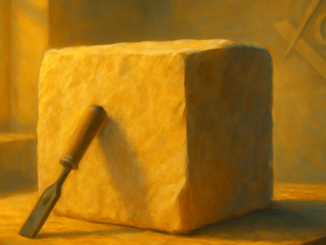
The appreciation for simplicity and sincerity that Montaigne articulates in this essay reflects an ideal that is also deeply rooted in Freemasonry. In the lodge, the Brother is invited to engage with himself and others without masks and without contrived stratagems. The goal is not to be the cleverest person in the room, but to become the most honest version of yourself. The rough ashlar is not refined by carving elaborate patterns into it — it is shaped by patiently chipping away what is superfluous, until the pure form emerges.
That process takes courage. It is tempting to hide behind complexity — behind jargon, behind strategies, behind a façade of learning. Montaigne warns that precisely this tendency makes you vulnerable. A simple and sincere plan, a clear and honest word, ultimately carries more force than the most sophisticated ruse. In this sense, Montaigne’s message touches the heart of what it means to build as a Brother: not with tricks, but with trust; not with cunning, but with light.
The Place of This Essay in Montaigne’s Greater Work
Essay 54 of the first book is one of the shorter pieces in Montaigne’s collection, but it functions as a clear window into his broader philosophy. Where other essays are deeply introspective and follow meandering streams of thought, ‘On Vain Stratagems’ is almost unusually direct. It feels as though Montaigne is consciously following his own advice here: keep it simple, make your point, and trust that the reader will grasp the deeper meaning. In a body of work that often revels in digression, this essay stands out as a quiet demonstration that sometimes the most powerful statement is the most concise one.
Montaigne’s Essay 54 may be brief, but its message resonates across centuries. Whether you are planning a project, navigating a difficult conversation, or working on your own inner architecture in the lodge, the principle holds: complexity is not a virtue in itself. The courage to be simple, honest, and direct — that is where true strength lies. It is a lesson the rough ashlar teaches us every time we pick up the gavel: what matters is not what we add, but what we have the wisdom to remove.
Copyright text & image: devrijmetselaar.nl
Texts are based on the ideas and content of the author of devrijmetselaar.nl, reviewed, corrected, and supplemented with the assistance of OpenAI. Images are created based on the ideas of the author of devrijmetselaar.nl using OpenAI/DALL-E.
Frequently Asked Questions
What is the main theme of Montaigne's essay 'On Vain Stratagems'?
Montaigne explores why clever tricks and overly elaborate strategies often fail in practice. He argues that such convoluted stratagems become so complex that they trap their creator in their own web of deceit, ultimately producing the opposite of the intended result. The essay examines the fine line between shrewdness and foolishness, suggesting that overconfidence in clever planning frequently leads to self-deception.
Where can 'On Vain Stratagems' be found in Montaigne's Essays?
'On Vain Stratagems' is located in Book 1, Essay 54 of Michel de Montaigne's famous Essays collection. While relatively brief compared to some of his other reflections, it touches on a recurring theme throughout his work: the dangers of overconfidence and the value of simplicity.
What historical examples does Montaigne use to support his argument?
Montaigne draws vivid examples from classical antiquity, sourced from works by historians like Plutarch and Livy. His examples often involve military commanders whose stratagems are so complicated that their own troops become confused. A particularly telling example features commanders who deliberately mislead their own messengers to spread false information to the enemy, only to discover that the same deception also misdirects their own forces, demonstrating that deceit is a double-edged sword.



Be the first to comment