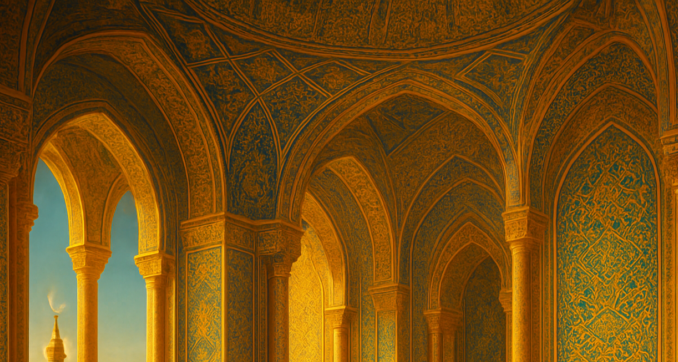
Imagine that everything you know — everything you take for granted — suddenly cracks open. The sky splits apart, the stars fall, the seas overflow. Not as punishment, but as revelation. This is exactly the image that opens the eighty-second surah of the Quran: a cosmic cleaving that describes not so much the end of the world, but the beginning of a deeper seeing. And within that image lies a surprising kinship with the spiritual journey that Freemasonry sets before its members.
What Does This Surah Describe?
The eighty-second surah of the Quran, known in Arabic as Al-Infitar, carries the name “The Cleaving.” It is a short but powerful text of nineteen verses, belonging to the early Meccan revelations. The surah opens with four overwhelming images: the sky splitting asunder, the stars scattering, the seas bursting forth, and the graves being overturned. These are not descriptions of random destruction. They are images of radical unmasking. Everything that was hidden is brought to light.
After this cosmic overture, the perspective shifts to the personal. The surah addresses the individual directly: what has distracted you from your Lord, who created you and shaped you? And then comes the heart of the matter: there are angels who record everything, who know what you do. On the Day of Judgment, every soul will be confronted with its own deeds. No detour, no excuse, no veil remaining.
The Veil That Falls: Cosmic Honesty
Perhaps you recognize the feeling. You live your daily life, filled with routines, distractions, and comforts, and somewhere deep down you know there is a deeper layer. A layer you would rather not touch, because honest self-confrontation is uncomfortable. This surah speaks to precisely that moment. It does not ask whether you profess a particular faith or follow a specific ritual. It asks: what is keeping you from sincere self-reflection?
In the Islamic tradition, this is understood as a call to taqwa — an inner vigilance and God-consciousness. But you need not be a Muslim to feel the power of that question. It is a universal theme that recurs throughout the ages with thinkers like Socrates, who declared the unexamined life not worth living, and Marcus Aurelius, who in his Meditations continually held himself accountable for honesty about his own shortcomings.
The Dark Chamber and the First Light
If you have any familiarity with Freemasonry, you know that the initiatory journey begins in darkness. The candidate is blindfolded and enters the lodge without seeing. This is not mere theater. It is a deliberate staging of precisely the moment this surah describes: the instant when everything you thought you knew is stripped away, so that you can truly begin to see. The blindfold falls away, the light floods in, and you stand face to face with yourself.
In the Quran, the sky cleaves open. In the lodge, light falls upon the candidate. The imagery differs, but the spiritual movement is closely related: a moment of radical unveiling is necessary before true growth can begin. Not growth in the sense of accumulating more knowledge or achieving a higher position, but growth as the ability to look at yourself honestly.
Spiritual growth begins where the veil falls: in the courage to see yourself as you truly are, stripped of every illusion.
The Recording Angels and the Work on Yourself
A striking element in this surah is the image of the “noble scribes” — angels who record your deeds. One could read this as an external assessment, a divine surveillance from above. But there is also an inward reading that comes surprisingly close to the Masonic understanding of conscience.
In Freemasonry, the Mason is expected to work on himself continuously, much as a stonecutter works on a rough stone. That rough stone — symbol of the unrefined human being — must be shaped through an honest examination of one’s own actions. No one else keeps you informed. It is your own inner scribe who notes when you deviate from your intended path. The eighteenth-century founder James Anderson laid down in his Constitutions that a Freemason must above all be a good person, faithful to the law of his own conscience.
Accountability Without Condemnation
What this surah does not do — and what Freemasonry does not do either — is condemn you. It is not about guilt or shame, but about awareness. The cosmic images of the sky splitting apart are not a threat. They are a wake-up call. Just as the ritual in the lodge is not a punishment, but an invitation to awaken from the slumber of the everyday.
What Connects These Traditions?
It is important to be careful here. The Quran is the holy book of Islam, and Freemasonry is not a religion. It requires of its members only that they believe in a higher ordering principle — a Supreme Architect of the Universe — without prescribing what that belief should look like. It is precisely for this reason that it is valuable to place spiritual traditions side by side: not to equate them, but to recognize where universal themes emerge.
Consider the parallels. First, the call to self-examination: both in this surah and in Masonic ritual, the central question is whether you dare to look at yourself honestly. Second, the falling of the veil: the cleaving of the sky mirrors the moment of enlightenment — the receiving of light in the lodge. Third, responsibility for one’s own actions: the recording angels and the Mason’s conscience serve the same purpose. And fourth, no condemnation, but invitation: both traditions focus on moral growth through compassion, not through fear.
Montaigne, who in his famous Essays constantly held the mirror up to himself, would likely have appreciated this interplay between traditions. He wrote that studying the other ultimately always leads to a deeper understanding of oneself. That principle resonates powerfully in both the Quranic call to self-awareness and the Masonic commitment to lifelong self-improvement.
The eighty-second surah of the Quran and the Masonic initiatory experience may seem worlds apart at first glance — one rooted in divine revelation, the other in symbolic ritual. Yet both traditions converge on a profound truth: genuine transformation requires the courage to let the familiar crack open. Whether the sky splits or the blindfold falls, the invitation is the same. Stop hiding behind comforts and distractions. Face yourself with honesty and compassion. For it is only when the veil is torn away that real light — and real growth — can enter.
Copyright text & image: devrijmetselaar.nl
Texts are based on the ideas and content of the author of devrijmetselaar.nl, reviewed, corrected, and supplemented with the assistance of OpenAI. Images are created based on the ideas of the author of devrijmetselaar.nl using OpenAI/DALL-E.
Frequently Asked Questions
What is Surah 82 (Al-Infitar) and what does it describe?
Surah 82, known as 'The Cleaving,' is a short but powerful text of nineteen verses from the early Meccan revelations of the Quran. It opens with four cosmic images: the sky splitting asunder, the stars scattering, the seas bursting forth, and the graves being overturned. These images represent radical unmasking and revelation rather than punishment. The surah then shifts to personal reflection, addressing individuals directly about what distracts them from their spiritual path and reminding them that angels record all deeds, and every soul will be confronted with its own actions on the Day of Judgment.
How does Surah 82 relate to the concept of self-reflection and inner vigilance?
Surah 82 calls for taqwa, which in Islamic tradition means inner vigilance and God-consciousness. Rather than focusing on external rituals or professed faith, it asks what keeps individuals from sincere self-reflection and honest self-confrontation. This universal theme echoes throughout history in the teachings of philosophers like Socrates, who declared the unexamined life not worth living, and Marcus Aurelius, who continually held himself accountable for honesty about his own shortcomings.
What is the connection between Surah 82 and Freemasonry?
The article suggests a surprising kinship between the spiritual message of Surah 82 and the initiatory journey of Freemasonry. Both traditions emphasize moving from darkness (literal or metaphorical) toward deeper seeing and self-awareness. The surah's theme of cosmic cleaving and radical unmasking parallels Freemasonry's initiatory process, which begins with the candidate entering the lodge in darkness (blindfolded) as the first step toward inner growth and enlightenment.

Be the first to comment