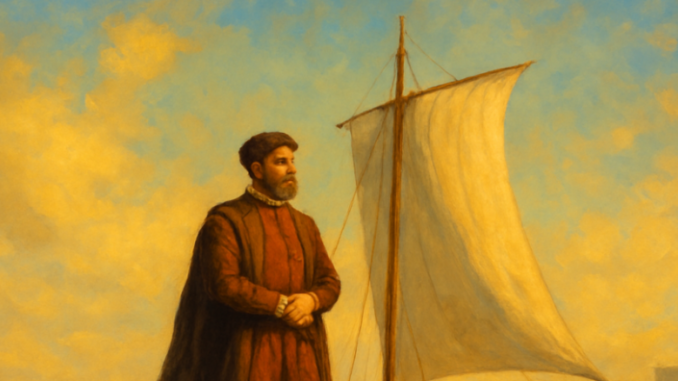
You probably know the feeling: you’re in a conversation and you notice the other person isn’t really listening — they’re already rehearsing their next clever response. Or maybe you catch yourself taking a roundabout approach when the straight path would have been far better. Michel de Montaigne wrote about exactly this in the sixteenth century, in his essay ‘On Vain Subtleties.’ What he reveals about false cleverness and genuine connection strikes remarkably close to the heart of what Freemasons strive for: sincerity, brotherhood, and the courage to remove our masks.
When Cleverness Becomes a Trap
In Essay 54 of the first book of his famous Essays, Michel de Montaigne describes how military commanders and political leaders brought ruin upon themselves by relying on elaborate stratagems. They devised refined strategies full of unexpected twists and ambiguous manoeuvres, but the results were often the exact opposite of what they had intended. Montaigne draws a clear conclusion: the more contrived the plan, the greater the chance of failure. Not because cleverness is inherently wrong, but because it severs the connection with reality.
That insight may sound simple, but try applying it to your own life. How often do you choose a convoluted approach because you fear the vulnerability of the direct path? How often do you wrap an honest message in so many layers that the core meaning is lost? Montaigne invites us to face that tendency — not with shame, but with genuine curiosity.
The Freemason and the Removal of Masks
Within Freemasonry, there is a deep-rooted tradition of self-reflection. When a candidate first enters the lodge, he is asked to set aside all outward signs of social status. This is not mere theatre — it is an invitation to appear without a mask. The idea behind this practice aligns seamlessly with what Montaigne describes: true strength lies not in the façade, but in the willingness to stand unadorned and sincere.
Freemasons speak of the search for light and knowledge. That light is not a spotlight meant to blind others, but an inner flame that brings clarity to your own thinking and actions. Montaigne would have recognised this immediately. His entire philosophical project revolves around the honest examination of one’s own mind — including its blind spots and its vain tendencies. In this, his work touches the Masonic ideal of inner growth: growing not by pretending to be greater than you are, but by coming to know yourself more deeply.
Sincerity as the Foundation of Brotherhood
There is a deeper layer in Montaigne’s argument that speaks directly to the Masonic principle of brotherhood. Vain cunning doesn’t just undermine your own effectiveness — it destroys trust between people. If you are constantly playing games, manipulating, and concealing, genuine connection becomes impossible. And without genuine connection, there is no brotherhood — only a network of mutual calculation.
True connection is not born from clever schemes, but from the courage to stand before another person without a mask.
Montaigne understood the value of friendship like few others. His profound bond with Étienne de La Boétie, which he described as a perfect merging of two souls, was built on precisely that kind of unadorned sincerity. Neither of them needed a stratagem to win the other over. They recognised in each other a kindred spirit and let everything else fall away. This is the kind of connection Freemasons strive for when they meet as brothers: a bond that transcends rank, background, and outward display.
The Square as a Moral Compass
Freemasons are well familiar with the square as a tool for moral living. The right angle represents rectitude — doing right by yourself and by others. In his essay, Montaigne describes how commanders who strayed from the straight path, choosing instead the winding detour of deception, ultimately endangered both themselves and their men. The square would have reminded them: keep your line straight. Not because curves are always wrong, but because the straight line of sincerity provides the strongest foundation.
This does not mean one should be naive. Montaigne was certainly no dreamer. He knew the world of politics intimately, having served as Mayor of Bordeaux and experienced firsthand how complex governance could be. But he drew a sharp line between pragmatic action and self-deception. The difference lies in intention: are you acting from a sincere desire for the good, or from a wish to appear cleverer than you really are?
What Montaigne and the Lodge Share
When you place Montaigne’s philosophy alongside the teachings of Freemasonry, the parallels are striking. Both share a deep distrust of outward show and inflated pretension. Both hold the conviction that self-knowledge is the first step toward wisdom. Both recognise that true strength resides in vulnerability and honesty. And both favour virtue over cunning as the guiding principle for action.
These are not abstract ideals locked away in old books or lodge rituals. They are living principles that demand daily practice and constant vigilance. Every time we choose authenticity over performance, every time we resist the temptation to embellish or manipulate, we honour both Montaigne’s legacy and the timeless values of the Craft.
From Sixteenth-Century Wisdom to Daily Practice
The beauty of Montaigne is that his insights never remain abstract. They invite you — tonight, at the kitchen table, or in a conversation with a friend — to pause and reflect on your own vain subtleties. Where are you making things unnecessarily complicated? Where would the straight path be not only more effective, but also more honest? It is precisely this daily application that makes the difference between philosophy as an intellectual exercise and philosophy as the art of living.
Freemasons call this process ‘working the rough stone.’ You begin with the material you have — with all your imperfections and ingrained habits — and you work on it patiently. Not to achieve perfection, but to live each day a little more sincerely, a little more consciously, and a little more connected to those around you. Montaigne did exactly the same in his writing tower at the Château de Montaigne, reflecting on his own shortcomings with a candour that still resonates four centuries later. His example reminds us that the most powerful tool we have is not cunning, but honesty — with ourselves and with each other.
Montaigne’s essay on vain cunning offers a mirror that every Freemason — and indeed every thoughtful person — can benefit from holding up. The temptation to rely on clever schemes and elaborate facades is as old as humanity itself, but so is the deeper wisdom that true connection, trust, and brotherhood can only be built on a foundation of sincerity. Whether you encounter this lesson in a sixteenth-century essay or in the sacred space of a Masonic lodge, the message remains the same: lay down the mask, walk the straight path, and discover that the unadorned truth is more powerful than any stratagem ever devised.
Copyright text & image: devrijmetselaar.nl
Texts are based on the ideas and content of the author of devrijmetselaar.nl, reviewed, corrected, and supplemented with the assistance of OpenAI. Images are created based on the ideas of the author of devrijmetselaar.nl using OpenAI/DALL-E.
Frequently Asked Questions
What does Montaigne mean by 'vain cunning' and how does it relate to Freemasonry?
Montaigne argues that excessive cleverness and overly complicated strategies often backfire because they disconnect us from reality and genuine communication. In Freemasonry, this concept relates directly to the practice of removing masks and social facades upon entering the lodge. Both Montaigne and Freemasonry emphasize sincerity and direct authenticity over elaborate pretense, recognizing that true strength comes from honest self-presentation rather than constructed cleverness.
Why do Freemasons ask candidates to remove outward signs of social status?
This Masonic practice invites candidates to appear without masks and social pretenses, aligning with Montaigne's philosophy that genuine connection requires vulnerability and directness. By setting aside outward status symbols, candidates engage in the kind of authentic self-examination that Montaigne advocated for. This ritual practice embodies the principle that true strength and knowledge come from honest self-awareness rather than social positioning.
How does the Masonic concept of 'seeking light' connect to Montaigne's philosophical approach?
In Freemasonry, the search for light represents an inner flame that brings clarity to one's own thinking and actions—not a means to blind or impress others. Montaigne's entire philosophical project similarly revolves around honest self-examination, including acknowledging one's blind spots and vain tendencies. Both approaches prioritize inner growth through genuine self-knowledge rather than external appearance or pretense, making them fundamentally aligned in their pursuit of truth and personal enlightenment.


Be the first to comment